
The Honest Judge Story Reading Exercises for Class 4
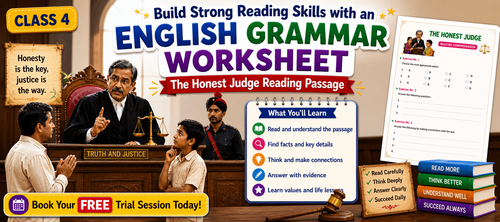

Build Strong Comprehension Skills with This English Grammar Worksheet for Grade 4 on The Honest Judge
Stories that involve honesty, truth, and clever thinking always make learning more interesting for children. This English grammar worksheet for Grade 4 on The Honest Judge helps students improve their reading comprehension skills through an engaging and meaningful story. The passage teaches students how careful observation and intelligence can help reveal the truth in difficult situations.
In this worksheet, students read about Judge Sharma, Mrs. Mehta, and Kamla, and answer different types of comprehension questions based on the passage. The activities help students focus on understanding details, identifying facts, making connections, and answering both objective and subjective questions carefully. Grade 4 students can strengthen their reading abilities while also learning an important moral lesson about honesty and justice.
Download these English grammar worksheets and practice regularly to strengthen your language skills and build a strong foundation. You can also book a free trial to get expert guidance and improve your reading, writing, and comprehension abilities. The worksheets are designed in a simple and structured way to help K–8 students learn grammar concepts easily and use them confidently in everyday communication.
What Is the Topic?
This worksheet focuses on reading comprehension through the story The Honest Judge. Students are expected to carefully read the passage and answer questions based on the events, characters, and details given in the story.
The passage explains how Judge Sharma solved a case in which Mrs. Mehta falsely accused her maid Kamla of stealing a necklace. Through a clever test, the judge discovered the truth and proved Kamla innocent. Students learn how to understand information from a passage, identify correct answers, quote lines from the text, and explain ideas clearly.
The worksheet also teaches students to:
- Read carefully for important details
- Understand character actions
- Identify evidence from the passage
- Answer objective and subjective questions
- Make connections with the text
What’s in This Worksheet?
1. A reading passage titled The Honest Judge that tells a story about truth, honesty, and justice.
2. Multiple-choice questions that test understanding of important facts from the passage.
3. Subjective questions that require students to answer using information from the story.
4. Text-based questions that ask students to explain ideas using evidence from the passage.
5. Critical-thinking questions that encourage students to connect ideas and explain character actions.
6. Vocabulary-based learning through identifying the meaning of a word from the passage.
7. Practice in quoting exact lines from the story correctly.
8. Exercises arranged in a simple and organized format for Grade 4 students.
9. Questions that help improve reading accuracy, thinking skills, and written expression.
10. Answer sections that allow students to review and compare their responses carefully.
Definitions, Examples, Techniques, and Tips
Reading comprehension means understanding a passage carefully and answering questions based on the information given in the text.
In this worksheet, students practice identifying important details from the story. For example, students learn that Kamla had worked for Mrs. Mehta’s family for ten years and that Judge Sharma used a clever trick to reveal the truth.
The worksheet also helps students learn how evidence from the passage supports answers. One example is when Judge Sharma became suspicious because Mrs. Mehta could not clearly describe the necklace except saying it was gold and had many diamonds.
Students also practice quoting exact words from the passage. For example:
“Your Honor, that is not hers. Her necklace had rubies, not diamonds, and the lock was broken.”
This teaches students how to answer comprehension questions accurately using lines from the text.
The worksheet encourages careful reading techniques such as:
- Reading the entire passage slowly
- Underlining important details
- Paying attention to character actions
- Looking for clues in conversations
- Revisiting the passage before answering
Quick learning tips from this worksheet include:
- Focus on details carefully
- Read each question completely
- Use evidence from the story
- Avoid guessing answers
- Check answers after completing the worksheet
Why Is It Important to Learn This?
Reading comprehension is an important skill for every student because it improves understanding, thinking ability, and confidence in reading. This English grammar worksheet for Grade 4 on The Honest Judge helps students learn how to understand stories deeply and answer questions correctly.
Comprehension practice improves vocabulary, sentence understanding, and attention to detail. Students also learn how to identify important facts and explain ideas clearly in written answers.
This topic is important because it teaches students:
- How to read carefully
- How to understand information from passages
- How to answer different types of questions
- How to support answers using evidence
- How to think logically about situations
The story also teaches an important lesson about honesty, fairness, and truth, which helps students develop good values along with academic skills.
Where Will This Knowledge Help You?
Reading comprehension skills are useful in many areas of learning and daily life.
Students will use these skills during:
- School comprehension tests
- English grammar exams
- Class discussions
- Homework assignments
- Reading activities
- Writing answers in examinations
Understanding passages carefully also helps students improve their communication and thinking skills. Students who practice comprehension regularly often become more confident readers and better writers.
This knowledge also helps students learn how to identify key details, understand character behavior, and explain ideas clearly using information from a text.
How to Use This Worksheet?
1. Read the passage carefully before attempting any question.
2. Try answering all the questions independently first.
3. Pay close attention to details such as names, actions, and important events in the story.
4. Re-read difficult parts of the passage if needed.
5. Attempt the multiple-choice questions carefully by selecting the most appropriate option.
6. Use exact information from the passage while answering subjective questions.
7. Review the complete answer key after finishing the worksheet.
8. Compare your answers carefully with the provided solutions.
9. Correct mistakes and understand where improvements are needed.
10. Practice similar comprehension worksheets regularly to improve reading skills and accuracy.
11. Remember that the solutions follow the exact worksheet order, so compare answers step by step carefully.
Important Tips and Tricks
1. Always read the full passage before answering questions.
2. Do not answer based on guessing. Use information directly from the passage.
3. While answering subjective questions, include details mentioned in the text.
4. Read multiple-choice options carefully before selecting an answer.
5. Important clues are often hidden in conversations between characters.
6. Examiners expect accurate answers supported by information from the passage.
7. While quoting lines from the story, copy them carefully and correctly.
8. For critical-thinking questions, connect your answer with events from the passage.
9. Avoid skipping any question because every question tests a different comprehension skill.
10. Practice reading slowly and carefully to avoid missing important details.
Complete Answer Key
Exercise No. 1
1. What did Mrs. Mehta accuse Kamla of doing?
b) Stealing her gold necklace
2. How long had Kamla worked for Mrs. Mehta's family?
c) Ten years
3. How did Judge Sharma prove that Mrs. Mehta was lying?
a) He showed them a different necklace and Mrs. Mehta claimed it was hers while Kamla correctly said it was not
Exercise No. 2
1. What made Judge Sharma suspect something was wrong with Mrs. Mehta's accusation? Provide evidence from the text.
Judge Sharma noticed that Mrs. Mehta could not describe the necklace clearly except saying "It is gold and has many diamonds."
2. What did investigations reveal about Mrs. Mehta? Give one line from the passage.
Investigations revealed that Mrs. Mehta had actually pawned her necklace for money and made a false accusation.
3. What did Kamla say when she saw the necklace from the evidence room? Quote her exact words.
Kamla said, "Your Honor, that is not her necklace. Her necklace had rubies, not diamonds, and the lock was broken."
Exercise No. 3
1. Why was Judge Sharma's trick with showing a different necklace clever? How did the two women's different reactions reveal the truth?
The judge knew the real owner would recognize that the wrong necklace was shown. Mrs. Mehta's eagerness to claim it proved she was lying, while Kamla's accurate description proved her honesty.
2. How did Kamla's ten years of honest service help prove her innocence? Connect her knowledge of the necklace to her character.
Because Kamla cleaned the necklace daily for ten years, she knew its exact details like rubies and the broken lock. Her accurate knowledge showed she was honest and had nothing to hide.
3. If you were Judge Sharma, what other questions would you have asked to find the truth? Explain using what you learned from how he solved this case.
I would ask Mrs. Mehta to describe specific details like the number of stones, the clasp type, and any scratches. True owners know their valuable jewelry well.
4. Find a word in the passage that means "a claim that someone did something wrong" OR give a new title for this story in 5-7 words.
The word "accusation" means a claim that someone did something wrong.
OR
New title: "The Judge's Clever Test Reveals Truth"
This English grammar worksheet for Grade 4 on The Honest Judge is an excellent way for students to improve comprehension skills while learning an important lesson about honesty and fairness. By practicing passages like these regularly, students can become more confident readers, better writers, and stronger thinkers. Careful reading and regular practice will help Grade 4 students perform well in school comprehension activities and exams.