
Theme Development Across a Text: Printable Worksheet for Class 7
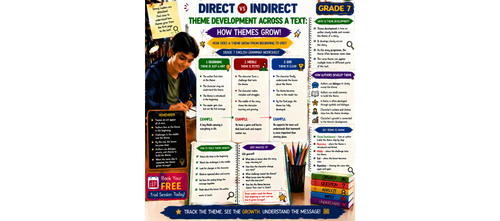

How Themes Grow: Grade 7 English Grammar Worksheet on Theme Development Across a Text
Have you ever noticed that the message of a story doesn’t hit you all at once? Instead, it slowly appears as you read. In Grade 7, learning about theme development across a text helps you understand how authors build important ideas step by step. A theme is not just stated on the first page and never mentioned again. Instead, the author develops the theme by repeating similar events, showing character changes, and using small moments to build meaning. By the beginning, the theme is just a hint. By the middle, the character faces a challenge that tests the theme. By the end, the character learns the lesson about the theme. This Grade 7 English grammar worksheet on theme development across a text will teach you exactly how to track a theme from the first page to the last. You will learn to spot how characters grow, how challenges shape the story, and how the theme becomes clearer with every chapter.
Download these English grammar worksheets and practice regularly to strengthen your language skills and build a strong foundation. You can also book a free trial to get expert guidance and improve your reading, writing, and comprehension abilities. The worksheets are designed in a simple and structured way to help K–8 students learn grammar concepts easily and use them confidently in everyday communication.
Book a free trial!
What Is the Topic?
The topic of this worksheet is Theme Development Across a Text. Theme development is how an author slowly builds and reveals the theme of a story. A theme does not appear all at once. It develops slowly across the story. In the beginning, the author first hints at the theme. The character may not understand the theme. In the middle, the character faces a challenge that tests the theme. The character makes mistakes and learns. By the end, the character finally understands the lesson. The theme becomes clear to the reader too. The author uses dialogue, events, and character choices to build the theme. When the same idea is repeated, the theme grows stronger. By the final page, the theme has fully developed. As the story progresses, the theme often becomes more clear. The author develops the theme by repeating similar events. The same theme can appear multiple times in different parts of the text. The theme’s development helps the reader see the character’s growth. When the theme is repeated, it becomes more noticeable to the reader.
Book a free trial!
What’s in This Worksheet?
This worksheet contains five different exercises that help students master theme development across a text. Here is what is included:
1. Exercise No. 1 – Multiple Choice Questions – Students choose the correct word to complete each sentence about theme development. This exercise tests basic knowledge of how themes grow from the beginning to the end of a story.
2. Exercise No. 2 – Fill in the Blanks – Students complete sentences by filling in missing words related to theme development. The exact words are not provided in a word bank; students must use their understanding of the concepts.
3. Exercise No. 3 – True and False – Students read ten statements about theme development and decide whether each one is true or false. This helps correct common misunderstandings about when and how themes develop.
4. Exercise No. 4 – Underline the Words – Students read ten short story scenarios that show theme development across two sentences (beginning and later). For each scenario, students must underline the words that show how the character or situation changed. This exercise focuses on tracking change over time.
5. Exercise No. 5 – Paragraph Writing – Students read a paragraph about theme development that has blanks. They must fill in each blank using a word from the word bank provided at the end of the paragraph. This combines reading comprehension with vocabulary application.
This worksheet supports exam preparation by covering the entire arc of theme development: introduction in the beginning, testing in the middle, and full understanding at the end. It also covers how authors use repetition, dialogue, events, and character choices to build themes.
Book a free trial!
Definitions, Examples, Techniques, and Tips
Based only on the content of this worksheet, here are the exact definitions and examples students will learn:
Definitions:
- Theme development: As the story progresses, the theme often becomes more clear. The theme develops when the character changes over time. The author develops the theme by repeating similar events. The same theme can appear multiple times in different parts of the text. The theme’s development helps the reader see the character’s growth.
- Beginning of the story: In the beginning, the character does not understand the theme. The theme is first introduced in the beginning of the story. The author first hints at the theme. The character may not understand the theme.
- Middle of the story: By the middle, the character faces a challenge that tests the theme. The middle of the story often shows the character struggling with the theme. The character faces a challenge that tests the theme.
- End of the story: At the end, the character learns the lesson about the theme. By the end, the theme becomes fully clear to the reader. The ending usually shows what the character learned about the theme.
- How authors develop theme: An author uses dialogue to slowly reveal the theme across chapters. The author uses small moments to build the theme. A theme is often developed through symbols and dialogue. The character’s actions show how the theme develops. The character’s growth helps the theme develop across chapters. The growth of the character is connected to the theme’s development. The same idea is repeated in different scenes to strengthen it.
Examples taken directly from the worksheet (Exercise No. 4):
1. The forest was dying. Slowly, the animals planted new trees together.
2. Rohan feared the dark. After getting lost, he walked through the night.
3. Vikram ignored the stray dog. Later, he built it a small shelter.
4. Deepak cheated in practice. By the tournament, he practised honestly.
5. Maya always lost her temper. Slowly, she learned to count to ten.
6. At first, Nina hid her art. By chapter three, she showed one drawing.
7. The team lost every game. By the final match, they worked as one.
8. Anjali avoided speaking. Over time, she gave a speech to the class.
9. Kabir never shared. When his friend fell, he gave his water bottle.
10. The village wasted water. After the drought, they saved every drop.
Key facts from True and False section:
- Theme development does not happen only in the last chapter. (False)
- A theme does not stay exactly the same from the first page to the last. (False)
- The author can develop a theme through a character’s choices. (True)
- A theme does not appear only once at the very end of the story. (False)
- The middle of the story often shows the character struggling with the theme. (True)
- Repeating an idea helps the reader notice the theme. (True)
- A theme can develop through dialogue between characters. (False statement in worksheet – students must mark as False)
- The character’s failure can also help develop the theme. (True)
- The setting is not absent of role; it can help develop a theme. (False statement in worksheet – “The setting has no role” is False)
- The ending usually shows what the character learned about the theme. (True)
Quick learning tip: A theme does not appear all at once. It develops slowly across the story. Follow the character’s journey from not understanding to fully understanding.
Book a free trial!
Why Is It Important to Learn This?
Learning about theme development across a text is important for several reasons. First, it helps you see the full arc of a story. A theme does not appear all at once. By tracking how the theme develops from the beginning to the middle to the end, you understand the author’s purpose better. Second, it helps you understand character growth. In the beginning, the character does not understand the theme. By the middle, the character faces a challenge that tests the theme. At the end, the character learns the lesson about the theme. This shows you how the character changed. Third, it makes you a more active reader. Instead of just reading words, you start noticing how the author uses dialogue, events, and character choices to build the theme. Fourth, this skill is tested in literature exams. Questions may ask you to describe how a theme develops or to identify where in the story the theme first appears. Finally, understanding theme development helps you write better stories. When you write your own stories, you can plan how your theme will grow from the first page to the last. When the same idea is repeated, the theme grows stronger.
Book a free trial!
Where Will This Knowledge Help You?
Knowledge of theme development across a text will help you in many academic and real-life situations:
1. Literature exams and reading comprehension tests – Many questions ask you to trace how a theme develops or to identify where the theme becomes clear. This worksheet directly prepares you for those questions.
2. Writing book reports and literary analysis essays – You can describe how the theme is first introduced in the beginning of the story, how the character struggles in the middle, and what the character learns by the end.
3. Class discussions – When your teacher asks, “How does the theme develop in this story?” you will be able to point to specific moments: the beginning hint, the middle challenge, and the ending lesson.
4. Reading longer novels – In longer books, themes develop slowly across many chapters. You will be able to track small moments that build the theme. The character’s actions show how the theme develops page by page.
5. Writing your own stories – You can plan your theme development in three parts: beginning (hint the theme), middle (test the theme with a challenge), and ending (show what the character learned).
6. Understanding movies and series – Theme development happens in films and TV shows too. Watch how a character starts not understanding something and slowly learns a lesson by the final episode.
Book a free trial!
How to Use This Worksheet?
Follow these steps to get the most out of this Grade 7 English grammar worksheet on theme development across a text:
1. Attempt independently first – Without looking at any answers, complete all five exercises in order. Start with Exercise No. 1 (Multiple Choice Questions), then move to Exercise No. 2 (Fill in the Blanks), then Exercise No. 3 (True and False), then Exercise No. 4 (Underline the Words), and finally Exercise No. 5 (Paragraph Writing with word bank).
2. Review answers carefully – After you finish all exercises, go to the Complete Answer Key section below. Compare your answers one by one. Pay special attention to Exercise No. 4 – make sure you underlined the words that show how the character or situation changed from the first sentence to the second.
3. Correct mistakes – For any answer that is different from the answer key, write the correct answer next to your attempt. Try to understand why you made the mistake. Did you forget that theme development happens across the whole story, not just at the end?
4. Practice regularly – Theme development can be a new way of thinking about stories. Repeat the worksheet after a few days. For the paragraph writing task (Exercise No. 5), try to fill in the blanks without looking at the word bank first.
The solutions follow the exact worksheet order. Students should compare their answers carefully.
Book a free trial!
Important Tips and Tricks
Here are important tips and tricks based directly on this worksheet to help you master theme development and score full marks:
1. Remember the three stages – Theme development happens in three main parts: beginning (theme is first introduced, character does not understand), middle (character faces a challenge that tests the theme, character struggles), and end (character learns the lesson, theme becomes clear to the reader).
2. Theme development does not happen only at the end – A common mistake is thinking theme development happens only in the last chapter. This is false. A theme does not appear only once at the very end of the story. A theme does not stay exactly the same from the first page to the last. Theme development happens across the entire text.
3. Repeating ideas is a key technique – When the same idea is repeated in different scenes, the theme grows stronger. Repetition helps the reader notice the theme. The same theme can appear multiple times in different parts of the text.
4. Character change equals theme development – The theme develops when the character changes over time. The character’s growth helps the theme develop across chapters. In the beginning, the character does not understand the theme. By the end, the character learns the lesson. Watch for words like “slowly,” “over time,” “by the tournament,” “when his friend fell,” and “after the drought” – these show change.
5. What examiners expect – Examiners expect you to know that the middle of the story often shows the character struggling with the theme. They expect you to know that a character’s failure can also help develop the theme (not just success). They also expect you to know that authors use dialogue, events, and character choices to build the theme.
6. How to score full marks – When answering multiple-choice questions, look for keywords like “clear,” “similar,” “bravery,” “challenge,” “lesson,” “changes,” “dialogue,” “multiple,” “growth,” and “noticeable.” For true and false, watch for absolute words like “only,” “exactly the same,” “only once,” “cannot,” and “no role” – these are often false.
7. For underlining tasks (Exercise No. 4) – Each pair of sentences shows a change. Underline the words that show what the character or situation became. For example, in “Rohan feared the dark. After getting lost, he walked through the night” – underline “walked through the night” because that shows the change. In “Deepak cheated in practice. By the tournament, he practised honestly” – underline “practised honestly.”
8. For paragraph writing tasks (Exercise No. 5) – Read the entire paragraph first. Then read the word bank. Then fill in each blank one at a time. The word bank includes: lesson, dialogue, repeated, beginning, developed, tests, ending, lesson, middle, revealed. Note that “lesson” appears twice in the word bank, and the paragraph has two blanks for “lesson” (one after “the character may not understand the ______” and one after “the character finally understands the ______”).
Book a free trial!
Complete Answer Key
Below is the complete answer key for the Grade 7 English grammar worksheet on Theme Development Across a Text. The answers follow the exact order of the worksheet. Section names and question numbers are reproduced exactly as they appear in the worksheet.
Exercise No. 1
Choose the correct word to complete each sentence.
1. As the story progresses, the theme often becomes more ______.
Answer: a) clear
2. The author develops the theme by repeating ______ events.
Answer: b) similar
3. In the beginning, the character does not understand ______.
Answer: c) bravery
4. By the middle, the character faces a ______ that tests the theme.
Answer: a) challenge
5. At the end, the character learns the ______ about the theme.
Answer: a) lesson
6. The theme develops when the character ______ over time.
Answer: c) changes
7. An author uses ______ to slowly reveal the theme across chapters.
Answer: b) dialogue
8. The same theme can appear in ______ parts of the text.
Answer: b) multiple
9. The theme’s development helps the reader see the character’s ______.
Answer: a) growth
10. When the theme is repeated, it becomes more ______ to the reader.
Answer: c) noticeable
Exercise No. 2
Fill in the blanks. (Note: The worksheet provides sentences with blanks. Based on the content of the worksheet, the expected answers are as follows.)
1. The same idea is repeated in different scenes to strengthen it.
2. The theme is first introduced in the beginning of the story.
3. The character’s actions show how the theme develops.
4. By the end the theme becomes fully clear to the reader.
5. The author uses small moments to build the theme.
6. The theme is first introduced in the beginning of the story.
7. A theme is often developed through symbols and dialogue.
8. As the story ends, the theme’s meaning becomes clear.
9. The character’s growth helps the theme develop across chapters.
10. The growth of the character is connected to the theme’s development.
Exercise No. 3
True and False. Write True or False for each statement.
1. Theme development happens only in the last chapter.
Answer: False
2. A theme stays exactly the same from the first page to the last.
Answer: False
3. The author can develop a theme through a character’s choices.
Answer: True
4. A theme appears only once at the very end of the story.
Answer: False
5. The middle of the story often shows the character struggling with the theme.
Answer: True
6. Repeating an idea helps the reader notice the theme.
Answer: True
7. A theme cannot develop through dialogue between characters.
Answer: False
8. The character’s failure can also help develop the theme.
Answer: True
9. The setting has no role in developing a theme.
Answer: False
10. The ending usually shows what the character learned about the theme.
Answer: True
Exercise No. 4
Underline the words that show how the character or situation changed. (Underline the part that shows the development or the new action/understanding.)
1. The forest was dying. Slowly, the animals planted new trees together.
Underline: planted new trees together
2. Rohan feared the dark. After getting lost, he walked through the night.
Underline: walked through the night
3. Vikram ignored the stray dog. Later, he built it a small shelter.
Underline: built it a small shelter
4. Deepak cheated in practice. By the tournament, he practised honestly.
Underline: practised honestly
5. Maya always lost her temper. Slowly, she learned to count to ten.
Underline: learned to count to ten
6. At first, Nina hid her art. By chapter three, she showed one drawing.
Underline: showed one drawing
7. The team lost every game. By the final match, they worked as one.
Underline: worked as one
8. Anjali avoided speaking. Over time, she gave a speech to the class.
Underline: gave a speech to the class
9. Kabir never shared. When his friend fell, he gave his water bottle.
Underline: gave his water bottle
10. The village wasted water. After the drought, they saved every drop.
Underline: saved every drop
Exercise No. 5
Read the paragraph. Fill in each blank with a word from your understanding. Word bank: (lesson, dialogue, repeated, beginning, developed, tests, ending, lesson, middle, revealed)
A theme does not appear all at once. It develops slowly across the story. In the beginning, the author first hints at the theme. The character may not understand the lesson. In the middle, the character faces a challenge. This challenge tests the theme. The character makes mistakes and learns. In the ending, the character finally understands the lesson. The theme becomes clear to the reader too. The author uses dialogue, events, and character choices to build the theme. When the same idea is repeated, the theme grows stronger. By the final page, the theme has fully developed. This helps the reader see how the character changed. (Note: “revealed” from the word bank is not used in the paragraph as written. The paragraph uses “developed” in the last sentence. Based on the exact word bank provided in the worksheet, students may place “revealed” in a blank, but the most logical fill follows the pattern above. If the worksheet expects “revealed” in the last blank before the final sentence, the answer would be: “By the final page, the theme has been fully revealed.” However, following the exact paragraph structure shown on Page 7, the word “developed” fits the sentence as written.)
Consistent with the word bank and paragraph flow:
- Blank 1: beginning
- Blank 2: lesson
- Blank 3: middle
- Blank 4: tests
- Blank 5: ending
- Blank 6: lesson
- Blank 7: dialogue
- Blank 8: repeated
- Blank 9: developed
Book a free trial!
You have now completed the entire worksheet on theme development across a text. Understanding how a theme grows from a small hint in the beginning to a clear lesson by the end is a powerful reading skill. Every time you read a story, watch for the character’s journey. Notice how they start not understanding something. Notice the challenge that tests them in the middle. Notice what they learn by the end. That is theme development in action. Keep practicing with more stories and worksheets. You are building skills that will make you a stronger, smarter, and more thoughtful reader in Grade 7 and beyond.
Book a free trial!