
Theme vs Main Idea vs Message: Literary Analysis Worksheet for Grade 7
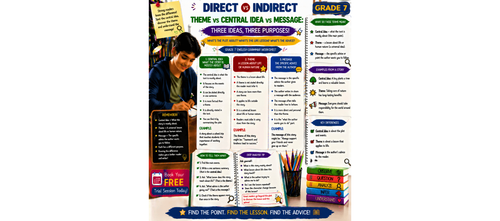

Theme vs Central Idea vs Message: Grade 7 English Grammar Worksheet for Literature Skills
Have you ever finished reading a story and felt like the author was trying to teach you something, but you weren’t sure what to call it? Was it the main point of the plot? Was it a life lesson? Or was it specific advice just for you? In Grade 7, learning the difference between theme, central idea, and message is a superpower for any reader. The central idea tells you what the story is mostly about. The theme teaches a universal lesson about life or human nature. The message gives you specific advice that the author wants you to follow. This Grade 7 English grammar worksheet on theme vs central idea vs message will help you clearly understand each term, spot them in any story, and use them in your own writing. Whether you are preparing for an exam or just want to enjoy reading more deeply, this worksheet is your perfect guide.
Download these English grammar worksheets and practice regularly to strengthen your language skills and build a strong foundation. You can also book a free trial to get expert guidance and improve your reading, writing, and comprehension abilities. The worksheets are designed in a simple and structured way to help K–8 students learn grammar concepts easily and use them confidently in everyday communication.
Book a free trial!
What Is the Topic?
The topic of this worksheet is Theme vs Central Idea vs Message. These three terms are often confused, but they mean different things. The central idea is what the text is mostly about. It focuses on the events of the story and can be stated directly in one sentence. You can find the central idea by summarizing the plot. The theme is a lesson about life or human nature. For example, “hard work pays off” is a theme. A theme is not stated directly; the reader must infer it using clues from the story. A story can have more than one theme running through it. The message is the specific advice the author gives to readers. The author writes to share a message with the audience. The message often tells the reader how to behave. Unlike a summary, a theme is a lesson about life that applies outside the story as well. Understanding these differences helps students become stronger readers and thinkers.
Book a free trial!
What’s in This Worksheet?
This worksheet contains five different exercises that help students master the differences between theme, central idea, and message. Here is what is included:
1. Exercise No. 1 – Multiple Choice Questions – Students choose the correct word to complete each sentence about theme, central idea, and message. This exercise tests basic definitions and key differences.
2. Exercise No. 2 – Fill in the Blanks – Students complete sentences by filling in missing words related to theme, central idea, and message. The exact words are not provided in a word bank; students must use their understanding of the concepts.
3. Exercise No. 3 – True and False – Students read ten statements about theme, central idea, and message and decide whether each one is true or false. This helps correct common misunderstandings.
4. Exercise No. 4 – Underline the Words – Students read ten short story scenarios. For each scenario, students must underline the specific event or action that reveals the central idea, theme, or message. This exercise focuses on applying the concepts to short examples.
5. Exercise No. 5 – Paragraph Writing – Students read a paragraph about theme, central idea, and message that has blanks. They must fill in each blank using a word from the word bank provided at the end of the paragraph. This combines reading comprehension with vocabulary application.
This worksheet supports exam preparation by covering definitions, examples, signal words, and analytical skills. It builds a strong foundation for literature analysis in higher grades.
Book a free trial!
Definitions, Examples, Techniques, and Tips
Based only on the content of this worksheet, here are the exact definitions and examples students will learn:
Definitions:
- Central idea: The central idea is what the text is mostly about. The central idea focuses on the events of the story. Unlike a theme, the central idea can be stated in one sentence. The central idea is more factual than a theme. The central idea is directly stated in the text. The central idea describes what the story is mostly about. The central idea can be found by summarizing the plot.
- Theme: The theme of a story is usually a lesson about life. A story can have more than one theme running through it. A theme is not stated directly; the reader must infer it. The theme of “honesty” teaches a lesson about telling the truth. The theme of “courage” teaches a lesson about facing fears. A theme applies to life outside the story as well. Unlike a summary, a theme is a lesson about life. A theme is a universal lesson about life or human nature. A story can have multiple themes. Readers must infer themes because they are not directly stated.
- Message: The message is often a specific lesson the author wants to share. The author writes to share a message with the audience. The message is the specific advice the author gives to readers. The author’s message often gives the reader specific advice to follow. The message often tells the reader how to behave.
Key differences from the worksheet:
- The central idea is the same as the theme of a story? (Answer: False)
- A story can have only one possible theme? (Answer: False)
- The author’s message is always the same as the theme? (Answer: False)
- The central idea is directly stated in the text.
- Unlike theme, the central idea can be stated in one sentence.
- The central idea is more factual than a theme.
Examples taken directly from the worksheet (Exercise No. 4):
1. Riya failed her test but studied harder and passed the next time.
2. Meera wanted to win the race but stopped to help an injured runner.
3. The villagers worked together to rebuild the school after the storm.
4. The merchant gave away half his goods to feed the hungry villagers.
5. Raj lied to his mother but later told the truth and felt relieved.
6. Ravi shared his lunch with a hungry classmate without being asked.
7. The old man planted trees knowing he would never sit in their shade.
8. Kunal returned the wallet he found even though no one was watching.
9. Asha practised cricket every day even when her friends went to play.
10. Priya chose to stay home and care for her sick grandmother instead of going to the party.
Quick learning tip: The central idea focuses on what happens in the story. The theme teaches a lesson about life. The message gives you specific advice on how to behave.
Book a free trial!
Why Is It Important to Learn This?
Learning the difference between theme, central idea, and message is important for several reasons. First, it helps you understand stories on a deeper level. When you know that the central idea is what the story is mostly about, you can summarize any book or passage quickly. Second, understanding theme helps you see the bigger picture. A theme applies to life outside the story as well, so you can learn valuable lessons about friendship, courage, honesty, and hard work from the books you read. Third, recognizing the author’s message helps you understand what the author wants you to do or believe. The message often gives the reader specific advice to follow in real life. Fourth, these skills are tested in almost every literature exam. Questions may ask you to identify the theme, state the central idea, or explain the author’s message. Finally, understanding these three concepts makes you a stronger writer. When you write your own stories, you can plan your central idea, develop a theme, and include a clear message for your readers.
Book a free trial!
Where Will This Knowledge Help You?
Knowledge of theme, central idea, and message will help you in many academic and real-life situations:
1. Literature exams and reading comprehension tests – Many questions ask you to identify the theme or central idea of a passage. This worksheet directly prepares you for those questions.
2. Writing book reports and essays – When your teacher asks, “What is the theme of this novel?” you will know exactly what to write. You can also explain the central idea and the author’s message separately.
3. Class discussions – You will be able to participate confidently when the class talks about what a story teaches or what the author wanted to say. You can point out that a story can have more than one theme running through it.
4. Reading for pleasure – Once you learn to identify themes, every story becomes more interesting. You will start noticing how authors share lessons about life and human nature.
5. Writing your own stories – You can plan the central idea first, then decide what theme you want to teach, and finally add a message for your readers. This makes your writing more meaningful and powerful.
6. Understanding movies, songs, and even advertisements – Theme, central idea, and message appear everywhere. Recognizing them helps you become a smarter viewer and listener.
Book a free trial!
How to Use This Worksheet?
Follow these steps to get the most out of this Grade 7 English grammar worksheet on theme vs central idea vs message:
1. Attempt independently first – Without looking at any answers, complete all five exercises in order. Start with Exercise No. 1 (Multiple Choice Questions), then move to Exercise No. 2 (Fill in the Blanks), then Exercise No. 3 (True and False), then Exercise No. 4 (Underline the Words), and finally Exercise No. 5 (Paragraph Writing with word bank).
2. Review answers carefully – After you finish all exercises, go to the Complete Answer Key section below. Compare your answers one by one. Pay special attention to Exercise No. 4 – make sure you underlined the correct words that show the central idea, theme, or message.
3. Correct mistakes – For any answer that is different from the answer key, write the correct answer next to your attempt. Try to understand why you made the mistake. Did you confuse theme with central idea? Did you forget that a theme is not stated directly?
4. Practice regularly – These concepts can be tricky at first. Repeat the worksheet after a few days. For the paragraph writing task (Exercise No. 5), try to fill in the blanks without looking at the word bank first.
The solutions follow the exact worksheet order. Students should compare their answers carefully.
Book a free trial!
Important Tips and Tricks
Here are important tips and tricks based directly on this worksheet to help you master theme, central idea, and message and score full marks:
1. Remember the basic definitions – Central idea = what the story is mostly about (factual, can be stated in one sentence, directly stated in the text). Theme = a lesson about life or human nature (not stated directly, reader must infer it, applies outside the story). Message = specific advice the author gives to readers (often tells you how to behave).
2. Do not confuse theme with central idea – A common mistake is thinking the central idea is the same as the theme. This is false. The central idea focuses on the events of the story. The theme is a lesson about life. The central idea is more factual than a theme. Unlike a summary, a theme is a lesson about life.
3. Remember that themes are not stated directly – Many students look for a sentence that says “The theme of this story is...” That sentence does not exist. Readers must use clues to infer the theme of a story. The theme is not stated directly; the reader must infer it.
4. A story can have multiple themes – Another common mistake is thinking a story can have only one possible theme. This is false. A story can have more than one theme running through it. Different readers might find different themes in the same story.
5. The author’s message is not always the same as the theme – This is an important difference. The message is specific advice. The theme is a universal lesson. The author writes to share a message with the audience, but that message may be different from the overall theme.
6. What examiners expect – Examiners expect you to know that the central idea is directly stated in the text and can be found by summarizing the plot. They expect you to know that theme must be inferred. They also expect you to know that a theme applies to life outside the story as well, not just to the characters.
7. How to score full marks – When answering multiple-choice questions, read all options carefully. Look for keywords like “lesson about life” for theme, “what the story is mostly about” for central idea, and “specific advice” for message. For fill-in-the-blanks, use the exact vocabulary from the worksheet. For true and false, watch for absolute words like “only” or “always.”
8. For paragraph writing tasks (Exercise No. 5) – Read the entire paragraph first. Then read the word bank. Then fill in each blank one at a time. Read the sentence with your chosen word to make sure it makes sense. The word bank includes: about, stated, behave, reader, meaningful, infer, specific, lesson, about, themes.
Book a free trial!
Complete Answer Key
Below is the complete answer key for the Grade 7 English grammar worksheet on Theme vs Central Idea vs Message. The answers follow the exact order of the worksheet. Section names and question numbers are reproduced exactly as they appear in the worksheet.
Exercise No. 1
Choose the correct word to complete each sentence.
1. The story’s central ______ is that friendship matters most.
Answer: c) idea
2. The theme of a story is usually a ______ about life.
Answer: a) lesson
3. A story can have more than one ______ running through it.
Answer: b) theme
4. The central ______ is what the story is mostly about.
Answer: a) idea
5. A theme is not stated directly; the reader must ______ it.
Answer: c) infer
6. The message is often a ______ lesson the author wants to share.
Answer: a) hidden
7. Unlike theme, the central idea can be stated in one ______.
Answer: a) sentence
8. The theme of “honesty” teaches a ______ about telling the truth.
Answer: b) lesson
9. The central idea is more ______ than a theme.
Answer: b) factual
10. A story’s message can be a ______ for the reader to follow.
Answer: a) guide
Exercise No. 2
Fill in the blanks. (Note: The worksheet provides sentences with blanks. Based on the content of the worksheet, the expected answers are as follows.)
1. The central idea of a text is what the text is mostly about.
2. The author writes to share a message with the audience.
3. A story can have multiple themes at the same time.
4. The message is the specific advice the author gives to readers.
5. The theme of “courage” teaches a lesson about facing fears.
6. A theme applies to life outside the story as well.
7. Unlike a summary, a theme is a lesson about life.
8. Readers must infer themes because they are not directly stated.
9. The central idea focuses on the events of the story.
10. The central idea is directly stated in the text.
Exercise No. 3
True and False. Write True or False for each statement.
1. The central idea is the same as the theme of a story.
Answer: False
2. A theme is a universal lesson about life or human nature.
Answer: True
3. The message is usually stated directly in one sentence.
Answer: False
4. A story can have only one possible theme.
Answer: False
5. The central idea can be found by summarizing the plot.
Answer: True
6. The author’s message is always the same as the theme.
Answer: False
7. Readers must use clues to infer the theme of a story.
Answer: True
8. The central idea describes what the story is mostly about.
Answer: True
9. A theme applies only to the characters in the story.
Answer: False
10. The message often gives the reader specific advice to follow.
Answer: True
Exercise No. 4
Underline the words that show the central idea, theme, or message in each sentence.
1. Riya failed her test but studied harder and passed the next time.
Underline: studied harder and passed the next time
2. Meera wanted to win the race but stopped to help an injured runner.
Underline: stopped to help an injured runner
3. The villagers worked together to rebuild the school after the storm.
Underline: worked together to rebuild the school
4. The merchant gave away half his goods to feed the hungry villagers.
Underline: gave away half his goods to feed the hungry villagers
5. Raj lied to his mother but later told the truth and felt relieved.
Underline: told the truth and felt relieved
6. Ravi shared his lunch with a hungry classmate without being asked.
Underline: shared his lunch with a hungry classmate
7. The old man planted trees knowing he would never sit in their shade.
Underline: planted trees knowing he would never sit in their shade
8. Kunal returned the wallet he found even though no one was watching.
Underline: returned the wallet he found
9. Asha practised cricket every day even when her friends went to play.
Underline: practised cricket every day
10. Priya chose to stay home and care for her sick grandmother instead of going to the party.
Underline: stay home and care for her sick grandmother
Exercise No. 5
Read the paragraph. Fill in each blank with a word from your understanding. Word bank: (about, stated, behave, reader, meaningful, infer, specific, lesson, about, themes)
When you read a story, you will find three important ideas. The central idea is what the story is mostly about. You can find it by looking at the main events. The theme is a lesson about life or human nature. For example, “hard work pays off” is a theme. The message is the specific advice the author gives. Unlike the central idea, the theme is not directly stated. The reader must use clues to infer the theme. The message often tells the reader how to behave. A story can have multiple themes, but only one central idea. Understanding these differences helps you become a stronger reader. All three work together to make the story meaningful. (Note: The word bank contains two instances of “about.” The first blank is filled with “about.” The fifth blank in the original paragraph says “The theme is a ______ about life” – the word “lesson” fits there. The final sentence uses “meaningful.”)
Correct paragraph with filled blanks:
When you read a story, you will find three important ideas. The central idea is what the story is mostly about. You can find it by looking at the main events. The theme is a lesson about life or human nature. For example, “hard work pays off” is a theme. The message is the specific advice the author gives. Unlike the central idea, the theme is not directly stated. The reader must use clues to infer the theme. The message often tells the reader how to behave. A story can have multiple themes, but only one central idea. Understanding these differences helps you become a stronger reader. All three work together to make the story meaningful.
Book a free trial!
You have now completed the entire worksheet on theme vs central idea vs message. Learning these three concepts is like learning three different lenses for looking at a story. The central idea lens shows you what happens. The theme lens shows you what the story teaches about life. The message lens shows you what the author wants you to do. Keep practicing with more stories, books, and worksheets. Soon you will be able to identify all three in any text you read. This skill will help you in Grade 7, in high school, and in every book you enjoy for the rest of your life. You are becoming a thoughtful, skilled, and confident reader.
Book a free trial!