
Tone Adjustment in Writing for Grade 7: Grammar Worksheet [Printable PDF]
![Tone Adjustment in Writing for Grade 7: Grammar Worksheet [Printable PDF]](https://cdn5.planetspark.in/media/small_Tone_Adjustment_in_Writing_for_Grade_7_17a8506795.png)

English Grammar Worksheet Grade 7: Rewriting for Tone Adjustment
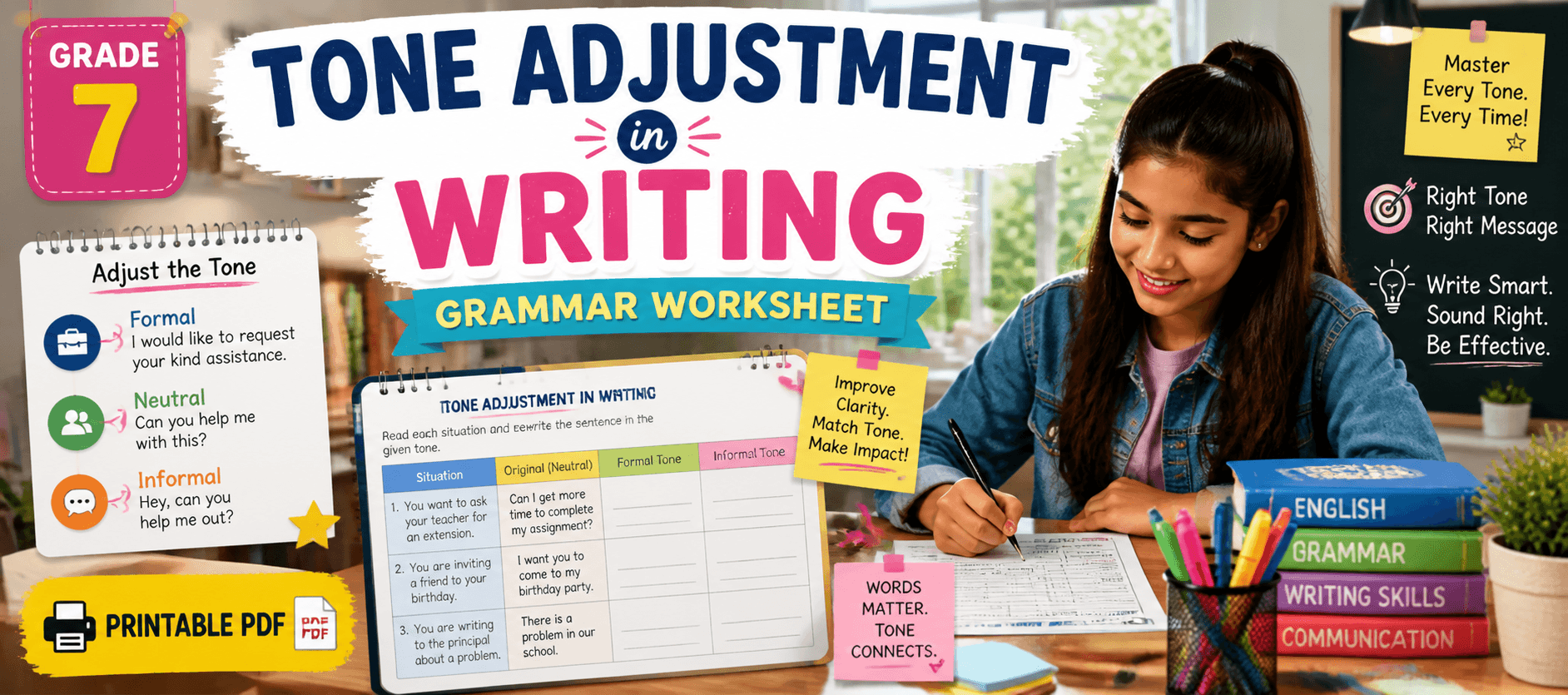
Adjusting the tone of your writing is an essential skill in both academic and professional settings. In this Grade 7 worksheet on "Rewriting for Tone Adjustment," students will practice transforming sentences to match a specific tone. Whether the tone is formal, informal, or neutral, being able to adjust the tone helps students communicate effectively and appropriately in different contexts.
Download these English grammar worksheets and practice regularly to strengthen your language skills and build a strong foundation. You can also book a free trial to get expert guidance and improve your reading, writing, and comprehension abilities. The worksheets are designed in a simple and structured way to help K–8 students learn grammar concepts easily and use them confidently in everyday communication.
Book a free trial!
## What is the topic?
This worksheet focuses on the skill of tone adjustment in writing. Tone refers to the attitude or mood conveyed in a piece of writing. It is essential to choose the correct tone for different types of writing. Students will practice transforming sentences with an informal tone into a more formal or neutral tone and vice versa.
Students will learn:
- How to identify the tone of a sentence.
- How to adjust the tone of writing to fit different contexts.
- Why it’s important to choose the right tone for effective communication.
## What’s in this worksheet?
The worksheet contains exercises that help students practice adjusting the tone of sentences. These exercises include:
1. **Underline the words** – Identifying key words or phrases that affect the tone of a sentence.
2. **Multiple choice questions** – Selecting the correct version of a sentence based on tone adjustment.
3. **Sentence rewriting** – Rewriting sentences to adjust their tone to a more formal or informal style.
4. **Fill in the blanks** – Completing sentences with appropriate tone adjustments.
5. **Paragraph writing** – Writing a short paragraph using different tones, depending on the context.
By practicing these exercises, students will become proficient at adjusting the tone of their writing, which is crucial for both academic assignments and personal communication.
## Definitions, examples, techniques, and tips
- **Tone Adjustment Definition**: Tone adjustment is the process of changing the style or mood of writing to suit a particular audience or purpose. This involves using specific vocabulary, sentence structures, and punctuation to convey the intended attitude, whether formal, informal, or neutral.
- **Example of Tone Adjustment**:
- **Informal Tone**: "I can’t believe I got an A!"
- **Formal Tone**: "I am delighted to have received an A."
- **Techniques for tone adjustment**:
1. **Vocabulary choice**: Use more formal or casual words based on the required tone (e.g., "assist" for formal, "help" for informal).
2. **Sentence structure**: Formal writing tends to use complete sentences and avoids contractions (e.g., "cannot" instead of "can't").
3. **Punctuation**: Informal writing may use exclamation marks for emphasis, while formal writing avoids them.
- **Quick learning tips**:
- When adjusting tone, consider the audience. Is it a formal letter, an academic essay, or a personal note?
- Avoid using slang or contractions in formal writing.
- Practice converting sentences from informal to formal to understand the difference in tone.
## Why is it important to learn this?
Mastering tone adjustment is crucial because it:
- Helps students communicate effectively in different contexts, whether academic, professional, or casual.
- Enables students to maintain the appropriate level of formality, depending on the situation.
- Enhances the clarity and impact of writing, as the tone helps convey the writer's attitude and intention.
This skill is important not only for Grade 7 assignments but also for future academic and professional writing tasks.
## Where will this knowledge help you?
This knowledge will be useful in many scenarios:
- **Exams**: Writing formal essays or reports requires the appropriate tone, especially in academic assessments.
- **Writing tasks**: Tone adjustment is essential when writing emails, letters, research papers, and speeches.
- **Class participation**: Adjusting tone is also important for presenting ideas clearly and professionally during class discussions.
# How to use this worksheet?
1. **Attempt independently first**: Read each sentence and identify the tone. Then, try to rewrite it in the required tone.
2. **Review answers carefully**: After rewriting, ensure that the tone is appropriate and matches the intended purpose.
3. **Correct mistakes**: If the tone doesn’t seem appropriate, adjust the vocabulary or sentence structure until it aligns with the desired tone.
4. **Practice regularly**: Keep practicing tone adjustment to become more comfortable using different tones in various writing tasks.
The solutions follow the exact worksheet order. Compare your answers carefully to ensure accuracy.
## Important tips and tricks
- **Common mistakes**:
- Mixing informal and formal language in the same sentence.
- Overcomplicating sentences in formal writing, making them less clear.
- **What examiners expect**:
- Consistent tone throughout a piece of writing.
- The correct use of formal, informal, or neutral language based on the assignment’s requirements.
- **How to score full marks**:
- Focus on clarity when adjusting tone and ensure that the tone matches the writing context.
- Avoid excessive informality in formal writing and vice versa.
- **How to approach activity-based or writing-based tasks**:
- For rewriting tasks, carefully consider the audience and purpose of the writing before making tone adjustments.
- For paragraph writing, maintain a consistent tone throughout the paragraph.
## Complete Answer Key
**Exercise No. 1:**
- This is bad stuff. (Underline: This, Circle: is)
- That’s a horrible situation. (Underline: That’s, Circle: is)
- He failed badly. (Underline: He, Circle: failed)
- She didn’t do well. (Underline: She, Circle: didn’t do)
- They were angry. (Underline: They, Circle: were)
**Exercise No. 2:**
1. b) This is unacceptable.
2. c) That’s an unfortunate situation.
3. b) He made an error.
4. b) She performed inadequately.
5. b) They were frustrated.
6. b) He did a poor job.
7. b) That was an unwise decision.
8. b) He struggled with the task.
9. c) She had difficulty with the task.
10. b) This is unacceptable.
**Exercise No. 3:**
1. This is unacceptable. (Ensure an appropriate tone is used.)
2. That’s an unfortunate situation. (Ensure an appropriate tone is used.)
3. He made an error. (Ensure an appropriate tone is used.)
4. She performed inadequately. (Ensure an appropriate tone is used.)
5. They were frustrated. (Ensure an appropriate tone is used.)
**Exercise No. 4:**
1. wonderful
2. adorable
3. loudly
4. wagging
5. laugh
6. energetic
7. pet
8. joyful
9. exciting
**Exercise No. 5**: Answers may vary.
## Outro
By mastering the skill of adjusting the tone in writing, students will improve their ability to communicate effectively across different contexts. This skill is essential for academic success and for expressing ideas with clarity and impact in both formal and informal settings.
Book a free trial!