
Types of Adjectives Exercises for Class 5 Printable PDF

Types of Adjectives with This English Grammar Worksheet for Grade 5 Students
Learning adjectives can make sentences more colorful, meaningful, and exciting. In this English grammar worksheet for Grade 5, students get to explore different types of adjectives through engaging and interactive activities. From descriptive adjectives to possessive adjectives, this worksheet helps children understand how adjectives improve communication and sentence structure.
The worksheet includes fun exercises like coloring adjective boxes, underlining adjectives, filling in the blanks, rewriting sentences, and picture description activities. These tasks encourage students to identify adjectives correctly and use them confidently in writing and speaking. With regular practice, Grade 5 students can strengthen their grammar skills and become more confident language users.
Download these English grammar worksheets and practice regularly to strengthen your language skills and build a strong foundation. You can also book a free trial to get expert guidance and improve your reading, writing, and comprehension abilities. The worksheets are designed in a simple and structured way to help K–8 students learn grammar concepts easily and use them confidently in everyday communication.
What Is the Topic?
An adjective is a word that tells us more about a noun — like how it looks, how many, whose it is, and which one.
This worksheet focuses on different types of adjectives and teaches students how to identify and use them correctly in sentences.
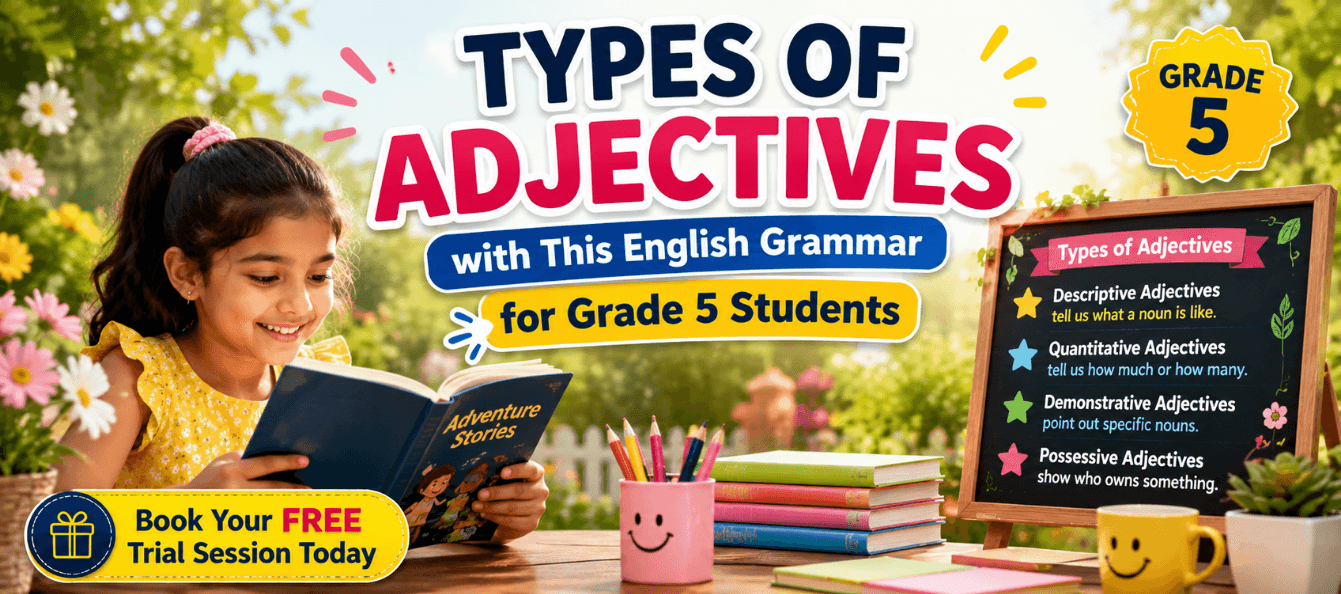
The worksheet explains these types of adjectives:
1. Descriptive Adjectives
These tell us what a noun is like.
Examples: tall, funny, soft, red
Example:
The sky is clear.
2. Quantitative Adjectives
These tell us how much or how many.
Examples: some, many, five, few
Example:
I ate two apples.
3. Demonstrative Adjectives
These point out specific nouns.
Examples: this, that, these, those
Example:
Look at that butterfly!
4. Possessive Adjectives
These show who owns something.
Examples: my, your, his, her
Example:
This is my pencil.
Students are expected to learn how to recognize these adjectives, use them correctly in sentences, and understand their different functions.
What’s in This Worksheet?
1. Students color all the adjective words from a table filled with mixed words.
2. Learners underline adjectives in sentences and label their types correctly.
3. Fill-in-the-blank questions help students choose suitable adjectives.
4. Sentence rewriting tasks encourage students to improve simple sentences by adding adjectives.
5. A picture description activity allows students to create sentences using different types of adjectives.
6. The worksheet practices descriptive, quantitative, demonstrative, and possessive adjectives.
7. The activities improve grammar understanding, sentence formation, vocabulary, and observation skills.
8. The exercises support school grammar practice and help students prepare for English exams.
Definitions, Examples, Techniques, and Tips
Definition of adjective:
An adjective is a word that tells us more about the noun.
Descriptive adjectives:
These tell us what a noun is like.
Examples:
tall
funny
soft
red
Sentence example:
The sky is clear.
Quantitative adjectives:
These tell us how much or how many.
Examples:
some
many
five
few
Sentence example:
I ate two apples.
Demonstrative adjectives:
These point out specific nouns.
Examples:
this
that
these
those
Sentence example:
Look at that butterfly!
Possessive adjectives:
These show who owns something.
Examples:
my
your
his
her
Sentence example:
This is my pencil.
Techniques students can use:
1. Look for words that describe nouns.
2. Check if the word tells quality, number, ownership, or points to something.
3. Read the sentence carefully before choosing the adjective type.
4. Practice rewriting sentences with stronger describing words.
Quick learning tips:
1. Adjectives usually come before nouns.
2. Read sentences slowly to identify describing words.
3. Practice using different adjective types in daily speaking.
4. Underline nouns first to help find adjectives.
Why Is It Important to Learn This?
Learning adjectives helps students make their writing more interesting and detailed. Instead of writing simple sentences, students can add describing words that make communication clearer and more expressive.
Understanding different types of adjectives also improves grammar accuracy. Students learn how to describe people, places, things, quantity, and ownership properly.
This topic is important because it strengthens sentence-building skills, improves vocabulary, and helps students speak and write confidently in English. It also supports reading comprehension because students can better understand descriptions in stories and passages.
Where Will This Knowledge Help You?
1. In school grammar exams and class tests.
2. During creative writing and paragraph writing activities.
3. While speaking confidently in class discussions.
4. In picture description and storytelling exercises.
5. During reading comprehension activities.
6. In daily communication and sentence formation.
7. While identifying parts of speech in English grammar lessons.
How to Use This Worksheet?
1. Read the explanation of adjectives carefully before starting the exercises.
2. Attempt every exercise independently first.
3. Follow the worksheet order carefully while answering.
4. Underline, fill, rewrite, and identify adjectives according to the instructions.
5. Compare your answers carefully with the completed answer key.
6. Review mistakes and understand why the adjective is used.
7. Practice similar sentences regularly to improve grammar confidence.
8. Remember that the solutions follow the exact worksheet order for easy checking.
Important Tips and Tricks
1. Identify the noun first before searching for the adjective.
2. Descriptive adjectives tell qualities such as beautiful, kind, or smart.
3. Quantitative adjectives show amount or number such as many, some, or five.
4. Demonstrative adjectives point to nouns using words like this, that, these, and those.
5. Possessive adjectives show ownership using words like my, your, and their.
6. Read each sentence carefully before labeling the adjective type.
7. In fill-in-the-blank questions, choose adjectives that make the sentence meaningful.
8. While rewriting sentences, add suitable adjectives naturally.
9. In picture description activities, observe details carefully before writing sentences.
10. Keep handwriting neat and underline adjectives properly during written practice.
Complete Answer Key
Exercise 1
Color all the boxes with adjectives in the table given below
Joyful
Three
Honest
Big
Many
Shiny
Which
Smart
Blue
This
Hungry
Some
Kind
Five
What
Brave
Tall
Clever
Funny
Their
Small
Lazy
Neat
Exercise 2
Underline the adjective in each sentence and label its type.
1. She wore a _beautiful_ dress. — Descriptive
2. _That_ boy is my best friend. — Demonstrative
3. How _many_ pencils do you need? — Quantitative
4. I have _some_ juice in my bottle. — Quantitative
5. The _third_ chapter is very interesting. — Quantitative
6. _This_ dog belongs to our neighbor. — Demonstrative
7. _Which_ color do you like more? — Demonstrative
8. They brought _many_ toys for the picnic. — Quantitative
9. _My_ uncle is a kind man. — Possessive
10. _Those_ shoes are too big for me. — Demonstrative
Exercise 3
Fill in the blanks with a suitable adjective.
1. She has a beautiful dress for the party.
2. We saw many birds in the tree.
3. My kind brother helped me with homework.
4. Which book is yours—this one or that one?
5. I drank some water after the run.
6. He is a very smart player.
7. Many students forgot their notebooks.
8. The pink flower was blooming.
9. Which pencil is on the table—mine or yours?
10. We met a friendly lady at the shop.
Exercise 4
Rewrite each sentence by adding a suitable adjective and label its type.
1. The cat is sleeping.
The orange cat is sleeping. (Descriptive)
2. I have a pencil.
I have a blue pencil. (Descriptive)
3. We visited a park.
We visited a beautiful park. (Descriptive)
4. The boy read a book.
The smart boy read a book. (Descriptive)
5. She wore a dress.
She wore a red dress. (Descriptive)
6. They watched a movie.
They watched an interesting movie. (Descriptive)
7. My friend has a bag.
My friend has a black bag. (Descriptive)
8. I bought apples.
I bought five apples. (Quantitative)
9. He found a coin.
He found a shiny coin. (Descriptive)
10. We ate a cake.
We ate a delicious cake. (Descriptive)
Exercise 5
Write 4 sentences each with different type of adjective on the picture given below.
Underline and label the adjective that you used.
1. The _happy_ children are playing in the classroom. (Descriptive)
2. _Many_ students are standing near the board. (Quantitative)
3. _Those_ children are smiling happily. (Demonstrative)
4. _Their_ classroom looks colorful and neat. (Possessive)
Practicing this English grammar worksheet for Grade 5 on types of adjectives can help students become stronger writers and confident speakers. By solving different exercises regularly, children learn how to identify and use adjectives correctly in everyday communication. Continued grammar practice will improve sentence structure, vocabulary, and overall English skills in a fun and meaningful way.