
Types of Sentences English Grammar Worksheet for Grade 6
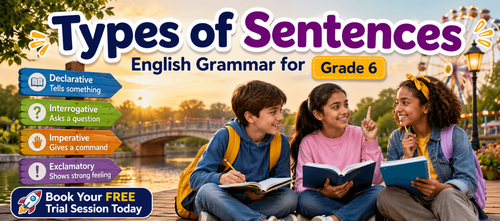

Types of Sentences with This English Grammar Worksheet for Grade 6
Understanding different types of sentences is an important step in improving communication skills. In Grade 6 English grammar, students learn how sentences can express information, ask questions, give commands, or show strong emotions. Learning sentence types helps students become better writers and more confident speakers.
This Types of Sentences English grammar worksheet for Grade 6 gives students engaging practice through sentence identification, sentence correction, changing sentence types, and sentence formation activities. These exercises help students understand how punctuation, tone, and sentence structure work together in English grammar.
By practicing these activities carefully, students can improve their grammar accuracy, writing style, speaking confidence, and comprehension skills. The worksheet is designed in a simple and structured format so learners can practice independently and strengthen their grammar foundation step by step.
Download these English grammar worksheets and practice regularly to strengthen your language skills and build a strong foundation. You can also book a free trial to get expert guidance and improve your reading, writing, and comprehension abilities. The worksheets are designed in a simple and structured way to help K–8 students learn grammar concepts easily and use them confidently in everyday communication.
What Is the Topic?
Types of sentences explain how sentences are used for different purposes in communication. Every sentence has a special function. Some sentences give information, some ask questions, some give instructions, and some express strong feelings.
In this worksheet, students learn the four main types of sentences in English grammar:
1. Declarative Sentence
A declarative sentence gives information or states something.
Example: I love ice cream.
2. Interrogative Sentence
An interrogative sentence asks a question and ends with a question mark.
Example: What is your name?
3. Imperative Sentence
An imperative sentence gives a command, instruction, or request.
Example: Close the door.
4. Exclamatory Sentence
An exclamatory sentence shows strong feelings such as joy, surprise, or excitement.
Example: What a beautiful flower!
Students are expected to identify sentence types, use correct punctuation marks, convert one sentence type into another, and create their own examples.
What’s in This Worksheet?
1. Sentence Identification
Students read different sentences and identify whether they are declarative, interrogative, imperative, or exclamatory sentences.
2. Punctuation Practice
Students add the correct punctuation marks and identify the sentence type.
3. Sentence Transformation
Students change sentences from one type into another as directed.
4. Sentence Writing
Students create their own examples for each type of sentence.
5. Grammar Skill Development
The worksheet improves sentence recognition, punctuation usage, sentence formation, and grammar understanding.
6. Exam Preparation Support
These exercises help students prepare for school tests and grammar assessments by strengthening sentence structure concepts.
Definitions, Examples, Techniques, and Tips
Declarative Sentence
A declarative sentence tells us something or gives information.
Example:
I love ice cream.
Interrogative Sentence
An interrogative sentence asks a question and ends with a question mark.
Example:
What is your name?
Imperative Sentence
An imperative sentence tells someone to do something.
Example:
Close the door.
Exclamatory Sentence
An exclamatory sentence shows a strong feeling and ends with an exclamation mark.
Example:
What a beautiful flower!
Techniques for Solving the Worksheet
1. Read the sentence carefully before identifying its type.
2. Look at the punctuation mark at the end of the sentence.
3. Check whether the sentence gives information, asks a question, gives a command, or expresses emotion.
4. While changing sentence types, keep the meaning similar.
5. Use proper punctuation marks carefully.
Quick Learning Tips
1. Questions usually end with a question mark.
2. Commands and requests are often imperative sentences.
3. Strong emotions usually use exclamation marks.
4. Statements normally end with a full stop.
5. Practice reading sentences aloud to understand their tone better.
Why Is It Important to Learn This?
Learning types of sentences is important because it improves both speaking and writing skills. Students can express thoughts clearly when they understand how different sentence types work.
This topic also helps students:
1. Use proper punctuation correctly
2. Improve communication skills
3. Write better paragraphs and essays
4. Understand grammar rules more clearly
5. Speak confidently in conversations and presentations
Strong grammar knowledge helps students perform better in school assignments and exams.
Where Will This Knowledge Help You?
1. School Exams
Questions about sentence types are common in English grammar tests.
2. Creative Writing
Students can make their writing more interesting by using different sentence types.
3. Classroom Communication
Students can ask questions, give responses, and express feelings clearly.
4. Daily Conversations
Correct sentence usage improves everyday speaking skills.
5. Reading Comprehension
Understanding sentence types helps students understand the writer’s purpose more easily.
How to Use This Worksheet?
1. Read each sentence carefully before answering.
2. Identify clues such as punctuation marks and sentence purpose.
3. Attempt all questions independently first.
4. Compare your answers carefully with the complete answer key.
5. Correct mistakes and understand why the answer is correct.
6. Practice sentence transformation regularly.
7. Follow the exact worksheet order while checking answers.
8. Revise the four sentence types again after completing the worksheet.
Important Tips and Tricks
1. Always check the punctuation mark at the end of the sentence.
2. Interrogative sentences always ask questions.
3. Imperative sentences often begin with action words.
4. Exclamatory sentences show excitement, surprise, or strong feelings.
5. Declarative sentences simply provide information.
6. Read the sentence tone carefully before choosing the answer.
7. During exams, avoid confusing exclamatory and declarative sentences.
8. While changing sentence types, keep the sentence meaning correct.
9. Use capital letters and punctuation marks properly.
10. Practice writing your own examples for better understanding.
Complete Answer Key
Exercise 1
Read each sentence. Identify its type — declarative, interrogative, imperative, or exclamatory.
1. Could you lend me your notebook?
Interrogative
2. Wow! What a clever idea that was!
Exclamatory
3. Please turn off the lights before leaving.
Imperative
4. Mangoes are my favorite fruit.
Declarative
5. Where did you keep the key?
Interrogative
6. Don’t touch the glass – it’s hot!
Imperative
7. We are going to the zoo tomorrow.
Declarative
8. What a mess this room is!
Exclamatory
9. Have you finished your homework yet?
Interrogative
10. Close the door quietly, please.
Imperative
Exercise 2
Add the correct punctuation at the end of each sentence. Then label the sentence type.
1. Can you help me with this?
Interrogative
2. Look at that giant balloon!
Exclamatory
3. This cake is delicious.
Declarative
4. Don’t forget to lock the door.
Imperative
5. Where is my science textbook?
Interrogative
6. Please turn off the lights.
Imperative
7. We are going on a trip tomorrow.
Declarative
8. How exciting this game is!
Exclamatory
9. What is the capital of France?
Interrogative
10. Finish your homework before dinner.
Imperative
Exercise 3
Change the sentence from one type to another as directed.
1. Change to interrogative: You are feeling better.
Are you feeling better?
2. Change to exclamatory: This drawing is very beautiful.
What a beautiful drawing this is!
3. Change to imperative: You should close the door.
Close the door.
4. Change to declarative: Please pass the salt.
You should pass the salt.
5. Change to interrogative: He is your new teacher.
Is he your new teacher?
6. Change to exclamatory: The puppy is so tiny.
What a tiny puppy it is!
7. Change to imperative: You must listen carefully.
Listen carefully.
8. Change to declarative: What a lovely dress!
The dress is very lovely.
9. Change to interrogative: She is reading a storybook.
Is she reading a storybook?
10. Change to exclamatory: The sunset looks amazing.
What an amazing sunset it is!
Exercise 4
Write one sentence for each type of sentence: Declarative, Interrogative, Imperative, Exclamatory.
1. Declarative: My brother plays football every evening.
2. Interrogative: Where are you going after school?
3. Imperative: Please clean your desk neatly.
4. Exclamatory: What a wonderful surprise this is!
Practicing different types of sentences regularly helps students become stronger writers and more confident speakers. This Types of Sentences English grammar worksheet for Grade 6 provides useful practice for identifying, correcting, changing, and writing sentences correctly. By revising these concepts carefully and practicing daily, students can improve their grammar accuracy and communication skills step by step.