
Understand Countable vs Uncountable Nouns – Grade 8 PDF

Learn Countable and Uncountable Nouns Grade 8 Worksheet PDF – Complete Answers and Explanation
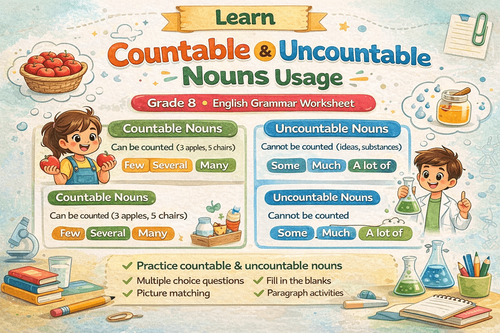
Learning nouns is an important part of mastering English grammar. In Grade 8, students begin to understand the difference between countable and uncountable nouns and how they are used in sentences. This English grammar worksheet titled “Learn Countable and Uncountable Nouns Grade 8 Worksheet PDF” provides structured practice through multiple-choice questions, fill-in-the-blanks, picture matching, noun identification, and paragraph writing. By working through this worksheet, students can improve their grammar skills and learn how to correctly use nouns in everyday language.
What Is Countable And Uncountable Nouns?
Countable and uncountable nouns are two important types of nouns in English grammar.
Countable nouns are nouns that can be counted individually. They have singular and plural forms and can be used with numbers. Examples include students, chairs, apples, and journals.
Uncountable nouns are nouns that cannot be counted individually. They usually represent ideas, substances, or qualities and do not have plural forms. Examples include advice, information, luggage, furniture, and knowledge.
In this Grade 8 English grammar worksheet, students learn how to identify and correctly use countable and uncountable nouns in different contexts. The exercises help them understand when to use words like many, much, several, or some depending on the type of noun.
What’s In This Worksheet?
This Grade 8 English grammar worksheet on countable and uncountable nouns includes several types of practice activities.
1. Multiple Choice Questions
Students choose the correct noun form to complete sentences.
2. Fill in the Blanks
Students select correct nouns from a word bank and place them in sentences.
3. Match the Following
Students complete words and match pictures with the correct noun form.
4. Underline the Words
Students identify countable nouns and circle uncountable nouns.
5. Paragraph Writing
Students complete a paragraph using appropriate countable or uncountable nouns.
These activities help students practice recognizing different noun types and applying them in meaningful sentences.
Definitions, Examples, Techniques, And Tips
Understanding the difference between countable and uncountable nouns becomes easier with practice and examples.
Countable nouns
Countable nouns refer to things that can be counted.
Examples:
students
chairs
apples
journals
These nouns can be used with numbers or words such as several, many, or a few.
Uncountable nouns
Uncountable nouns refer to things that cannot be counted individually.
Examples:
information
advice
luggage
furniture
knowledge
These nouns are usually used with words such as much, little, or some.
Example sentences from the worksheet show how nouns behave in context:
The professor gave us useful advice.
Students must read many journals daily.
The journalist gathered information quickly.
These examples help students see how noun type affects sentence structure.
Why Is It Important To Learn This?
Learning countable and uncountable nouns helps students communicate more accurately in English.
First, it improves sentence construction. When students know whether a noun is countable or uncountable, they can choose the correct words such as many or much.
Second, it strengthens writing skills. Proper noun usage makes essays, answers, and reports clearer and more grammatically correct.
Third, it supports exam preparation. Many grammar exams include questions on noun types, determiners, and correct sentence formation.
Finally, it improves speaking skills. Correct noun usage helps students express ideas clearly in discussions and presentations.
Where Will This Knowledge Help You?
Understanding countable and uncountable nouns helps students in many real-life and academic situations.
In school exams
Grammar questions often test students on noun types and correct usage.
In writing assignments
Students use nouns while writing essays, reports, or paragraphs.
In class discussions
Correct grammar helps students communicate ideas clearly.
In presentations and projects
Students often describe research, information, or equipment where uncountable nouns are commonly used.
Mastering this concept makes both spoken and written English more effective.
How To Use This Worksheet?
Follow these steps to get the best results from this Grade 8 English grammar worksheet.
1. Attempt the worksheet independently
Students should try answering all questions without help first.
2. Read each sentence carefully
Understanding the context helps identify whether the noun should be countable or uncountable.
3. Compare with the answer key
After finishing, check answers carefully with the solution section.
4. Correct mistakes
Review incorrect answers to understand the grammar rule behind them.
5. Practice regularly
Repeating exercises improves accuracy and confidence in grammar.
The solutions below follow the exact order of questions in the worksheet so students can easily compare their answers.
Important Tips And Tricks
1. Use “many” with countable nouns
Example: many students, many chairs.
2. Use “much” with uncountable nouns
Example: much information, much advice.
3. Remember that uncountable nouns usually have no plural form.
4. Words like luggage, furniture, and equipment are always treated as uncountable nouns.
5. When identifying nouns in sentences, focus on whether they represent objects that can be counted.
6. In exams, read the entire sentence before choosing the noun form.
7. Practice identifying nouns in everyday sentences to build confidence.
Complete Answer Key
Exercise No. 1
Choose the correct noun form to complete each sentence.
1. The professor gave us _much_ useful advice.
2. We need _many_ chairs for the seminar.
3. She carried _much_ luggage during the trip.
4. The teacher shared _much_ important information.
5. There are _some_ apples left in the basket.
6. He has _much_ research to finish before exams.
7. They offered _some_ feedback after the event.
8. We saw _several_ students waiting outside.
9. There isn’t _much_ water in the bottle.
10. The library has _several_ journals on economics.
Exercise No. 2
Fill in the blanks using the correct words from the bank.
Word bank: research, luggage, information, journals, patience, knowledge, equipment, advice, furniture, traffic
1. We need more _research_ on climate change.
2. She bought new _luggage_ for the trip.
3. The lab received modern _equipment_ last week.
4. The professor gave sound _advice_.
5. He has little _knowledge_ about the subject.
6. Students must read many _journals_ daily.
7. The car was stuck in heavy _traffic_.
8. The house was decorated with new _furniture_.
9. He admired her calm _patience_.
10. The scientist presented groundbreaking _information_.
Exercise No. 3
Complete and match each picture with the correct determiner.
1. Salt – _some_
2. Box of toys – _many_
3. Boy asking – _any_
4. Clothes – _several_
5. Car – _a_
6. Animals – _few_
7. Coins (money) – _much_
8. Group of children – _many_
9. Bowl of salad – _some_
10. Apple – _an_
Exercise No. 4
Underline the countable nouns and circle the uncountable nouns.
1. The journalist gathered (_information_) quickly.
2. He arranged (_furniture_) in the living room.
3. Researchers published _journals_ last year.
4. The travelers carried (_luggage_) carefully.
5. She received (_advice_) from her mentor.
6. They conducted (_research_) on biodiversity.
7. Students gained (_knowledge_) through reading.
8. The storm slowed (_traffic_) on highways.
9. The technician repaired (_equipment_) yesterday.
10. The audience showed (_patience_) during delay.
Exercise No. 5
Complete short paragraph using countable or uncountable nouns.
In Delhi, students prepared for a large conference with _research_ and _knowledge_ to strengthen their presentations. The library offered several _journals_ and digital _information_, while teachers provided useful _advice_ to improve arguments. Heavy _traffic_ caused delays on the road, yet their _patience_ kept spirits high. Each delegate packed personal _luggage_ carefully and staff arranged additional _furniture_ for the event. Inside the hall, volunteers placed enough _chairs_ for the audience and checked that technical _equipment_ worked smoothly. The keynote speaker reminded everyone that progress requires _research_ and _knowledge_ together. It was a hectic day, but with teamwork and effort, _students_ managed it successfully.
Practicing worksheets like this Grade 8 English grammar worksheet helps students clearly understand how countable and uncountable nouns function in real sentences. By completing exercises, identifying noun types, and using them in paragraphs, students build stronger grammar skills and gain confidence in writing and speaking English.