
Understanding the Water Cycle through Fun Activities in Grade 5

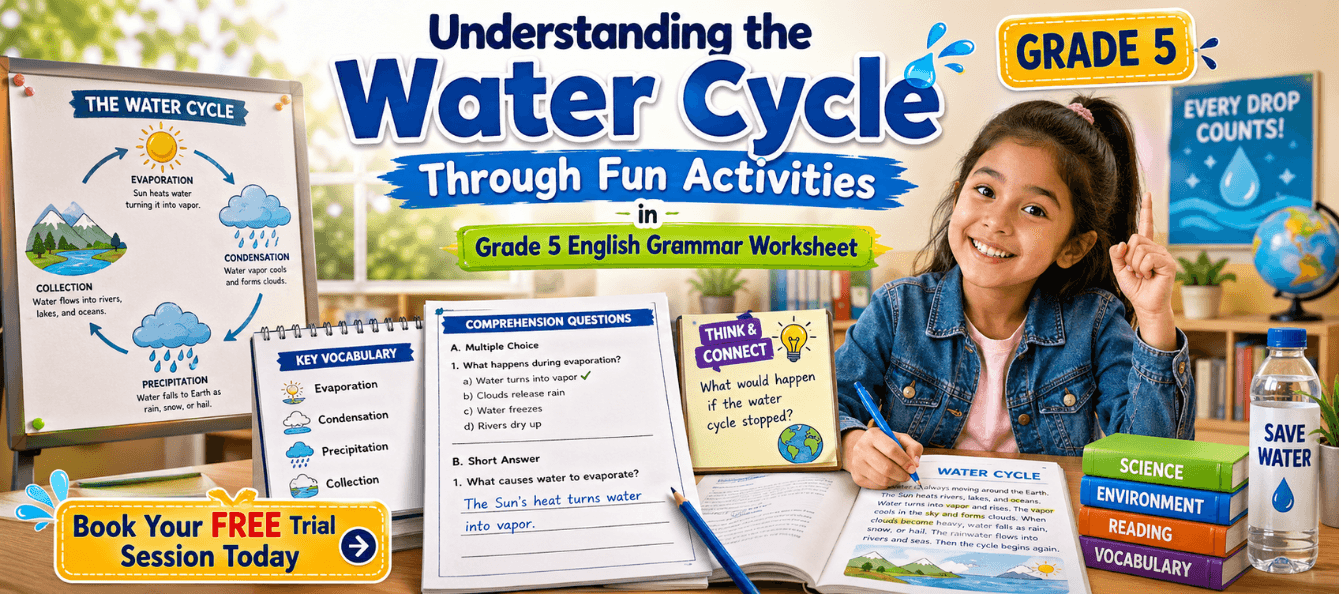
Understanding the Water Cycle Through Fun Activities in Grade 5 English Grammar Worksheet
Learning about the water cycle becomes exciting when students can read interesting passages and answer engaging comprehension questions. This Grade 5 English grammar worksheet helps students understand how water moves around the Earth while improving reading, comprehension, vocabulary, and answer-writing skills. The worksheet includes multiple-choice questions, short-answer questions, and thinking-based activities that encourage students to carefully read the passage and answer in the correct order.
Students learn important concepts like evaporation, condensation, and precipitation in a simple and structured way. The worksheet also helps students understand how the Sun, clouds, rain, rivers, and oceans are connected through the water cycle. By practicing these activities regularly, students can improve both comprehension skills and scientific understanding in an enjoyable way.
Download these English grammar worksheets and practice regularly to strengthen your language skills and build a strong foundation. You can also book a free trial to get expert guidance and improve your reading, writing, and comprehension abilities. The worksheets are designed in a simple and structured way to help K–8 students learn grammar concepts easily and use them confidently in everyday communication.
What Is the Water Cycle?
The water cycle is a continuous process in which water moves around the Earth. In this Grade 5 worksheet, students learn that the Sun heats rivers, lakes, and oceans, causing water to turn into vapor. This process is called evaporation. The vapor rises into the sky and cools to form clouds. This process is known as condensation.
When clouds become heavy, the water falls back to Earth as rain, snow, or hail. This process is called precipitation. The rainwater then flows into rivers and seas, beginning the cycle again.
Students are expected to:
- Understand the stages of the water cycle
- Learn key vocabulary from the passage
- Improve comprehension skills
- Answer questions correctly in sequence
- Build logical thinking and reading confidence
What’s in This Worksheet?
1. A reading passage explaining the water cycle in simple language.
2. Multiple-choice questions based on facts from the passage.
3. Short-answer questions that require complete sentence answers.
4. Connection-based questions to encourage deeper understanding.
5. A vocabulary activity asking students to find a synonym.
6. Activities arranged in a clear and structured order.
7. Exercises that improve reading comprehension and answer-writing skills.
8. Practice questions that help students prepare for school assessments and exams.
Definitions, Examples, Techniques, and Tips
Definitions
- Water cycle: The continuous movement of water around the Earth.
- Evaporation: The process in which water turns into vapor.
- Condensation: The process where water vapor cools and forms clouds.
- Precipitation: Water falling back to Earth as rain, snow, or hail.
Examples from the Worksheet
- “When the Sun heats rivers, lakes, and oceans, the water turns into vapor and rises.”
- “The vapor cools in the sky and forms clouds through condensation.”
- “When clouds become heavy, the water falls back to the Earth as rain, snow, or hail.”
Techniques Students Can Use
- Read the passage slowly and carefully.
- Underline important words related to the water cycle.
- Match each answer with information from the passage.
- Follow the serial order of questions while answering.
Quick Learning Tips
- Remember that the Sun starts the process of evaporation.
- Clouds form when water vapor cools.
- Rainwater flows into rivers and seas.
- Learn important scientific words carefully.
- Practice answering in complete sentences.
Why Is It Important to Learn This?
Learning about the water cycle helps students understand how nature works. Water is necessary for all living beings, and this cycle helps keep water moving around the Earth. Students also learn how rain forms and how the Sun helps drive the entire process.
This Grade 5 English grammar worksheet improves:
- Reading comprehension
- Vocabulary skills
- Scientific understanding
- Logical thinking
- Sentence-writing abilities
The worksheet also encourages students to read carefully and answer accurately in the correct order.
Where Will This Knowledge Help You?
Students can use this knowledge in:
- School exams
- Reading comprehension activities
- Science lessons
- English assignments
- Classroom participation
- Environmental studies
- Vocabulary practice
Understanding the water cycle also helps students explain natural events like rain, clouds, and evaporation more confidently.
How to Use This Worksheet?
1. Read the entire passage carefully before answering.
2. Underline important words and scientific terms.
3. Attempt each question independently.
4. Follow the exact order of the questions while answering.
5. Compare answers carefully with the passage.
6. Rewrite incorrect answers and practice again.
7. Read the answer key after completing the exercises.
8. Practice regularly to improve comprehension and writing skills.
9. The solutions below follow the exact worksheet order.
10. Students should check every answer according to the serial number given in the worksheet.
Important Tips and Tricks
1. Read every question carefully before answering.
2. Focus on keywords like evaporation, condensation, and precipitation.
3. Do not confuse cloud formation with rainfall.
4. Remember that the Sun powers evaporation.
5. Write answers in complete sentences.
6. Follow the correct order of the exercises and questions.
7. Recheck spellings of important words.
8. Use information directly from the passage.
9. Read all options carefully before choosing the correct answer.
10. Practice comprehension passages regularly to improve accuracy and confidence.
Complete Answer Key
Reading Passage:
Water Cycle
“Water is always moving around the Earth in a continuous process called the water cycle. When the Sun heats rivers, lakes, and oceans, the water turns into vapor and rises—this step is called evaporation. The vapor cools in the sky and forms clouds through condensation. When clouds become heavy, the water falls back to the Earth as rain, snow, or hail. This is precipitation. The rainwater then flows into rivers and seas, starting the cycle again. The water cycle keeps the Earth cool, plants alive, and water clean for all living beings.”
Exercise No. 1
1. What happens during evaporation?
✓ a) Water turns into vapor
b) Clouds release rain
c) Water freezes
d) Rivers dry up
2. What is the process called when water falls as rain?
a) Condensation
✓ b) Precipitation
c) Evaporation
d) Filtration
3. Where does rainwater finally go?
a) Into deserts
✓ b) Into rivers and seas
c) Into mountains
d) Into air
Exercise No. 2
1. What causes water to evaporate?
The Sun’s heat turns water into vapor.
2. How are clouds formed?
Clouds form when water vapor cools and condenses.
3. Why is the water cycle important for life?
It keeps water available and supports life on Earth.
Exercise No. 3
1. How does the Sun play a key role in the water cycle?
The Sun powers evaporation and drives the cycle.
2. What would happen if the water cycle stopped?
Without it, Earth would become dry and lifeless.
3. How does the water cycle help plants and animals?
It ensures living things always have water to survive.
4. Find a synonym of “continuous.”
Synonym: constant – The water cycle is a constant process.
This Grade 5 English grammar worksheet on the water cycle is a simple and engaging way for students to improve reading comprehension and learn important environmental concepts. By practicing these activities regularly, students can become more confident in understanding passages, answering questions correctly, and building stronger language skills. Continue practicing comprehension worksheets to improve vocabulary, reading accuracy, and overall learning confidence.