
Vocabulary Practice Worksheet for Class 2 Kids [Free PDF]
![Vocabulary Practice Worksheet for Class 2 Kids [Free PDF]](https://cdn5.planetspark.in/media/small_Vocabulary_Practice_Worksheet_for_Class_2_Kids_Free_PDF_85f54a75a9.png)

Vocabulary Practice Worksheet for Class 2 Kids [Free PDF]
Grade 2 students often find it exciting to explore how words are connected in meaning. This English grammar worksheet on Word Meaning Relationships makes learning fun by helping children understand synonyms, antonyms, and words with multiple meanings. By practicing these, students strengthen their vocabulary and grammar skills in a way that feels engaging and useful for everyday communication.
Download these English grammar worksheets and practice regularly to strengthen your language skills and build a strong foundation. You can also book a free trial to get expert guidance and improve your reading, writing, and comprehension abilities. The worksheets are designed in a simple and structured way to help K–8 students learn grammar concepts easily and use them confidently in everyday communication.
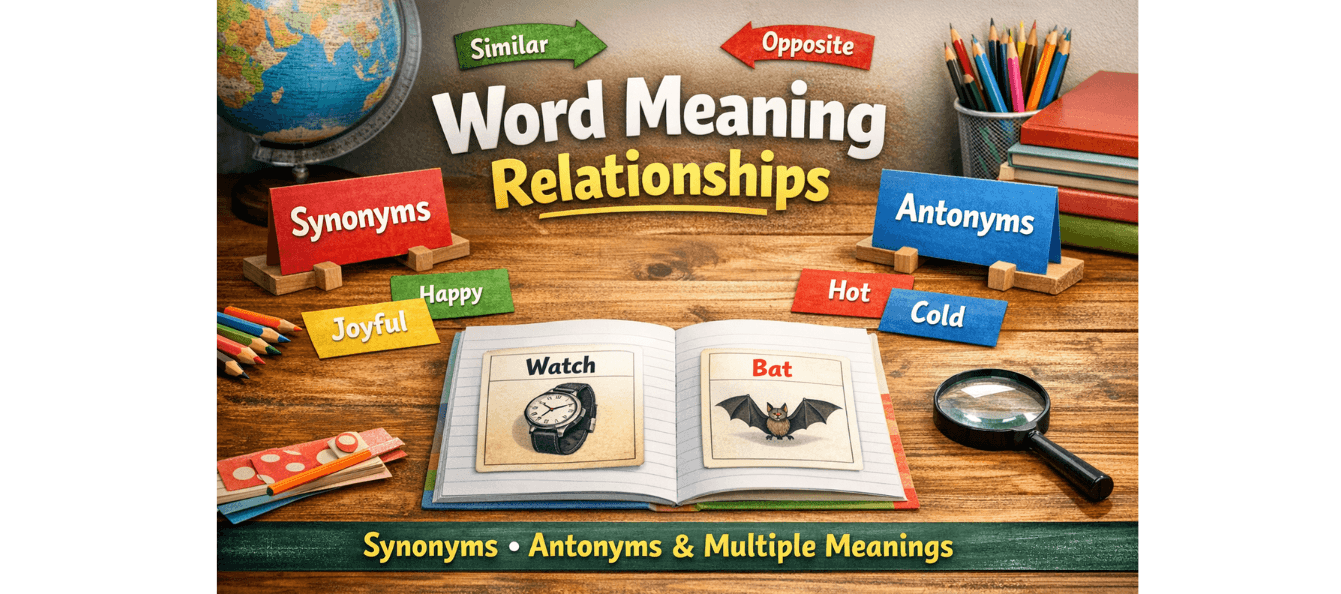
What Is the Topic?
Word meaning relationships are about how words connect to each other in terms of meaning. Some words mean the same (synonyms), some mean the opposite (antonyms), and some words can have more than one meaning depending on how they are used. In this Grade 2 English grammar worksheet, students learn to recognize these relationships clearly. The goal is to help them build stronger vocabulary, understand context better, and use words more accurately in writing and speaking.
What’s in This Worksheet?
1. Questions on opposites (antonyms) to test understanding of word contrasts.
2. Questions on synonyms to practice words with similar meanings.
3. Picture-based questions to identify words with multiple meanings.
4. Action words with opposite meanings to strengthen verb usage.
5. Adjectives with opposite meanings to expand descriptive vocabulary.
This structure supports exam preparation by giving students practice in multiple-choice questions, reinforcing grammar concepts, and improving word recognition.
Definitions, Examples, Techniques, and Tips
- Definitions:
- Synonyms are words with similar meanings.
- Antonyms are words with opposite meanings.
- Some words can have more than one meaning depending on context.
- Examples from the worksheet:
- Opposite of brave is scared.
- Synonym of tiny is small.
- Watch can mean a timepiece or to look carefully.
- Techniques:
- Read each option carefully before choosing.
- Think about how the word is used in everyday life.
- Quick learning tips:
- Practice opposites by pairing words.
- Use synonyms to make writing more interesting.
- Notice words with double meanings in stories or conversations.
Why Is It Important to Learn This?
Learning word meaning relationships helps students improve their vocabulary, understand reading passages better, and write more effectively. It strengthens both speaking and writing skills by giving them the ability to choose the right word for the right situation. Academically, it prepares them for exams where synonyms, antonyms, and vocabulary questions are common.
Where Will This Knowledge Help You?
- In exams where vocabulary-based questions appear.
- In writing tasks like essays and stories.
- In class participation when answering questions or reading aloud.
How to Use This Worksheet?
1. Attempt each question independently first.
2. Review the answers carefully.
3. Correct mistakes by checking the answer key.
4. Practice regularly to remember word meanings.
The solutions follow the exact worksheet order, so students should compare their answers carefully.
Important Tips and Tricks
1. Do not rush through options; read each carefully.
2. Examiners expect accurate answers, so avoid guessing.
3. To score full marks, practice opposites and synonyms regularly.
4. For activity-based or picture-based tasks, focus on the context shown.
Complete Answer Key
Exercise No. 1 (Opposites)
1. Opposite of brave → scared
2. Opposite of empty → full
3. Opposite of smooth → rough
4. Opposite of above → below
5. Opposite of happy → sad
6. Opposite of early → late
7. Opposite of loud → soft
8. Opposite of wide → narrow
9. Opposite of weak → strong
10. Opposite of begin → end
Exercise No. 2 (Synonyms)
1. Synonym of tiny → small
2. Synonym of angry → mad
3. Synonym of smart → clever
4. Synonym of silent → quiet
5. Synonym of begin → start
6. Synonym of cold → cool
7. Synonym of funny → silly
8. Synonym of quick → fast
9. Synonym of big → large
10. Synonym of neat → tidy
Exercise No. 3 (Multiple Meanings)
1. Watch → a timepiece
2. Bat → an animal that flies at night
3. Well → a place to get water
4. Light → makes things bright
5. Ring → jewellery worn on finger
6. Bank → a place where people keep money
7. Duck → a bird
8. Nail → part of a finger or toe
9. Pen → something used for writing
10. Park → to stop a car
Exercise No. 4 (Action Opposites)
1. Opposite of push → pull
2. Opposite of open → shut
3. Opposite of sit → stand
4. Opposite of come → go
5. Opposite of give → take
6. Opposite of catch → throw
7. Opposite of enter → exit
8. Opposite of start → end
9. Opposite of climb → fall
10. Opposite of laugh → cry
Exercise No. 5 (Adjective Opposites)
1. Opposite of dirty → clean
2. Opposite of hot → cold
3. Opposite of tall → short
4. Opposite of heavy → light
5. Opposite of fast → slow
6. Opposite of hard → soft
7. Opposite of happy → sad
8. Opposite of near → far
9. Opposite of full → empty
10. Opposite of old → young
Learning word meaning relationships in Grade 2 builds a strong foundation for grammar and vocabulary. With this English grammar worksheet, students can practice confidently and prepare well for exams. Keep practicing, stay motivated, and remember that every step makes you better at using words.