
Word Combinations English Practice Sheet for Grade 7 Learners
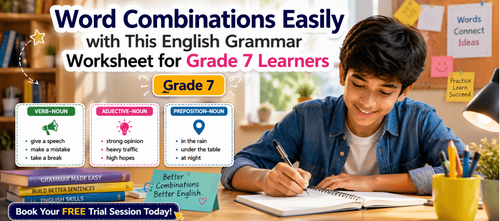

Word Combinations Easily with This English Grammar Worksheet for Grade 7 Learners
Learning word combinations is an important part of improving English grammar skills. This Grade 7 English grammar worksheet on Word Combinations helps students understand how words naturally fit together in sentences. By practicing commonly used combinations such as verb-noun, adjective-noun, and preposition-noun pairs, students can improve sentence formation, writing clarity, and speaking confidence.
This worksheet includes engaging and fun exercises such as underlining word combinations, sorting exercises, rewriting sentences, fill in the blanks, sentence formation, and paragraph writing. These activities help Grade 7 learners become more comfortable using natural English expressions in everyday communication and academic writing.
Download these English grammar worksheets and practice regularly to strengthen your language skills and build a strong foundation. You can also book a free trial to get expert guidance and improve your reading, writing, and comprehension abilities. The worksheets are designed in a simple and structured way to help K–8 students learn grammar concepts easily and use them confidently in everyday communication.
What Is the Topic?
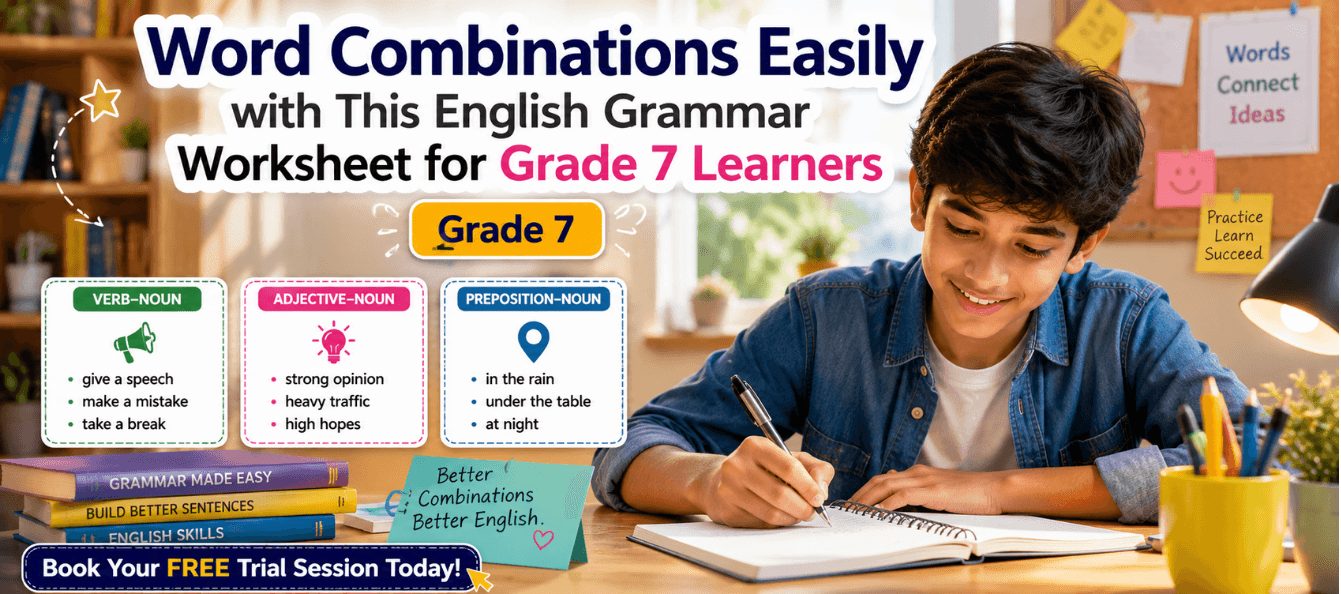
This English grammar worksheet for Grade 7 focuses on Word Combinations. Word combinations are groups of words that naturally go together in sentences. The worksheet mainly includes three types of combinations:
1. Verb-Noun combinations
2. Adjective-Noun combinations
3. Preposition-Noun combinations
Students learn how to identify these combinations, use them correctly, rewrite incorrect combinations, and complete sentences using natural expressions. The worksheet also gives students practice in paragraph writing using suitable word combinations.
The activities encourage learners to observe sentence patterns carefully and improve sentence fluency through repeated usage.
What’s in This Worksheet?
1. Underline the Word Combinations activity where students identify combinations and label their type.
2. Sorting Exercise where students classify word combinations into categories such as Verb–Noun, Adjective–Noun, and Preposition–Noun.
3. Fill in the Blanks activity to practice natural word combinations in sentences.
4. Rewrite the Sentences section where students correct incorrect word combinations.
5. Sentence Formation activities that combine phrases into complete natural sentences.
6. Paragraph Writing task using different types of word combinations.
7. Grammar practice focused on sentence building and correct usage of combinations.
8. Exercises arranged in a structured order for easy understanding and revision.
9. Practice that supports classroom learning, grammar revision, and exam preparation.
Definitions, Examples, Techniques, and Tips
Definitions
Verb-Noun combinations include a verb followed by a noun.
Examples from the worksheet:
made a mistake
take a seat
gave a speech
Adjective-Noun combinations include an adjective followed by a noun.
Examples from the worksheet:
strong opinion
heavy traffic
high hopes
growing concern
great courage
Preposition-Noun combinations include a preposition connected with a noun.
Examples from the worksheet:
under the table
Examples
The worksheet gives several sentence examples using word combinations:
She made a mistake in the report.
He has a strong opinion about the movie.
Please take a seat.
He gave a speech at the event.
There is a growing concern about pollution.
The cat was hiding under the table.
Techniques
1. Read the complete sentence carefully before choosing the word combination.
2. Observe how words naturally fit together.
3. Practice sorting combinations into categories.
4. Rewrite incorrect combinations correctly.
5. Use combinations while forming complete sentences and paragraphs.
Quick Learning Tips
1. Practice common combinations regularly.
2. Read sentences aloud to understand natural usage.
3. Learn combinations as groups instead of separate words.
4. Pay attention to repeated combinations in exercises.
5. Use correct combinations while speaking and writing.
Why Is It Important to Learn This?
Learning word combinations is important because it helps students form natural and meaningful sentences. Correct combinations improve writing clarity and speaking confidence. Students can express ideas more clearly when they use suitable combinations such as make a mistake, pay attention, and heavy traffic.
This topic also helps students avoid incorrect combinations while writing or speaking. Repeated practice improves grammar accuracy and sentence structure. Understanding word combinations also supports better paragraph writing and classroom communication.
For Grade 7 learners, practicing these combinations regularly builds a stronger foundation in English grammar and sentence formation.
Where Will This Knowledge Help You?
Students can use this knowledge in many practical situations:
1. School grammar exercises and tests
2. Paragraph writing and sentence writing
3. Class participation and speaking activities
4. Everyday English communication
5. Reading comprehension activities
6. Writing assignments and homework
7. Correcting sentence errors
8. Improving vocabulary and fluency
How to Use This Worksheet?
1. Read each question carefully before answering.
2. Attempt every activity independently first.
3. Underline or identify the correct word combinations properly.
4. Follow the exact order of questions while solving.
5. Compare answers carefully with the solutions.
6. Review incorrect answers and understand the corrections.
7. Practice the combinations again through sentence writing.
8. Complete the paragraph writing task using different combinations.
9. The solutions follow the exact worksheet order, so students should compare answers carefully.
10. Practice regularly to improve sentence formation and grammar accuracy.
Important Tips and Tricks
1. Do not mix incorrect word combinations such as “did a mistake” or “took a speech.”
2. Read combinations naturally to understand which words fit correctly.
3. Pay attention to verbs used with nouns in the worksheet.
4. Learn common combinations through repeated practice.
5. While rewriting sentences, focus on correcting only the incorrect combination.
6. In fill in the blanks exercises, read the complete sentence before choosing the answer.
7. Use proper punctuation while rewriting complete sentences.
8. For paragraph writing, include all required types of combinations carefully.
9. Examiners expect correct sentence structure and natural combinations.
10. Practice sentence formation activities to improve fluency and grammar accuracy.
Complete Answer Key
Exercise 1
Underline the word combination and label its type (verb-noun, adjective-noun, preposition-noun).
1. She __made a mistake__ in the report. – Verb-Noun
2. He has a __strong opinion__ about the movie. – Adjective-Noun
3. We reached a __decision__ after much thought. – Verb-Noun
4. Please __take a seat__. – Verb-Noun
5. They have __heavy traffic__ every morning. – Adjective-Noun
6. He __gave a speech__ at the event. – Verb-Noun
7. She has __high hopes__ for the exam. – Adjective-Noun
8. There is a __growing concern__ about pollution. – Adjective-Noun
9. He showed __great courage__. – Adjective-Noun
10. The cat was hiding __under the table__. – Preposition-Noun
Exercise 2
Sort the words combinations from the box into the categories given below.
VERB–NOUN
make a choice
take a break
pay attention
give a speech
ADJECTIVE–NOUN
strong tea
heavy traffic
bright idea
PREPOSITION–NOUN
in time
at night
on fire
Exercise 3
Fill in the blank with the most natural word combination.
1. Please take a seat.
2. She made a big mistake.
3. We reached a decision quickly.
4. He gave a speech at the assembly.
5. You must pay attention to the instructions.
6. She has a strong accent.
7. We are running out of time.
8. He caught a cold in the rain.
9. There was heavy traffic this morning.
10. Please make an effort to improve.
Exercise 4
Read each sentence, spot the word combination error, and rewrite it correctly.
1. She made a mistake in the test.
2. He made a decision quickly.
3. They took a nap after lunch.
4. She took a bath and felt refreshed.
5. We made a journey through the forest.
6. Please do your homework now.
7. He gave a speech during assembly.
8. I gave help to my friend.
9. She made an effort to finish early.
10. They paid a visit to the museum.
Exercise 5
Combine the phrases using the most natural word combination.
1. She gave a speech at the event.
2. He made a mistake in the report.
3. I took a break after lunch.
4. They had heavy traffic in the morning.
5. He paid attention during class.
6. She has a strong opinion about the topic.
7. We caught a cold in winter.
8. They took a quick decision.
9. He gave help to a stranger.
10. I did homework before dinner.
Exercise 6
Write a paragraph using at least three verb-noun, two adjective-noun and one preposition-noun combinations.
Yesterday, our teacher gave a speech during assembly about road safety. I paid attention carefully because it was an important topic. On the way home, we faced heavy traffic near the market. My friend shared a bright idea to avoid the crowded road. Later, I took a break under the tree and completed my homework before dinner.
Practicing word combinations regularly can help students improve grammar, sentence structure, and communication skills. This Grade 7 English grammar worksheet on Word Combinations provides useful practice through engaging activities such as sorting exercises, sentence correction, fill in the blanks, and paragraph writing. By completing these exercises carefully and reviewing the correct combinations, students can become more confident in both writing and speaking English naturally.