
Class 8 Vocabulary Worksheet on Tone and Mood

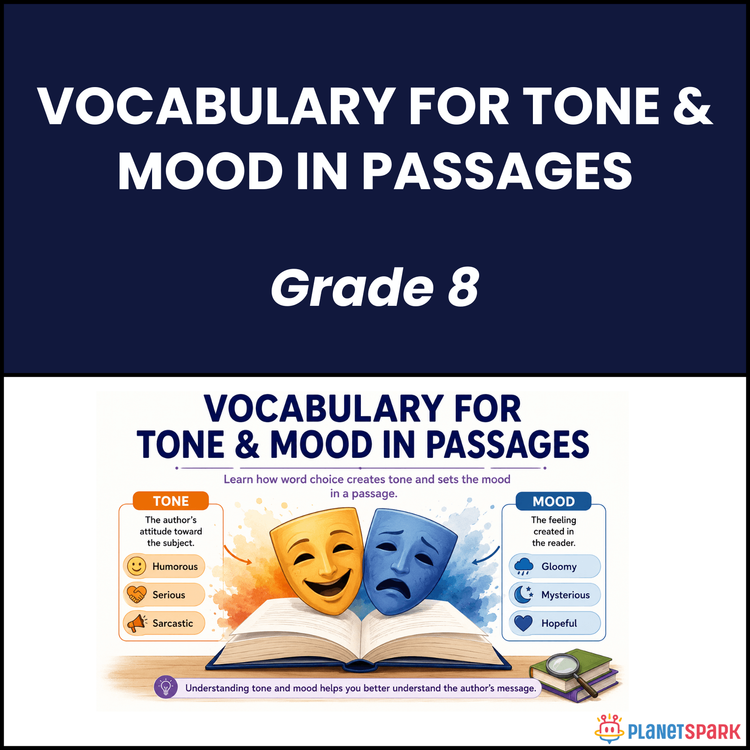
Class 8 Vocabulary Worksheet on Tone and Mood
Emotion Explorer: Tone & Mood Vocabulary Practice for Grade 8
This Grade 8 worksheet helps students strengthen their understanding of tone and mood vocabulary through engaging grammar and vocabulary activities. Learners explore how words shape emotions, attitudes, and atmosphere in passages while improving reading comprehension and expressive writing skills.
Why Tone & Mood Vocabulary Matters in Grammar?
Understanding tone and mood helps students become stronger readers and writers. For Grade 8 learners, this topic is important because:
1. Tone reveals the speaker’s or writer’s attitude toward a topic.
2. Mood helps readers feel emotions created by a passage.
3. Descriptive vocabulary improves comprehension and communication.
4. Context clues help students identify emotional meaning accurately.
5. Strong vocabulary supports better creative and academic writing.
What’s Inside This Worksheet?
This worksheet includes five engaging vocabulary and grammar exercises that improve emotional language understanding and sentence-building skills:
🧠 Exercise 1 – Multiple Choice Questions
Students choose the most suitable vocabulary word to match the tone or mood of each sentence. Example: identifying words like hopeful, eerie, sarcastic, and composed based on context.
✏️ Exercise 2 – Fill in the Blanks
Students complete sentences using vocabulary words from a word bank such as confidently, anxiously, calmly, and cheerfully. This activity builds contextual vocabulary understanding.
📋 Exercise 3 – True or False
Learners evaluate statements related to tone, mood, vocabulary, and context clues. This helps reinforce grammar concepts and reading comprehension skills.
📝 Exercise 4 – Underline the Noun and Circle the Verb
Students identify nouns and verbs in complete sentences while improving grammar awareness and sentence structure recognition.
💡 Exercise 5 – Sentence Writing
Students create original sentences using emotional vocabulary words like joyful, gloomy, hopeful, tense, calm, proud, and anxious. This activity encourages creativity and practical vocabulary usage.
✅ Answer Key (For Parents & Educators)
Exercise 1 – Multiple Choice Questions
1. inspired
2. sarcastic
3. eerie
4. serious
5. hopeful
6. confident
7. gloomy
8. composed
9. annoyed
10. excitedly
Exercise 2 – Fill in the Blanks
1. fearlessly
2. hopefulness
3. confidently
4. gloominess
5. delightedly
6. anxiously
7. cheerfully
8. thankfully
9. calmly
10. restlessly
Exercise 3 – True or False
1. True
2. False
3. True
4. True
5. True
6. True
7. True
8. True
9. True
10. False
Exercise 4 – Read each sentence. Underline the word that shows the tone or mood.
- warmly
- gloomy
- confidently
- calmly
- anxiously
- proudly
- joyful
- tense
- hopefully
- cheerfully
Exercise 5 – Sample Sentence Answers
1. Joyful – The children felt joyful after winning the competition.
2. Gloomy – The sky looked gloomy before the storm.
3. Hopeful – We remained hopeful about the final results.
4. Tense – The classroom felt tense during the surprise test.
5. Calm – The teacher stayed calm during the discussion.
6. Proud – My parents felt proud of my achievement.
7. Anxious – She was anxious before the interview.
8. School Assembly – The students stood quietly during the school assembly.
9. Monsoon Weather – Monsoon weather makes the roads wet and slippery.
10. Exam Feelings – Many students feel nervous before exams.
Build your child’s confidence in vocabulary, comprehension, and expressive writing with engaging English activities designed for Grade 8 success.
🔖Book a free trial!
How does this Grade 8 tone and mood worksheet improve vocabulary skills? This worksheet helps students understand emotional and descriptive vocabulary through MCQs, fill-in-the-blanks, grammar exercises, and sentence writing activities that strengthen comprehension and expression.
Why is learning tone and mood important for Grade 8 students? Tone and mood help students understand an author’s attitude and the emotions created in a passage, improving reading comprehension, creative writing, and communication skills.
What types of activities are included in this vocabulary worksheet? The worksheet includes multiple choice questions, fill-in-the-blanks, true or false, noun and verb identification, and sentence-writing tasks focused on tone and mood vocabulary.
Frequently Asked Questions
Tone shows the author’s attitude, while mood describes the feeling created for the reader in a Class 8 English worksheet.
Tone and mood vocabulary helps Grade 8 students understand emotions, character reactions, and author intent in literature passages.
Students can improve by reading short passages, highlighting emotional words, and practicing with CBSE English comprehension worksheets.