
Class 5 Grammar Worksheet on Future Forms Usage

Class 5 Grammar Worksheet on Future Forms Usage
Future Ready Grammar: Mastering Will vs Going To for Class 5
This Grade 5 worksheet focuses on helping students understand and correctly use future forms—*will* and *going to*—in everyday English. Designed with engaging and structured activities, this worksheet strengthens grammar accuracy while building confidence in expressing future plans, decisions, and predictions.
Why Future Forms Matter in Grammar?
Understanding future forms is essential for clear communication. For Grade 5 learners, this topic is important because:
1. It helps students express future plans, intentions, and spontaneous decisions.
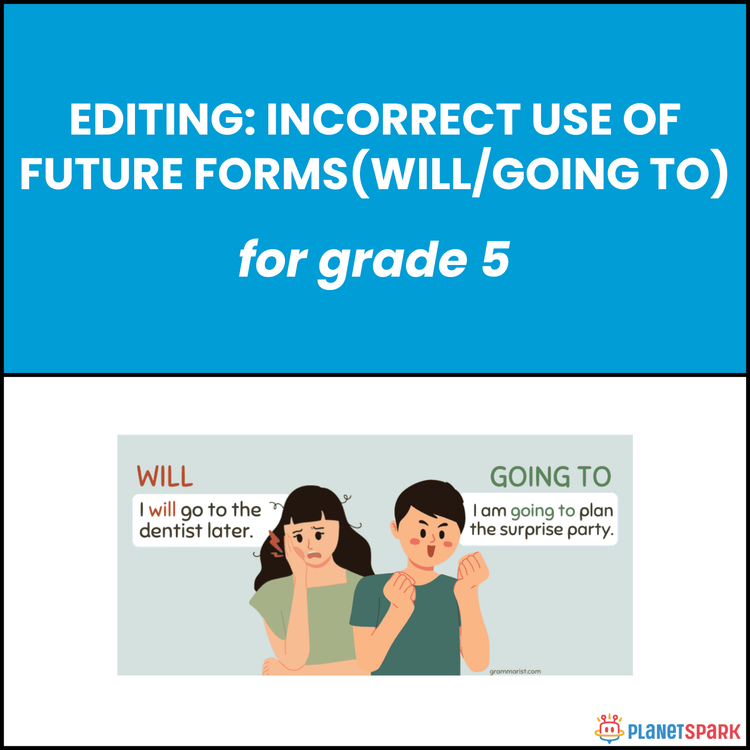
2. It teaches the difference between planned actions (*going to*) and instant decisions (*will*).
3. It improves sentence construction and grammatical accuracy.
4. It builds a strong foundation for both spoken and written English.
What’s Inside This Worksheet?
This worksheet includes five grammar-rich activities that build fluency with future forms:
Exercise 1 – Choose the Correct Future Form
Students select the correct sentence using *will* or *going to* from two options. This sharpens their ability to identify correct grammar usage.
Exercise 2 – True or False
Students read sentences and decide whether the use of *will/going to* is correct. This develops error detection and editing skills.
Exercise 3 – Fill in the Blanks
Students complete sentences using the correct future form. This reinforces practical usage in real-life contexts.
Exercise 4 – Sentence Rewriting
Students rewrite sentences by changing the future form as instructed (from *will* to *going to* or vice versa), improving flexibility and understanding.
Exercise 5 – Paragraph Writing (Fill in the Blanks)
Students complete a short passage using appropriate future forms. This builds contextual grammar skills and fluency in longer writing.
Answer Key (For Parents & Educators)
Exercise 1 – Choose a) or b)
1. b) Roja will go to school tomorrow.
2. a) Ravi is going to play cricket.
3. a) Meera will buy fruits later.
4. b) They are going to watch a movie.
5. a) Asha will visit her aunt soon.
6. b) Raj is going to study tonight.
7. a) We will go to market later.
8. a) She will finish her work soon.
9. b) They are going to clean room.
10. b) I will call you in evening.
Exercise 2 – True or False
1. True
2. False
3. False
4. True
5. True
6. True
7. False
8. True
9. False
10. False
Exercise 3 – Fill in the Blanks
1. will
2. will
3. going to
4. going to
5. will
6. going to
7. will
8. going to
9. will
10. will
Exercise 4 – Sentence Rewriting
1. Dev is going to attend the school fair tomorrow.
2. Imran will write an email now.
3. Sonal will bake a cake later.
4. Lata is going to pack her bag in the evening.
5. Farhan will complete the task soon.
6. Tara and Ijas are going to visit the library after class.
7. Isha is going to call her friend at night.
8. Rohan is going to join the music class soon.
9. Naveen and Suma will paint a picture today.
10. Kavita will dance on stage now.
Exercise 5 – Paragraph Completion
1. will
2. will
3. going to
4. will
5. going to
6. going to
7. will
8. going to
9. will
10. going to
Help your child confidently express future plans and ideas with accuracy and ease through structured grammar practice.
Book a free trial!
Frequently Asked Questions
Future forms include structures like will and going to used to talk about actions that will happen later.
They often do not understand the difference between planned actions and spontaneous decisions.
By using real-life examples and sentence writing exercises in grammar worksheets.