
Class 5 Worksheet on Colon and Semicolon Practice

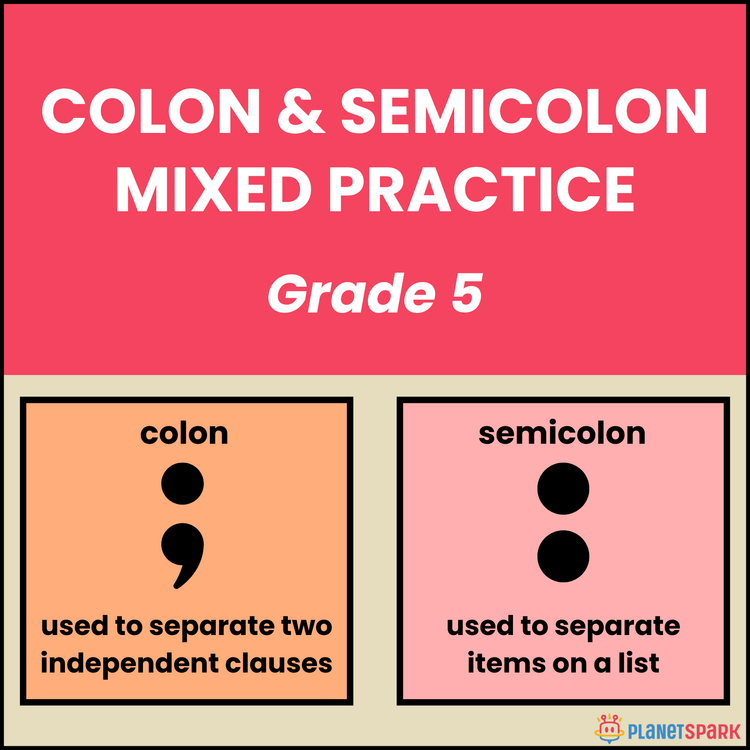
Class 5 Worksheet on Colon and Semicolon Practice
Colon & Semicolon Mixed Practice for Class 5
This Grade 5 worksheet focuses on the critical punctuation skills of colons and semicolons. Designed to strengthen foundational grammar, this worksheet provides engaging exercises to help students master the proper use of these punctuation marks in various sentence structures.
Students will practice identifying and correctly applying colons and semicolons through multiple-choice questions, true/false statements, sentence rewriting, and paragraph completion. These activities are ideal for boosting confidence in punctuation use and ensuring grammatical precision in writing.
Why Colons & Semicolons Matter in Grammar?
For Grade 5 learners, understanding when to use colons and semicolons is crucial because:
1. Colons are used to introduce lists, quotations, and explanations.
2. Semicolons help separate related independent clauses or items in complex lists.
3. These punctuation marks improve clarity, precision, and readability in writing.
4. Proper punctuation is essential for clear and effective communication in both academic and real-life scenarios.
What’s Inside This Worksheet?
This worksheet includes five grammar-rich activities that build fluency with colons and semicolons:
Exercise 1 – Multiple-Choice Questions:
Students select the sentence that uses a colon (:) or semicolon (;) correctly. Example:
“The lunch box had food ___ rice and curry.”
a) The lunch box had food; rice and curry.
b) The lunch box had food: rice and curry.
c) The lunch box had food, rice and curry.
Exercise 2 – True or False Statements:
Students assess statements related to colon and semicolon usage. Example:
“A semicolon is used to replace every comma.” (True or False)
Exercise 3 – Adding Colon and Semicolon:
Students add colons or semicolons in the correct places to improve sentence structure. Example:
“We bought snacks ___ chips, juice, and biscuits.”
Exercise 4 – Sentence Rewriting (Colons and Semicolons):
Students rewrite sentences by inserting colons or semicolons in the appropriate places. Example:
“I wake up early ___ I board the bus.”
Exercise 5 – Paragraph Completion:
Students read a paragraph and insert colons and semicolons where needed. Example:
“The setup is always the same ___ we place the wooden board on the table.”
These activities help students reinforce their understanding of punctuation usage in everyday writing.
Answer Key (For Parents & Educators)
Exercise 1 – Multiple-Choice Questions
1. b) The lunch box had food: rice and curry.
2. a) The assembly ended; students went back.
3. c) She had one dream: to win the race.
4. a) It was very windy; we stayed indoors.
5. b) The market sold items: fruits, vegetables, and snacks.
6. c) He felt tired; he rested.
7. c) The match was exciting; everyone cheered.
8. a) She carried several things: a bag, a bottle, and an umbrella.
9. b) The road was crowded; we waited.
10. c) He enjoys two hobbies: painting and reading.
Exercise 2 – True or False Statements
1. False
2. True
3. False
4. True
5. False
6. True
7. False
8. False
9. True
10. True
Exercise 3 – Adding Colon and Semicolon
1. The bell rang; students moved out.
2. Pack your school bag: books, lunch, and bottle.
3. The sky turned dark; it started raining.
4. We bought snacks: chips, juice, and biscuits.
5. The game ended; players shook hands.
6. The reason is clear: he forgot his homework.
7. It was very hot; we drank water.
8. Tara had one aim: to become captain.
9. The class finished; children went outside.
10. He possessed one great ambition: to lead the team.
Exercise 4 – Sentence Rewriting
1. I wake up early; I board the bus.
2. I arrange my bag: books and notebook.
3. I complete homework; I watch TV.
4. I help my parents; I clean the table.
5. I organize my desk: pencils and paper.
6. I drink water; I feel energetic.
7. I tidy my shelf; it looks neat.
8. The reason for the delay was clear: a flat tire.
9. I play cricket; I enjoy the game.
10. I sleep early; I wake refreshed.
Exercise 5 – Paragraph Completion (Sample Answers)
Playing carrom with my sister is a daily tradition; it is the highlight of our afternoon. The setup is always the same: we place the wooden board on the square table and grab the striker. My sister has a very specific goal: to win the Queen every single game. I focus on a different strategy; I try to clear all my white pieces first. We keep our gear in a small wooden box: the striker, the coins, and the fine powder. First, I sprinkle the powder across the surface: the coins slide much faster now. My sister takes the first break; the coins scatter to every corner of the board. The room is usually quiet; however, the clicking sound of the wood is constant. She makes a brilliant shot: a double-rebound into the bottom left pocket. I respond with a direct hit; my white coin disappears instantly.
Help your child master colons and semicolons today with a Free 1:1 Grammar Skills Trial Class at PlanetSpark.
Frequently Asked Questions
A colon is used to introduce a list, explanation, or quote after a complete sentence.
A semicolon connects two related independent clauses, while a colon introduces information.
Students often use colons incorrectly after incomplete sentences instead of using a semicolon.