
Class 4 Basic Suffixes -ful -less Grammar Worksheet

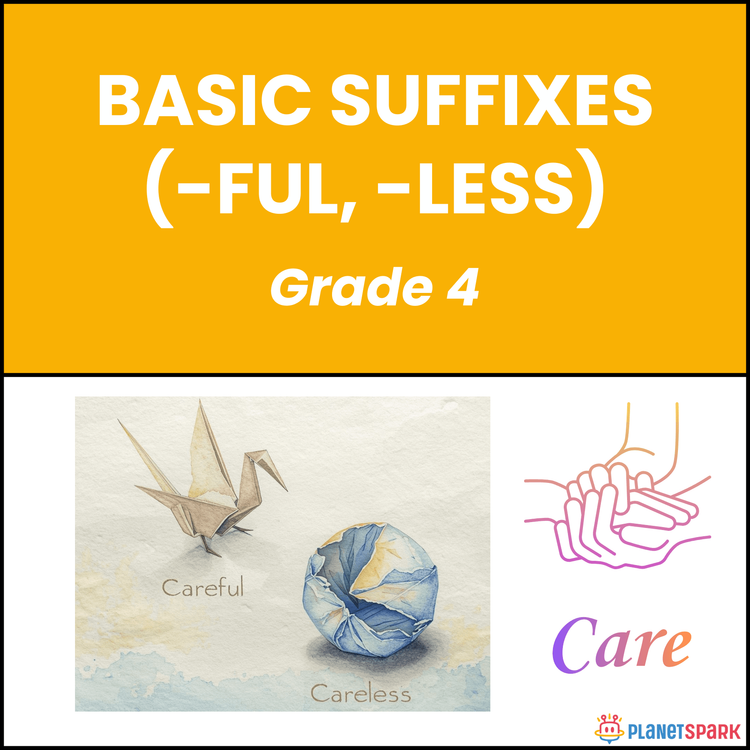
Class 4 Basic Suffixes -ful -less Grammar Worksheet
Add to the End: Basic Suffixes (-ful, -less) for Class 4
This Grade 4 worksheet introduces students to the power of suffixes — small word parts added to the end of a base word to create a new word with a different meaning or function. Focusing on two of the most commonly used suffixes in English, -ful (meaning full of or having) and -less (meaning without), this resource helps Class 4 learners build new words, understand how suffixes change word meaning, and use suffixed words correctly in sentences through a variety of engaging activities.
Why Do Basic Suffixes Matter in Grammar?
Learning suffixes is a key word-building skill for Grade 4 students. Understanding -ful and -less is important because:
1. It teaches students how adding letters to the end of a word creates a brand new word with a related but different meaning.
2. It rapidly expands vocabulary by building on words students already know.
3. It helps students understand parts of speech — how a noun like care becomes an adjective (careful) or how a noun like kind becomes another noun (kindness).
4. It strengthens reading comprehension and spelling by helping learners recognise and apply common word patterns.
What's Inside This Worksheet?
This worksheet includes five well-structured activities that build suffix recognition and correct usage across a variety of sentence contexts:
Exercise 1 – Match the Following
Students match each base word on the left to its correctly suffixed new word from the pool on the right. Base words include care, help, beauty, play, teach, quick, hope, kind, use, and child, matched to words like careful, helpful, beautiful, playful, teacher, quickly, hopeful, kindness, useful, and childhood. This activity builds immediate recognition of how suffixes transform base words into new forms.
Exercise 2 – Sort the Words
Students sort given word pairs into two groups — Has Suffix (the second word is formed by adding a suffix to the first) and No Suffix (the two words are unrelated). Pairs like help/helpful, use/useful, beauty/beautiful, child/childhood, hope/hopeful, kind/kindness, care/careful, play/playful, quick/quickly, and teach/teacher go into the Has Suffix group, while pairs like desk/chair, rain/monsoon, leaf/tree, road/bridge, and shop/market go into the No Suffix group.
Exercise 3 – Fill in the Blanks
Students select the correct suffixed word from a given pair to complete each sentence. With 10 contextual sentences featuring familiar Indian names like Rahul, Neha, Diya, Kartik, and Aarav, this exercise makes learning practical and relatable for Class 4 learners across different subject contexts.
Exercise 4 – Multiple Choice Questions
Students choose the correctly suffixed word from four options to answer each question. With 10 questions across two pages, this activity builds both word-building knowledge and exam-style confidence in using suffixes accurately in context.
Exercise 5 – Sentence Rewriting
Students rewrite 10 given sentences by replacing the incorrect base word with its correctly suffixed form. This error-correction task challenges learners to apply their understanding of suffixes in a meaningful writing context.
Answer Key (For Parents & Educators)
Exercise 1 – Match the Following
care → careful
help → helpful
beauty → beautiful
play → playful
teach → teacher
quick → quickly
hope → hopeful
kind → kindness
use → useful
child → childhood
Exercise 2 – Sort the Words
Has Suffix:
help/helpful
use/useful
beauty/beautiful
child/childhood
hope/hopeful
kind/kindness
care/careful
play/playful
quick/quickly
teach/teacher
No Suffix:
desk/chair
rain/monsoon
leaf/tree
road/bridge
shop/market
Exercise 3 – Fill in the Blanks
1. helpful (helpful / help)
2. hopeful (hopeful / hope)
3. useful (useful / use)
4. careful (careful / care)
5. playful (playful / play)
6. teacher (teacher / teach)
7. quickly (quickly / quick)
8. beautiful (beautiful / beauty)
9. childhood (childhood / child)
10. kindness (kindness / kind)
Exercise 4 – Multiple Choice Questions
1. d) teacher
2. c) kindness
3. c) quickly
4. a) careful
5. d) playful
6. d) helpful
7. a) useful
8. b) beautiful
9. b) childhood
10. c) hopeful
Exercise 5 – Sentence Rewriting
1. My teacher explained the lesson well.
2. She showed kindness in every act.
3. Diya finished the race quickly today.
4. Be careful when you cross the road.
5. Aarav is playful during study time.
6. This clue was helpful for my quiz.
7. The torch is useful in the dark.
8. The view is beautiful after monsoon.
9. Kartik remembers his childhood days well.
10. Neha is hopeful about the match.
Help your child master the art of building words with a Free 1:1 English Grammar Trial Class at PlanetSpark — because knowing how to add the right ending to a word is the key to richer writing and stronger communication!
Frequently Asked Questions
Suffixes like -ful and -less change the meaning of words by adding a sense of being full of or without something (e.g., joyful, helpless).
Learning suffixes helps students expand their vocabulary and use descriptive words more effectively in writing.
Encourage children to identify words with -ful and -less, then use them in their own writing.