
Class 1 Writing Worksheet on Picture Captions

Class 1 Writing Worksheet on Picture Captions
See, Say, and Write: Picture Captions and Short Instructions for Grade 1
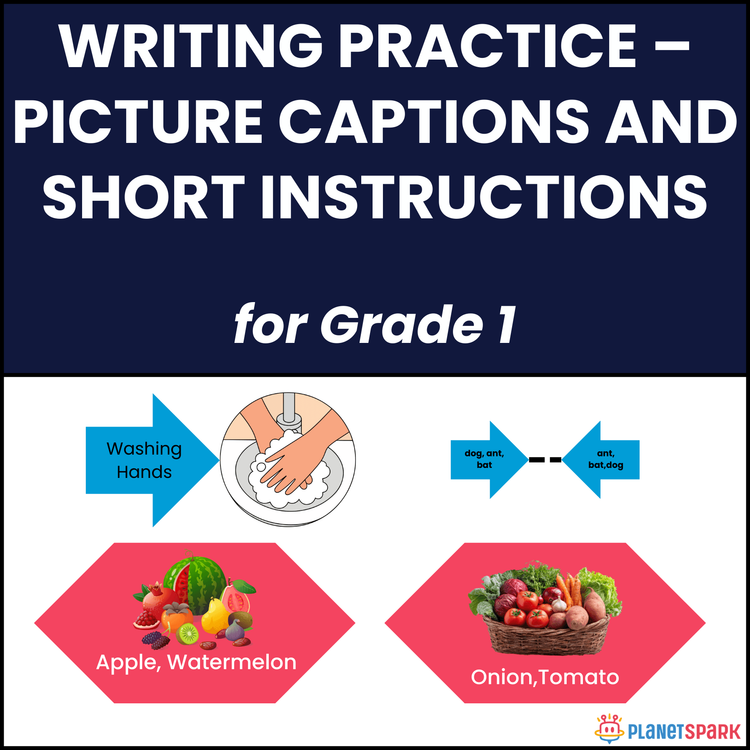
This Grade 1 writing worksheet helps young learners describe pictures clearly and follow simple instructions using short, meaningful sentences. The topic focuses on observation-based writing and functional language, enabling children to connect what they see with what they write.
Designed for early writers, this worksheet builds sentence clarity, correct grammar usage, and logical thinking in an age-appropriate way. Through picture captions, command sentences, alphabetical ordering, word sorting, and short story writing, students practise essential writing skills needed for everyday communication.
Why Picture Captions and Instructions Matter in Grammar?
Learning to write captions and instructions helps Grade 1 learners express ideas clearly and purposefully.
1. Picture captions improve observation and descriptive writing skills.
2. Command sentences teach action-based and functional language.
3. Alphabetical order builds word awareness and organisation.
4. Short stories encourage creativity and sentence flow.
What’s Inside This Worksheet?
This worksheet includes five practical and engaging writing activities:
🖼️ Exercise 1 – Writing Picture Captions
Students write one clear, complete sentence describing what is happening in each picture, using correct grammar and punctuation.
👉 Exercise 2 – Writing Short Instructions
Learners write one command sentence for each picture, beginning with an action word to tell what the person should do.
🔤 Exercise 3 – Alphabetical Order
Students rewrite groups of words in alphabetical order by comparing the first letter of each word.
🗂️ Exercise 4 – Sorting Words Under Headings
Learners sort given words correctly under headings such as animals, birds, fruits, and vegetables.
📘 Exercise 5 – Writing 2–3 Sentence Mini Stories
Students write short mini stories on familiar topics like a sunny day, a pet dog, school, ice cream, best friends, and birthday parties.
ANSWER KEY
Exercise 1 – Picture Captions
(Answers may vary)
1. Two children are playing football in the park.
2. A girl is reading a book happily.
3. A boy is riding a bicycle.
Exercise 2 – Short Instructions
(Answers may vary)
1. Tie your shoelaces properly.
2. Wash your hands neatly.
3. Close the door carefully.
Exercise 3 – Alphabetical Order
(Answers grouped)
1. ant, bat, dog
2. hat, pen, sun
3. blue, green, red
4. apple, ball, cat
5. apple, bread, milk
6. cat, lion, tiger
7. book, pen, pencil
8. cake, donut, ice
9. bear, elephant, frog
10. banana, mango, orange
Exercise 4 – Sorting Words
(Answers grouped)
1. Animals – cat, dog | Fruits – apple, mango
2. Birds – parrot, crow | Animals – cow, goat
3. Fruits – apple, banana | Vegetables – carrot, potato
4. Animals – lion, tiger | Birds – hen, sparrow
5. Fruits – mango, grapes | Vegetables – onion, cabbage
6. Animals – rabbit, deer | Fruits – apple, orange
7. Birds – pigeon, eagle | Animals – cat, dog
Exercise 5 – Mini Stories
(Answers may vary)
1. About a sunny day
It is a bright sunny day. I play outside with my friends.
2. About going to school
I go to school every day. I like my teacher and friends.
3. About a pet dog
I have a pet dog. It is playful and friendly.
4. About eating ice cream
I eat ice cream in summer. It tastes sweet and cold.
5. About my best friend
My best friend is kind. We play together every day.
6. About a birthday party
I had a birthday party. We ate cake and had fun.
This worksheet is ideal for classroom writing practice, homework assignments, or guided learning at home, helping children become confident and independent writers.
Frequently Asked Questions
Picture caption writing helps early learners convert visual understanding into simple sentences, strengthening sentence formation and observation skills in Class 1 English worksheets
By linking images with words, children learn to choose correct nouns and action words, making it easier to write clear and meaningful sentences independently
Parents should encourage children to say the sentence aloud, use simple present tense, and describe only what they see to avoid confusion in early grammar learning