
Class 1 Reading Passage on The Farmer and His Sons

Class 1 Reading Passage on The Farmer and His Sons
Stronger Together: Reading Passage “The Farmer and His Sons” for Class 1
This Grade 1 reading comprehension worksheet retells the classic moral story The Farmer and His Sons. It teaches children the power of unity and teamwork through a short, easy to understand passage that builds comprehension, moral reasoning, and reading fluency.
Why Reading Comprehension Matters in Early Learning?
1. It strengthens understanding of sequence and cause-effect in stories.
2. It improves vocabulary, reasoning, and attention span.
3. It helps children learn moral lessons in a relatable way.
4. It develops confidence in reading and independent thinking.
What’s Inside This Worksheet?
📖 Reading Passage – The Farmer and His Sons
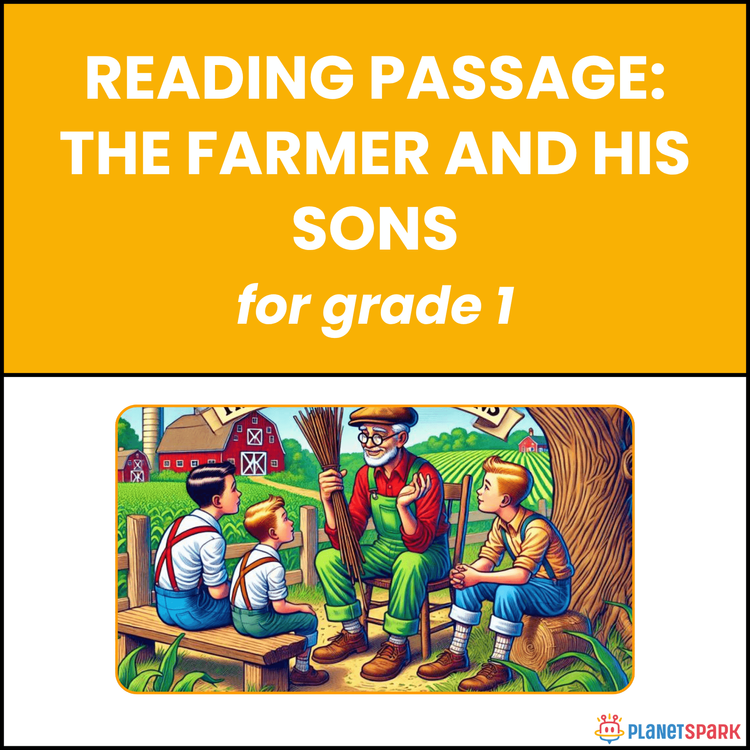
A story about a wise farmer who teaches his sons that they are stronger when united. He gives them sticks to break, one at a time, then tied together, showing that together they cannot be broken.
🧠 Objective Questions – Multiple Choice
Students answer factual questions about what the farmer did, what happened with the bundle, and what lesson the sons learned.
✏️ Subjective Questions – Short Answers
Learners write short, thoughtful responses about unity, teamwork, and helping others.
✅ Answer Key (For Parents & Educators)
Objective Questions:
1. b) Sticks
2. a) It was easy
3. b) Hard to break
4. c) Unity is strength
5. b) More than two sons
6. d) Working together makes us strong
Subjective Questions:
7. He tied all the sticks together.
8. Working together makes things easier.
9. They could not break it because it was a bundle.
10. I would help my friends in a group task.
Help your child learn the importance of teamwork and unity through this meaningful story and interactive comprehension practice!
🔖Book a free trial!
Frequently Asked Questions
The story emphasizes the value of hard work and family cooperation.
Show that the treasure represents knowledge and effort, not just material wealth.
It encourages reading comprehension and introduces cause-effect relationships in stories.