
Class 1 Writing Worksheet on Weather and Feelings

Class 1 Writing Worksheet on Weather and Feelings
Weather Words & Feelings First: Sentence Writing for Grade 1
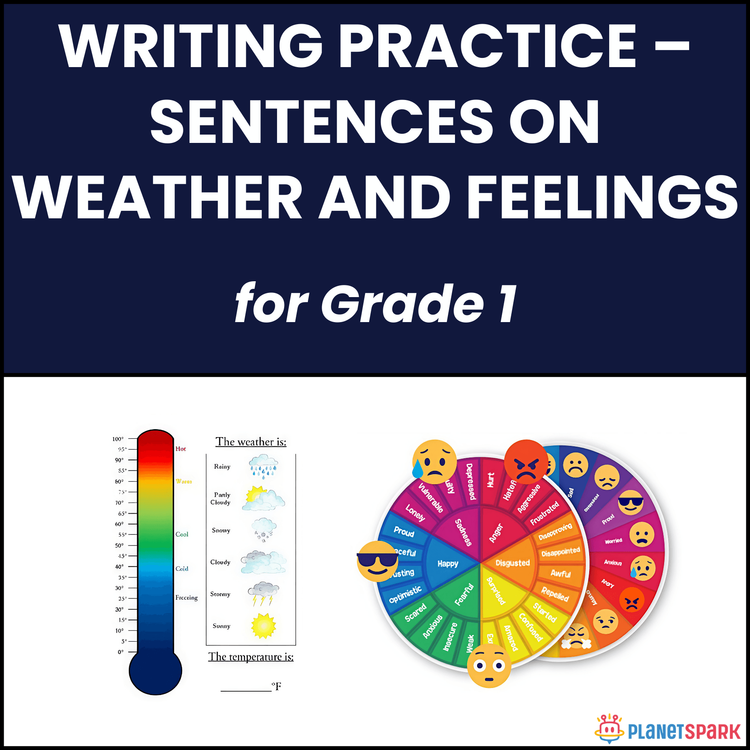
This Grade 1 writing worksheet helps young learners describe different weather conditions and express their feelings through simple, meaningful sentences. The topic connects everyday weather experiences with emotions, allowing children to relate language learning to real life.Designed for early writers, this worksheet strengthens sentence formation, vocabulary development, and emotional expression in an age-appropriate way. Through guided reading, fill-in-the-blank tasks, picture sequencing, and short creative writing prompts, students learn how to observe, think, and write clearly.
Why Weather and Feelings Matter in Grammar?
Understanding weather words and feeling words helps Grade 1 learners build strong connections between language and daily experiences.
1. Weather descriptions improve observation and descriptive skills.
2. Feeling words help children express emotions confidently.
3. Simple sentences build early grammar and punctuation habits.
4. Picture-based writing strengthens sequencing and storytelling skills.
What’s Inside This Worksheet?
This worksheet includes five engaging writing activities designed for early learners:
🌤️ Exercise 1 – Read and Tell the Weather
Students read simple sentences and identify or describe the type of weather shown in each sentence.
😊 Exercise 2 – Describe Your Feelings
Learners complete sentences by writing about situations that make them feel excited, sad, scared, proud, happy, calm, kind, loved, angry, or bored.
🖼️ Exercise 3 – Picture Sequencing (First, Next, Last)
Students write three short sentences for each picture set, describing events in the correct order.
📖 Exercise 4 – Finish the Story Starter
Each prompt begins with “One day I went to…”, and students add one sentence describing how they felt, encouraging personal expression.
📝 Exercise 5 – Write a Picture Title
Learners observe pictures carefully and write a suitable short title for each image, building summarisation skills.
ANSWER KEY
Exercise 1 – Describe the Weather
(Answers grouped – key weather words)
1. sunny, bright
2. cloudy, grey
3. rainy
4. cool, pleasant
5. hot, clear
6. cool
7. foggy
8. pleasant, calm
9. stormy
10. chilly, rainy
Exercise 2 – Describe Your Feelings
(Answers may vary)
1. I am excited when I play with my friends.
2. I am sad when my toy breaks.
3. I am scared when it is very dark.
4. I am proud when I do my work well.
5. I am happy when I get a hug.
6. I feel angry when someone shouts.
7. I feel kind when I help others.
8. I feel loved when my parents hug me.
9. I feel calm when I listen to music.
10. I feel bored when I have nothing to do.
Exercise 3 – Picture Sequencing
(Sample answers)
Set 1
i. First, the boy wakes up from bed.
ii. Next, he brushes his teeth.
iii. Last, he goes to school.
Set 2
i. First, the girl takes out her toys.
ii. Next, the toys are scattered on the floor.
iii. Last, the room is cleaned.
Set 3
i. First, the child packs the school bag.
ii. Next, the child waits for the bus.
iii. Last, the child reaches school.
Exercise 4 – Finish the Story Starter
(Answers may vary)
1. One day I went to the zoo and felt excited.
2. One day I went to the beach and felt happy.
3. One day I went to school and felt proud.
4. One day I went to the market and felt curious.
5. One day I went to the temple and felt calm.
6. One day I went to the library and felt peaceful.
7. One day I went to the playground and felt excited.
8. One day I went to the garden and felt relaxed.
9. One day I went to the mall and felt joyful.
10. One day I went to my grandparents’ house and felt loved.
Exercise 5 – Picture Titles
(Answers may vary)
1. A Fun Day at the Beach
2. Shopping at the Kids Store
3. A Busy Day at the Mall
This worksheet is ideal for classroom practice, homework, or guided writing sessions at home, helping children express thoughts and emotions with confidence.
Frequently Asked Questions
Children learn how to form simple sentences using describing words, practise subject–verb structure, and connect emotions or weather words meaningfully in early English writing
Many early learners can name feelings or weather types but need structured guidance to turn those ideas into complete sentences in Class 1 grammar worksheets
It supports CBSE English outcomes by improving sentence construction, vocabulary use, and expressive writing through familiar real-life contexts