
Class 7 Grammar Worksheet on Inference Words

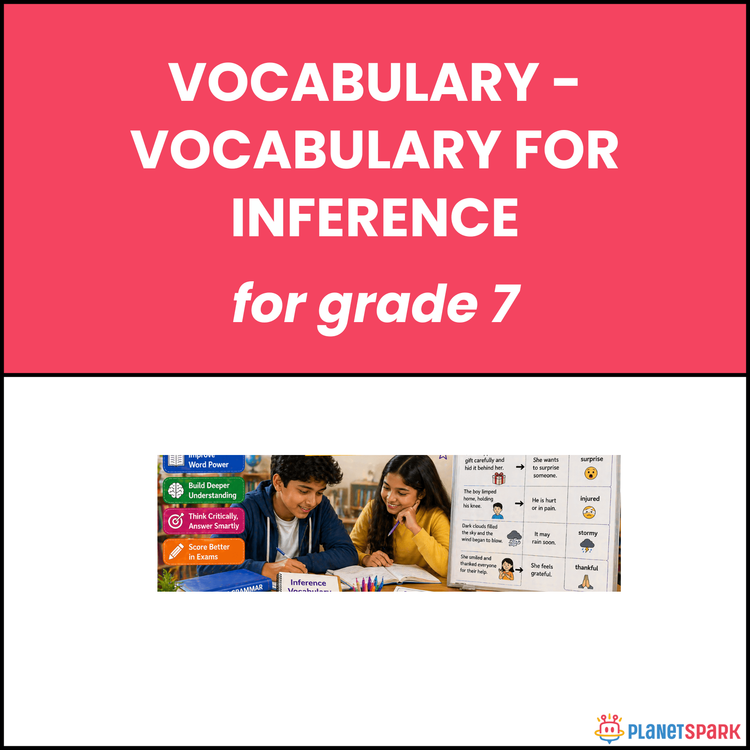
Class 7 Grammar Worksheet on Inference Words
Reading Between the Lines: Vocabulary for Inference for Class 7
This Grade 7 worksheet helps students master the art of inference by building a robust vocabulary of "clue" and "reasoning" words. Through five engaging activities—including true/false statements, word sorting, context-based blanks, multiple-choice questions, and sentence rewriting—learners develop the ability to draw logical conclusions from provided evidence. This resource is designed to move students beyond literal comprehension toward advanced analytical thinking.
Why Inference Matters in Grammar?
Inference is a critical pillar of reading comprehension and effective communication. For Grade 7 learners, this topic is vital because:
1. It helps students decode hidden meanings in complex texts.
2. It encourages the use of evidence-based reasoning in writing.
3. It introduces academic vocabulary like 'ample', 'scant', 'deduce', and 'imply'.
4. It builds critical thinking skills necessary for high school literature and formal debates.
What’s Inside This Worksheet?
This worksheet includes five grammar-rich activities that build fluency with inference vocabulary:
🧠 Exercise 1 – True and False
Students evaluate definitions of key inference terms (e.g., *ample, hesitant, precise*) to confirm their understanding of word meanings.
✏️ Exercise 2 – Sort the Words
Learners categorize word pairs into 'Evidence Words (Clues)' and 'Reasoning Words (Actions)'. This exercise also includes homophones to sharpen spelling accuracy.
📋 Exercise 3 – Fill in the Blanks
Students choose the most appropriate word from a pair to complete contextually rich sentences, ensuring the logical flow of the statement.
📝 Exercise 4 – Multiple Choice Questions
A comprehensive check of vocabulary definitions where students identify synonyms and meanings for words like *vast, dismal, and wary*.
✍️ Exercise 5 – Sentence Rewriting
Students apply their knowledge by rewriting sentences to incorporate precise inference vocabulary, replacing vague or incorrect phrasing with professional academic terms.
✅ Answer Key (For Parents & Educators)
Exercise 1 – True or False
1. True 2. False
3. True 4. False
5. True 6. False
7. True 8. True
9. False 10. False
Exercise 2 – Sort the Words
Evidence Words (Clues) Reasoning Words (Actions)
- Clue / Hint - Infer / Conclude
- Sign / Signal - Deduce / Assume
- scant / few - Evaluate / Judge
- vast / large - Trace / Mark
- swift / fast - hour / our (Homophone)
- sad / gloomy - main / mane (Homophone)
- meat / meet (Homophone) - calm / still
Exercise 3 – Fill in the Blanks
1. reluctant 2. analyse
3. implies 4. hesitant
5. indicator 6. ample
7. precise 8. dismal
9. scant 10. wary
Exercise 4 – Multiple Choice Questions
1. b) tired 2. c) large
3. b) unsure 4. d) fast
5. a) enough 6. b) exact
7. c) gloomy 8. b) little
9. b) cautious 10. a) old
Exercise 5 – Sentence Rewriting (Sample Corrections)
1. I inferred the ending based on the facts.
2. Riya will draft a letter now.
3. The author used precise words to make the meaning clear.
4. The boat will sail on the sea.
5. I can hear the bell ring here.
6. The lawyer presented strong evidence to prove the case.
7. The knight was courageous in Delhi.
8. The weather is pleasant now.
9. Dismal music is used to recap a scary event in the movie.
10. Use the provided clues to remember what will happen next.
Help your child unlock advanced reading skills today with a Free 1:1 Communication Skills Trial Class at PlanetSpark.
Frequently Asked Questions
Inference words help children guess from clues.
It builds reasoning and reading comprehension skills.
Read passages and identify hidden clues carefully.