
Class 7 Worksheet on Avoiding Run On Sentences

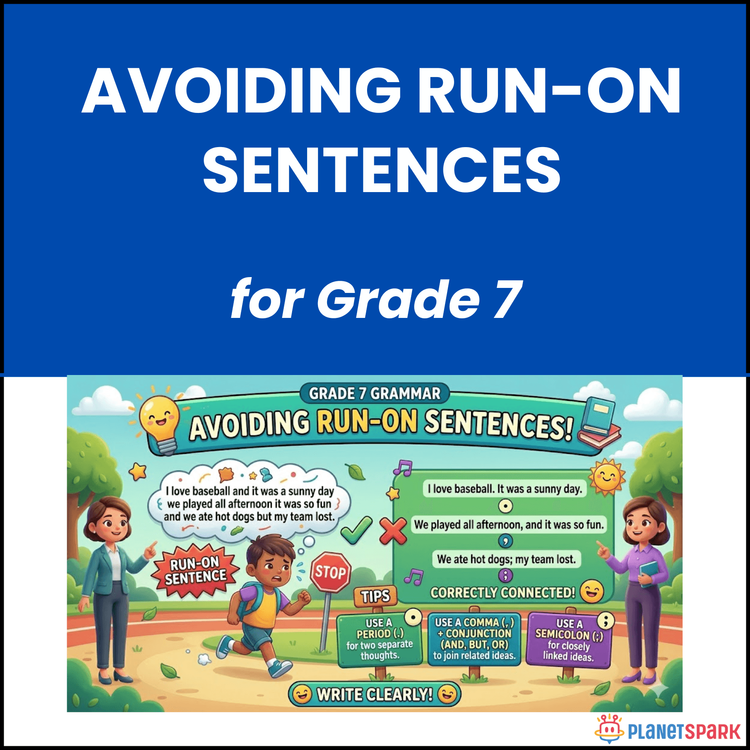
Class 7 Worksheet on Avoiding Run On Sentences
Fix the Flow: Avoiding Run-on Sentences for Class 7
This Grade 7 worksheet on Avoiding Run-on Sentences helps students learn how to connect ideas clearly using proper punctuation, conjunctions, and sentence boundaries. By identifying incorrectly joined clauses and rewriting confusing sentences, learners strengthen sentence clarity, grammar accuracy, and writing fluency.
Why Avoiding Run-on Sentences Matters in Grammar?
Run-on sentences can confuse readers and weaken communication. Learning how to separate or correctly connect ideas is an important writing skill for Grade 7 students because:
1. It improves sentence clarity and readability.
2. It helps students organize ideas logically.
3. It teaches correct use of conjunctions and punctuation.
4. It strengthens academic, creative, and everyday writing skills.
What’s Inside This Worksheet?
Students move from identifying run-on errors to correcting and rewriting complete sentences through structured grammar practice.
🧠 Exercise 1 – Identify Connectors and Errors
Students underline connectors and circle places where connectors are missing or incorrectly used in sentences.
✏️ Exercise 2 – Multiple Choice Questions
Students choose the sentence that correctly fixes each run-on sentence using appropriate connectors and punctuation.
📋 Exercise 3 – Sentence Rewriting
Students rewrite run-on sentences using conjunctions, semicolons, and correct sentence separation methods.
📝 Exercise 4 – Fill in the Blanks
Students complete a grammar passage using words related to sentence structure, punctuation, and readability.
✍️ Exercise 5 – Paragraph Writing
Students write a paragraph on “Fixing Sentence Errors” in 5–7 sentences. They must include at least two correctly joined sentences using conjunctions and one sentence corrected using punctuation such as a semicolon or full stop.
A strong response will include sentences such as “Riya studied, and she felt confident.” and “The bus arrived late; we waited outside.”
✅ Answer Key (For Parents & Educators)
Exercise 1 – Connectors and Errors
1. and
2. Missing connector between “studied” and “she felt confident”
3. because
4. Incorrect connector use after “notes”
5. Correct semicolon usage
6. Missing connector between “fast” and “he won the race”
7. although
8. Incorrect connector use after “late”
9. and
10. although
Exercise 2 – Multiple Choice Questions
1. a) Riya studied, and she felt confident.
2. c) Ravi played cricket, and he enjoyed it.
3. a) Meera wrote notes, but she missed details.
4. c) Asha read quietly because she was focused.
5. a) Raj ran fast, so he won the race.
6. c) The teacher explained, and students listened.
7. b) The boy studied, so he passed easily.
8. b) The bus arrived late, so we waited outside.
9. c) The girl smiled although she was nervous.
10. b) The dog followed him, and it stayed close.
Exercise 3 – Sentence Rewriting (Sample Answers)
1. Riya studied, and she felt confident.
2. Ravi played cricket; he enjoyed it.
3. Meera wrote notes, but she missed details.
4. Asha read quietly because she was focused.
5. Raj ran fast, so he won the race.
6. The teacher explained. Students listened.
7. The boy studied, so he passed easily.
8. The bus arrived late; we waited outside.
9. The girl smiled although she was nervous.
10. The dog followed him, and it stayed close.
Exercise 4 – Fill in the Blanks
1. independent
2. correct
3. coordinating
4. unclear
5. sentence
6. proper
7. clause
8. idea
9. thought
10. overall
Exercise 5 – Paragraph Writing (Sample Answer)
Fixing Sentence Errors
Good writing uses clear sentence structure, and it helps readers understand ideas easily. Many students create run-on sentences because they forget punctuation or conjunctions. I learned to join related ideas correctly, so my writing became smoother. Although long sentences can include many ideas, they must stay properly connected. The teacher explained the grammar rule; students practiced correcting errors carefully. Strong punctuation improves readability, and correct connectors make writing more effective.
Help your child improve grammar accuracy and sentence clarity through structured writing practice that builds stronger communication skills.
Frequently Asked Questions
Run-on sentences occur when multiple ideas are joined without correct punctuation or linking words.
Because they often do not recognize where one idea ends and another begins.
Using full stops, commas with conjunctions, or rewriting the sentence into separate parts improves clarity.