
Class 3 Grammar Worksheet on Simple and Compound Use

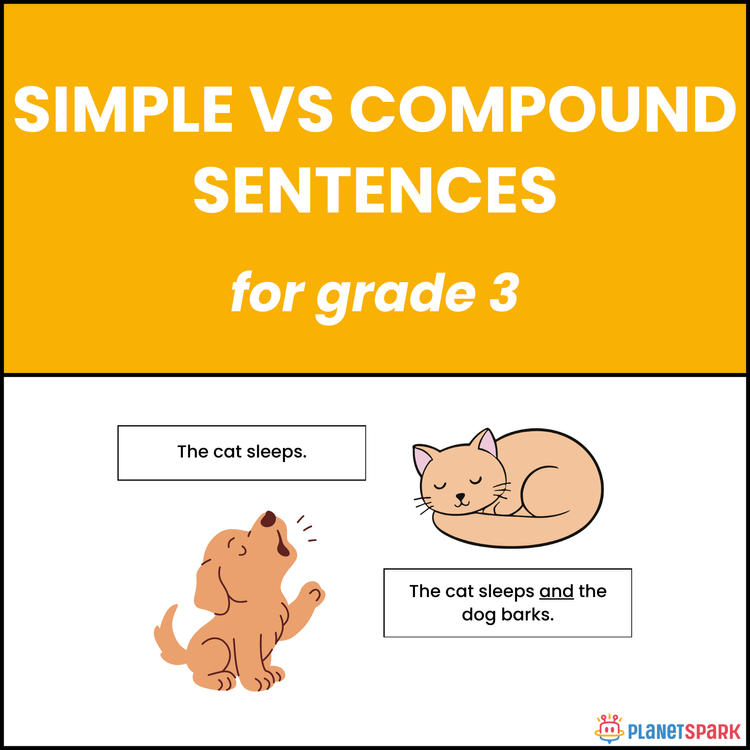
Class 3 Grammar Worksheet on Simple and Compound Use
Connected Ideas: Simple and Compound Sentences for Grade 3
This Grade 3 worksheet helps young learners understand the difference between simple and compound sentences, focusing on connectors such as and, but, and or. Through activities like underlining nouns and verbs, multiple-choice questions, rewriting tasks, a passage-based fill-in-the-blanks exercise, and paragraph writing, students learn how two ideas can be joined meaningfully. This worksheet strengthens early sentence-construction skills and helps children communicate more clearly in writing.
Why Simple and Compound Sentences Matter in Grammar?
1. They help children understand how to join ideas smoothly using connectors.
2. They build sentence variety, making writing more interesting and expressive.
3. They support reading comprehension by teaching how actions and ideas relate.
4. They prepare learners for more advanced sentence structures in higher grades.
What’s Inside This Worksheet?
Exercise 1 – Underline Noun and Circle Verb
Students identify the noun and verb in each sentence to strengthen structural awareness.
Exercise 2 – Multiple Choice Questions
Learners identify simple vs compound sentences and choose correct connectors.
MCQ answer format used:
1. c) I like apples and I like bananas.
Exercise 3 – Sentence Rewriting
Students rewrite sentences into simple or compound forms as instructed.
Exercise 4 – Fill in the Blanks (Passage-Based)
Students complete a short garden narrative using appropriate connectors.
Exercise 5 – Paragraph Writing
Learners write about their weekend activities using both simple and compound sentences.
✅ Answer Key (For Parents & Educators)
Exercise 1 – Underline the Noun and Circle the Verb
1. Riya — reads
2. children — play
3. father — washes
4. birds — sing
5. We — visit
6. Meera — waters
7. boy — jumps
8. She — eats
9. teacher — writes
10. dog — runs
Exercise 2 – Multiple Choice Questions (Answer + Option Letter)
1. c) I like apples and I like bananas.
2. b) He runs fast.
3. c) Riya is tall and her sister is taller.
4. b) The bell rang and the students went out.
5. b) I went to the park.
6. b) You can have tea or coffee.
7. a) The sun set and the stars appeared.
8. b) Meera danced.
9. a) I wanted to play but it rained.
10. a) He opened the book and started reading.
Exercise 3 – Sentence Rewriting
1. Simple → I like mangoes.
2. Simple → The sky grew dark. It did not rain.
3. Compound → Meera sings and dances.
4. Compound → I went to the shop and bought something.
5. Simple → He tried to jump.
6. Simple → She was tired.
7. Simple → We stayed home.
8. Compound → The dog barked and he got scared.
9. Simple → She cooked food. She set the table.
10. Compound → They played cricket and enjoyed.
Exercise 4 – Fill in the Blanks (Passage-Based)
1. and
2. and
3. This
4. or
5. but
6. and
7. I
Exercise 5 – Paragraph Writing
Answers may vary.
Help your child express ideas clearly and confidently with this Grade 3 worksheet designed to build strong sentence-construction skills.
🔖Book a free trial!
Frequently Asked Questions
A simple sentence has one idea, while a compound sentence joins two ideas using and, but, or.
They should choose the conjunction based on meaning—“and” adds, “but” contrasts, and “or” offers a choice.
They often join ideas without using proper conjunctions, so guided practice strengthens sentence-building skills.