
Class 2 Worksheet on Materials and Textures Vocabulary

Class 2 Worksheet on Materials and Textures Vocabulary
Touch, Feel, and Learn: Matter, Materials, and Textures for Class 2
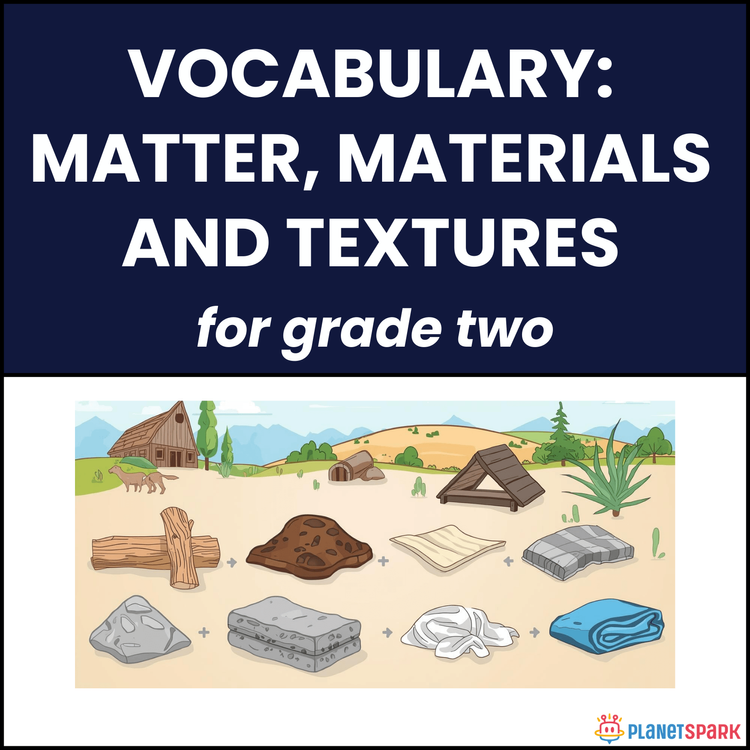
This Class 2 worksheet helps young learners explore everyday objects by understanding states of matter, materials they are made from, and how different things feel to touch. Through simple multiple-choice questions and real-life examples, students learn to identify solids, liquids, and gases, common materials like wood and metal, and texture words such as soft, rough, smooth, and hard in a clear, hands-on way.
Why Matter, Materials, and Textures Matter in Grammar?
This worksheet helps learners:
1. Identify solids, liquids, and gases using familiar examples.
2. Learn what common objects are made of in daily life.
3. Use correct describing words for texture and feel.
4. Build observation skills and accurate vocabulary for speaking and writing.
What’s Inside This Worksheet?
This worksheet includes four science-based vocabulary activities:
Exercise 1 – States of Matter
Students identify whether objects like air, water, ice, milk, steam, and stone are solids, liquids, or gases.
Exercise 2 – Materials Around Us
Learners choose correct materials for objects such as chairs, spoons, windows, bricks, and terracotta toys, connecting objects with what they are made from.
Exercise 3 – Describing Words for Properties
Students select describing words like hard, soft, fragile, light, strong, and stretchy to explain properties of objects.
Exercise 4 – Texture Words
Learners identify texture words such as rough, smooth, prickly, slippery, and sticky based on touch-based examples.
✅ Answer Key (For Parents & Educators)
Exercise 1 – States of Matter
1. gas
2. gas
3. solid
4. liquid
5. solid
6. solid
7. gas
8. liquid
9. solid
10. liquid
Exercise 2 – Materials
1. wood
2. metal
3. glass
4. plastic
5. metal
6. wood
7. rubber
8. graphite
9. clay
10. clay
Exercise 3 – Describing Words
1. absorbent
2. hard
3. cold
4. soft
5. hard
6. fragile
7. stretchy
8. strong
9. light
10. soft
Exercise 4 – Texture Words
1. rough
2. smooth
3. prickly
4. cold
5. rough
6. soft
7. soft
8. rough
9. slippery
10. sticky
Help your child observe the world more closely by learning how objects feel, what they are made of, and how matter behaves in everyday life.
🔖Book a free trial!
Frequently Asked Questions
They describe what objects are made of and how they feel, such as hard or soft.
Both describe objects, but one shows substance while the other shows feel.
Sorting and example-based activities help children understand clearly.