
Class 2 English Worksheet Using But for Contrast

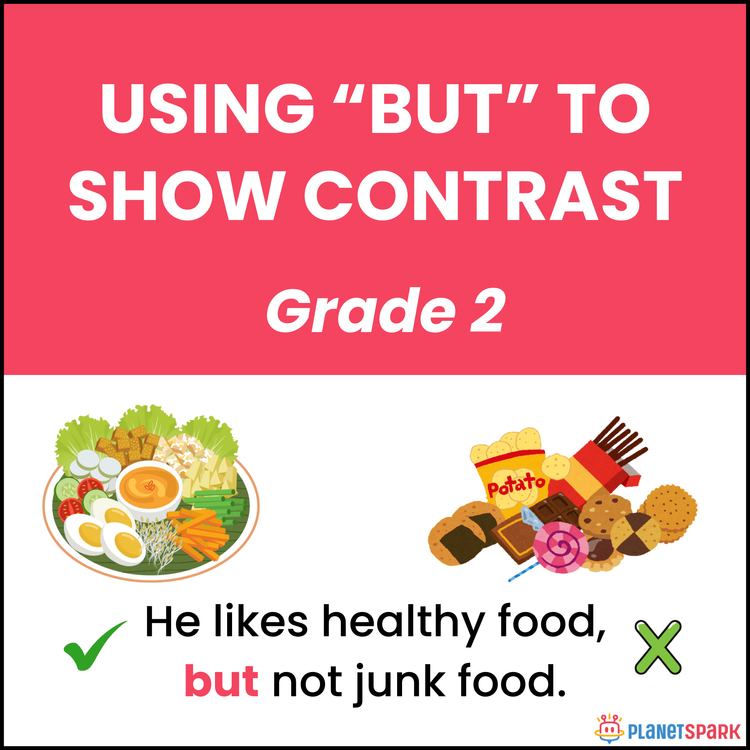
Class 2 English Worksheet Using But for Contrast
Think Before You Link: Using “But” to Show Contrast for Class 2
This Class 2 English grammar worksheet is designed to help young learners understand and correctly use the conjunction “but” to show contrast between two ideas. Aimed at Grade 2 students, the worksheet builds clarity around how opposite or unexpected ideas can be joined meaningfully in a sentence. The activities are carefully structured so children must think before choosing “but,” rather than using it automatically. Learners practice identifying when contrast is present and when “but” is not required, strengthening both grammar accuracy and logical reasoning.
Why Conjunctions Like “But” Matter in Grammar?
The word “but” helps Grade 2 learners:
1. Join opposite or surprising ideas clearly
2. Improve sentence meaning and flow
3. Avoid incorrect or unnecessary connectors
4. Build stronger sentence-writing skills
What’s Inside This Worksheet?
🧠 Exercise 1 – Fill in the Blanks
Students fill in the blank with “but” where it shows contrast. If “but” is not needed, they write a cross (×).
✏️ Exercise 2 – True or False
Students read each sentence and decide whether “but” is used correctly.
📋 Exercise 3 – Multiple Choice
Students choose option (a) or (b) to identify correct or incorrect use of “but.”
📝 Exercise 4 – Sentence Rewriting
Students rewrite sentences by placing “but” in the correct position.
✍️ Exercise 5 – Paragraph Writing
Students write a short paragraph about a friend using “but” to show contrast.
Answer Key (For Parents & Educators)
Exercise 1 – Fill in the Blanks
1. but
2. ×
3. but
4. ×
5. but
6. but
7. ×
8. but
9. ×
10. but
Exercise 2 – True or False
1. True
2. False
3. True
4. True
5. False
6. False
7. True
8. True
9. False
10. False
Exercise 3 – Multiple Choice Questions
1. b
2. a
3. a
4. a
5. b
6. b
7. a
8. b
9. a
10. a
Exercise 4 – Rewritten Sentences
1. Riya is happy, but she is tired.
2. Ravi wants to play, but it is raining.
3. Aarav wants to play, but he must do homework first.
4. Meera is small, but she runs fast.
5. Rimi is thin, but she is strong.
6. The dog barked, but it was friendly.
7. I like chocolate, but I do not like candy.
8. They are friends, but they sometimes fight.
9. The cat is small, but it is very clever.
10. Meera wanted ice cream, but the shop was closed.
Exercise 5 – Paragraph Writing
Answers may vary.
Help your child learn when contrast truly matters in a sentence with guided grammar practice.
Frequently Asked Questions
“But” connects two ideas that are opposite or unexpected, helping children express contrast clearly.
Encourage children to identify two contrasting ideas and join them using “but” to make meaningful sentences.
Yes, students sometimes start a sentence with “but” unnecessarily or confuse it with “and,” affecting sentence meaning.