
Class 2 Worksheet on Word Meaning Relationships

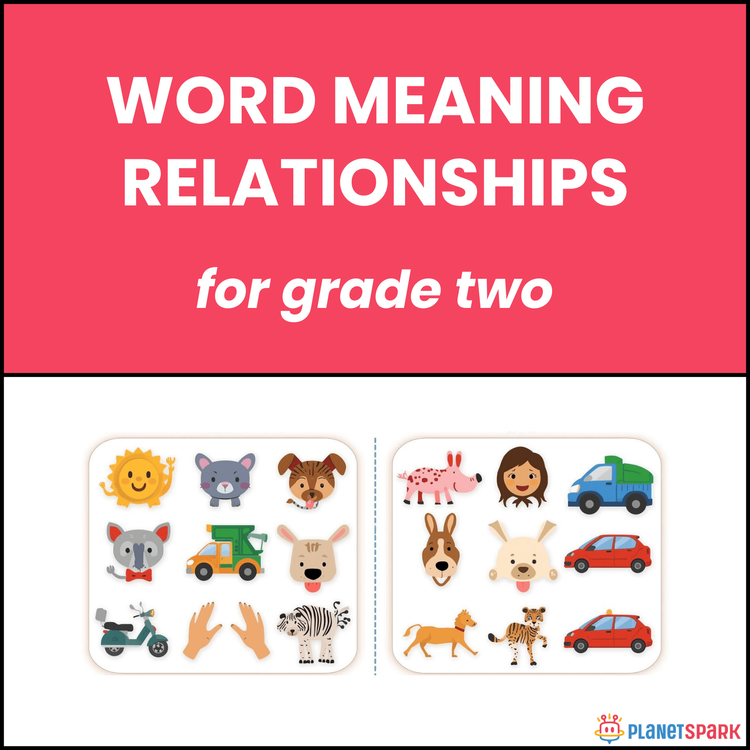
Class 2 Worksheet on Word Meaning Relationships
Opposites & Alike: Word Meaning Relationships for Class 2
This Class 2 worksheet builds strong vocabulary skills by helping young learners understand word meaning relationships such as opposites, synonyms, and words with multiple meanings. Through engaging multiple-choice activities and picture-based questions, students learn how words connect and change meaning in different contexts, making grammar learning clear, fun, and practical.
Why Word Meaning Relationships Matter in Grammar?
This worksheet helps learners:
1. Understand how words can have opposite or similar meanings.
2. Build vocabulary by learning synonyms and antonyms.
3. Recognize words that change meaning based on context and usage.
4. Improve reading comprehension and confident word choice in speaking and writing.
What’s Inside This Worksheet?
This worksheet includes five vocabulary-rich activities:
Exercise 1 – Opposites (MCQs)
Students choose the correct opposite for given words such as brave, empty, smooth, early, and begin, helping them build contrast-based vocabulary understanding.
Exercise 2 – Synonyms (MCQs)
Learners identify words with the same meaning, like tiny–small, angry–mad, silent–quiet, and neat–tidy, strengthening word association skills.
Exercise 3 – Words with Multiple Meanings (Picture-Based MCQs)
Using pictures, students choose the correct meaning of words like watch, bat, bank, ring, and duck, learning how context changes meaning.
Exercise 4 – Action Word Opposites
Students match action verbs with their opposites such as push–pull, open–shut, laugh–cry, and enter–exit, improving verb clarity.
Exercise 5 – Adjective Opposites
Learners identify opposites of describing words like hot, dirty, tall, heavy, and happy, reinforcing descriptive vocabulary.
✅ Answer Key (For Parents & Educators)
Exercise 1 – Opposites
1. scared
2. full
3. rough
4. below
5. sad
6. late
7. soft
8. narrow
9. strong
10. end
Exercise 2 – Synonyms
1. small
2. mad
3. clever
4. quiet
5. start
6. cool
7. silly
8. fast
9. large
10. tidy
Exercise 3 – Correct Meanings (Picture-Based)
1. a timepiece
2. a ball
3. a place to get water
4. makes things bright
5. jewellery worn on finger
6. a place where people keep money
7. a bird
8. part of a finger or toe
9. something used for writing
10. a place with swings
Exercise 4 – Action Word Opposites
1. pull
2. shut
3. stand
4. go
5. take
6. throw
7. exit
8. end
9. fall
10. cry
Exercise 5 – Adjective Opposites
1. clean
2. cold
3. short
4. light
5. slow
6. soft
7. sad
8. far
9. empty
10. young
Strengthen your child’s vocabulary foundation and reading confidence with fun word-meaning practice that truly sticks!
🔖Book a free trial!
Frequently Asked Questions
Word meaning relationships explain how words connect through synonyms, antonyms, and related meanings for vocabulary growth.
They help early learners expand vocabulary and improve sentence understanding in CBSE English.
The English worksheet uses matching and examples to make word relationships easy to grasp.