
Class 2 Grammar Worksheet to Use Has and Have

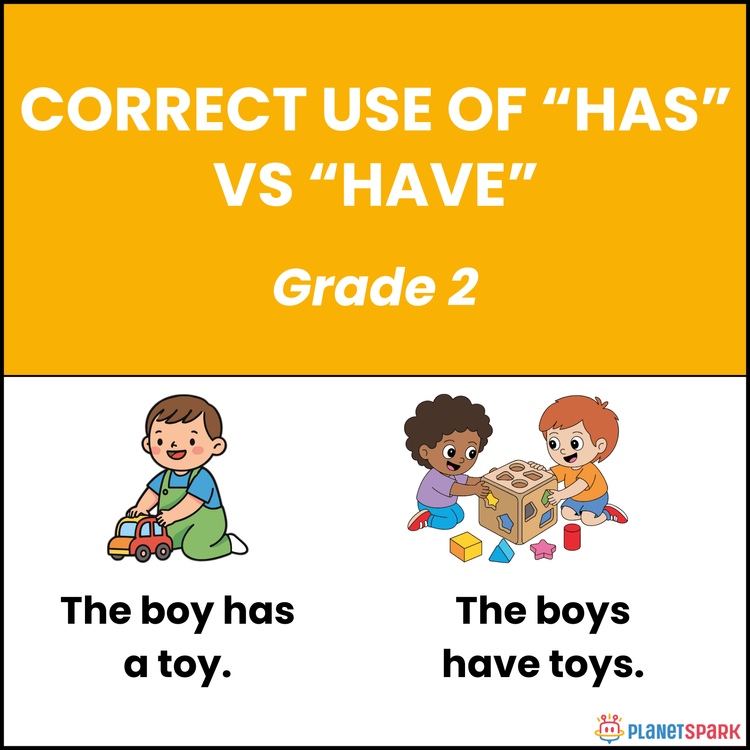
Class 2 Grammar Worksheet to Use Has and Have
Have or Has? Getting It Right for Class 2
This Grade 2 English worksheet is designed to help young learners confidently use “has” and “have” by applying subject–verb agreement rules in meaningful, everyday sentences. Through carefully structured exercises, students learn how verb choice changes with singular and plural subjects. The worksheet blends recognition, correction, and sentence application tasks to make grammar learning clear, practical, and effective.
Why “Has” and “Have” Matter in Grammar?
Correct use of “has” and “have” is a key foundation of English grammar. For Grade 2 learners, this topic is important because:
1. It teaches subject–verb agreement in simple sentences.
2. It helps children speak and write with grammatical accuracy.
3. It reduces common errors in everyday communication.
4. It builds a strong base for learning tenses in higher grades.
What’s Inside This Worksheet?
This worksheet includes five grammar-rich activities that gradually build mastery of “has” and “have”:
🧠 Exercise 1 – Fill in the Blanks
Students choose “has” or “have” from a word bank to complete each sentence correctly.
✏️ Exercise 2 – True or False
Students read each sentence carefully and decide whether the usage of “has” or “have” is correct.
📋 Exercise 3 – Multiple Choice Questions
Students select the correct verb option, strengthening quick decision-making and grammar accuracy.
📝 Exercise 4 – Sentence Correction
Students replace the incorrect verb in each sentence with the correct form, reinforcing grammar rules.
🧾 Exercise 5 – Paragraph Writing
Students write sentences about things their friends have, applying “has” and “have” in real-life contexts.
ANSWER KEY (For Parents & Educators)
Exercise 1 – Fill in the Blanks
1. has
2. have
3. has
4. has
5. have
6. has
7. has
8. have
9. have
10. has
Exercise 2 – True or False
1. False
2. True
3. False
4. False
5. True
6. False
7. True
8. True
9. False
10. True
Exercise 3 – Multiple Choice Questions
1. a) has
2. a) have
3. c) has
4. b) has
5. b) have
6. a) has
7. c) have
8. b) have
9. c) have
10. a) has
Exercise 4 – Sentence Correction
1. Riya has a new kite.
2. We have ten pencils.
3. Meera has red shoes.
4. Asha has her lunch.
5. Raj has a football.
6. These cats have soft tails.
7. You have a doll.
8. We have school books.
9. They have a small garden.
10. He has a notebook.
Exercise 5 – Paragraph Writing
Answers may vary.
Help your child build strong grammar foundations by mastering “has” and “have” through guided, engaging practice.
Frequently Asked Questions
“Has” is used with third-person singular subjects, while “have” is used with I, you, we, and they.
By associating has with he, she, it, and have with other subjects in daily practice sentences.
Yes, we use “does not have” for third-person singular and “do not have” for other subjects.