
Class KG Worksheet on Straight Letter Path Tracing

Class KG Worksheet on Straight Letter Path Tracing
Straight-Line Tracing Mastery: Letter Path Writing for KG
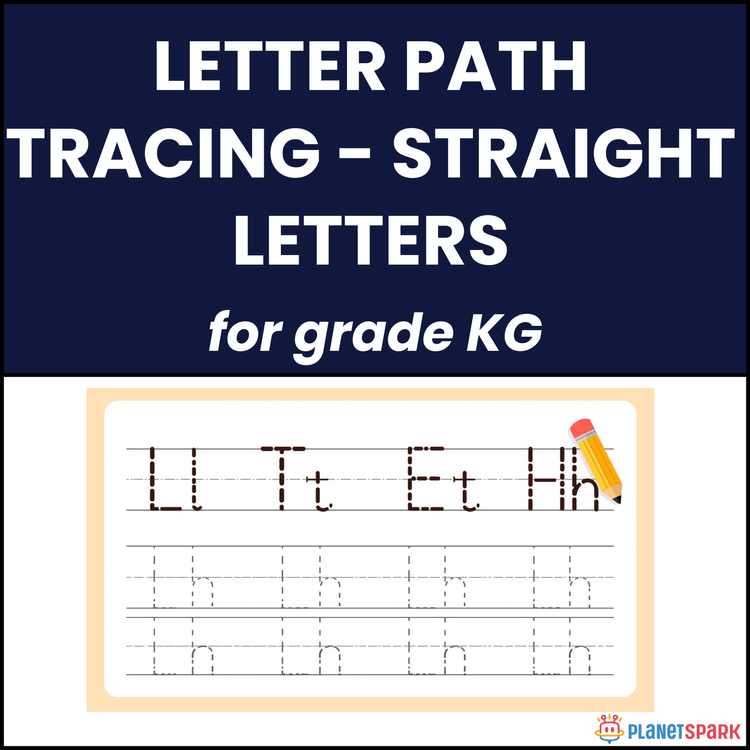
This KG worksheet helps children practise writing straight-line uppercase letters by tracing clear stroke paths. On page 3, students trace letters L, K, W, I, E, F, T, H, V, and Y using repeated straight-line sequences before writing the final letter independently.
Learners then test their concept understanding with True/False statements on page 4, identifying which letters are formed completely with straight lines.
Pages 5–6 include picture-based MCQs where children match traced letter shapes—such as L, T, Y, H, F, I, V, K, W, and Z—to the correct straight-line letter option.
Finally, pages 7–8 guide children to write words using only straight-line letters (I, H, M, T, V, W, Y, K, E), supported by picture cues such as ink, hat, mat, ten, van, eye, key, tin, yak, and wet.
This worksheet develops fine motor control, visual discrimination, and letter-shape recognition with a focus on straight-line formation essential for early handwriting skills.
Why Straight-Letter Tracing Matters?
Straight-line tracing helps children:
1. Build pencil control and line-direction awareness.
2. Understand structural differences between letters.
3. Strengthen early handwriting fluency and accuracy.
4. Recognise tall, slanted, and parallel straight-line patterns.
What’s Inside This Worksheet?
🧠 Exercise 1 – Straight Letter Tracing
Children trace straight-line uppercase letters L, K, W, I, E, F, T, H, V, Y (page 3).
✏️ Exercise 2 – True or False
Learners evaluate statements about which letters are formed with only straight lines (page 4).
📘 Exercise 3 – Multiple Choice
Students match each straight-line traced letter to the correct letter option—letters include L, T, Y, H, F, I, V, K, W, Z (pages 5–6).
📝 Exercise 4 – Word Writing
Children write words that use straight-line letters only, guided by the worksheet’s word bank (page 7–8).
This worksheet strengthens handwriting fundamentals by helping learners master straight-line letter structures.
ANSWER KEY ( for Parents and Educators)
Exercise 1 – Trace & Complete the Letter
1. L
2. K
3. W
4. I
5. E
6. F
7. T
8. H
9. V
10. Y
Exercise 2 – True or False
1. True
2. True
3. True
4. True
5. True
6. False
7. False
8. True
9. True
10. True
Exercise 3 – Straight-Line MCQs
1. L
2. T
3. Y
4. H
5. F
6. V
7. K
8. I
9. Y
10. Z
Exercise 4 – Word Writing
(Any correct word using the straight-line letter is acceptable; below are worksheet-supported answers.)
1. I → ink
2. H → hat
3. M → mat
4. T → ten / tin
5. T → ten
6. V → van
7. W → wet
8. Y → yak
9. K → key
10. E → eye
Build early handwriting confidence with straight-line tracing designed to strengthen pencil control and letter formation skills!
Give your child a strong start with expert-guided straight-line handwriting practice crafted for KG learners!
🔖Book a free trial!
Frequently Asked Questions
It improves control for letters with straight strokes such as L, T, and I.
Their pencil grip may be weak; using thicker crayons helps stability.
Tracing from top to bottom on ruled lines builds confidence.