
Class KG Worksheet on Visual Discrimination b d p q

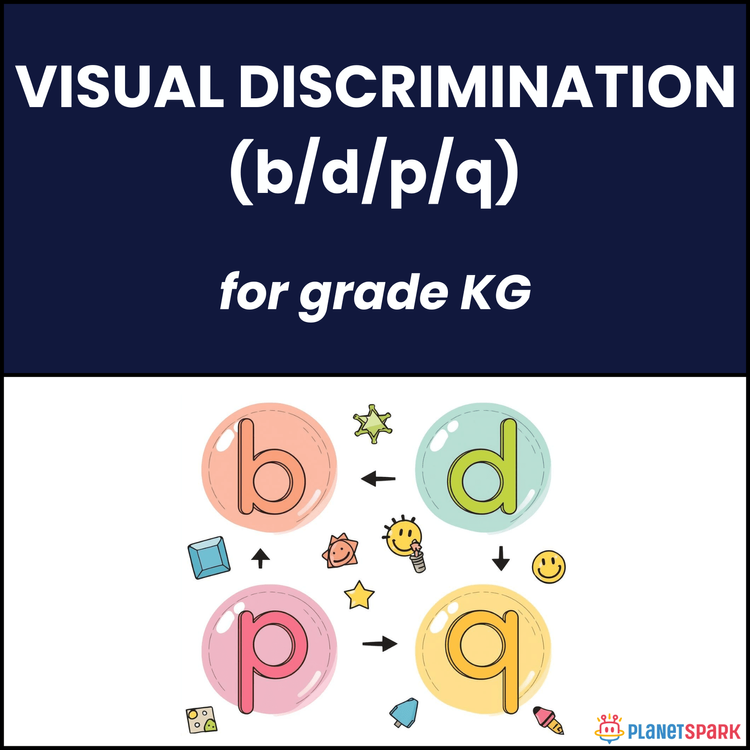
Class KG Worksheet on Visual Discrimination b d p q
Mirror & Match: Visual Discrimination of b, d, p, q for KG Learners
This Kindergarten worksheet is designed to strengthen early literacy skills by helping young learners visually differentiate between commonly confused letters — b, d, p, and q. Through simple, guided, and age-appropriate activities, children build strong letter recognition while improving focus, observation, and pre-writing confidence.
Why Learning Visual Discrimination Matters in Early Literacy?
1. It helps children clearly recognize letter shapes and directions.
2. It reduces letter-reversal errors in reading and writing.
3. It strengthens visual memory and attention to detail.
4. It builds a strong foundation for phonics, spelling, and sentence formation.
What’s Inside This Worksheet?
🧠 Exercise 1 – Circle the Target Letter
Children carefully look at rows of mixed letters and circle the correct letter (b, d, p, or q) as instructed. This improves visual scanning and letter identification.
✏️ Exercise 2 – Multiple Choice Questions
Learners identify the correct letter by choosing the right option from three choices, reinforcing recognition through visual cues.
📋 Exercise 3 – Fix the Incorrect Letter
Children read simple sentences and replace the incorrect letter with the correct one based on given rules (e.g., Fix d to b, Fix q to p). This builds early proofreading skills.
📝 Exercise 4 – Paragraph Writing
Students write a short paragraph using any three letters from b, d, p, and q, encouraging creative use of learned letters and early sentence-building.
✅ Answer Key (For Parents & Educators)
Exercise 1 – Circle the Target Letter
Correct letters to be circled in each row as instructed:
1–10. As per given target letter (b / p / q / d) in each line
Exercise 2 – Multiple Choice Questions
1. c 2. a 3. b 4. b 5. c 6. c 7. a 8. c 9. b 10. a
Exercise 3 – Corrected Words
1. bat
2. pig
3. dog
4. bag
5. quiz
6. pen
7. buck
8. pants
9. bed
10. pants
Exercise 4 – Paragraph Writing
Answers may vary.
Build strong letter foundations early with fun, visual-based practice that prepares your child for confident reading and writing success.
🔖Book a free trial!
Frequently Asked Questions
It helps children tell similar-looking letters apart, improving early reading skills.
They can play simple matching games using b, d, p, and q.
Because they look similar and differ mainly in direction.