
NCERT Solutions for Class 5 English Santoor Unit 5 Chapter 9
NCERT solutions for Class 5 English Chapter Vocation – complete answers & explanations
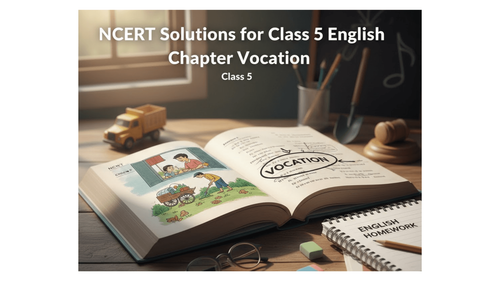
This blog provides NCERT solutions for Class 5 English Unit 5 Work is Worship Chapter 9 Vocation. The chapter talks about different kinds of work people do and how a child observes and admires these vocations in daily life. Understanding this chapter helps students respect all kinds of work and improves their reading, thinking, and language skills. These NCERT solutions are prepared strictly based on the given worksheet and follow the exact order and content provided there.
What this NCERT chapter covers?
1. The poem Vocation and the
speaker’s thoughts about different jobs.
2. Understanding meanings of words used in the poem.
3. Grammar practice through sentence correction.
4. Listening, speaking, writing, and thinking activities related to vocations.
5. Awareness about different professions and personal preferences.
How to use these NCERT solutions?
1. Read each question or instruction
from the worksheet carefully before checking the answer.
2. Compare your responses with the answers given here to self-check.
3. Use the explanations to understand what is expected in each activity.
4. Parents and teachers can guide students by discussing the ideas given.
5. All answers follow the exact worksheet order for easy reference.
Important tips & tricks for students
1. Read the poem carefully to understand the speaker’s feelings.
2. Pay attention to grammar rules while correcting sentences.
3. Write clear and simple sentences for writing tasks.
4. For activities and discussions, think calmly and express your ideas clearly.
5. Follow instructions carefully, especially for listening and speaking tasks.
NCERT solutions – complete answer key
Let us recite
Explanation:
Read the poem aloud with proper pronunciation, rhythm, and expression. Pay attention to the feelings of the speaker and the different vocations described in the poem.
Let us think
A. Answer the following questions.
Explanation:
Read the poem again carefully. Think about the speaker’s thoughts, observations, and feelings before answering the questions.
1. The speaker in the poem is a school-going child.
2. The speaker wants to be a hawker because the hawker moves freely on the road and does not have any fixed schedule or hurry.
3. He likes that the gardener digs the ground freely, gets dirty, and no one scolds him for working in the sun or rain.
4. The speaker compares the street lamp to a giant with one red eye.
5. The speaker goes to school in the morning, returns home in the afternoon, and goes to bed at night while observing different workers during the day.
B. Think and discuss.
Explanation:
Think about your own experiences and observations. Discuss your ideas with classmates or think silently before answering.
1. The speaker admires people with different vocations because they seem independent and free while doing their work.
2. On the way to school and back home, one can see hawkers, shopkeepers, gardeners, watchmen, vehicles, and people doing different kinds of work.
Let us learn
A. Here are some of the words from Vocation. Read the poem and match each word with its meaning.
Explanation:
Read the words and meanings carefully. Match each word with the correct meaning based on what you learned from the poem.
Gong – A metal disc that produces a loud sound when hit with a small hammer
Spade – A tool used for gardening
Lane – A narrow path
Giant – An imaginary man-like creature of great height and strength
Lantern – A case that holds a candle or light in any form and can be easily carried
B. There is one mistake in each sentence given below. Underline the mistakes and rewrite the correct sentences in the given space. One example has been done for you.
Explanation:
Read each sentence carefully, identify the grammatical mistake, and rewrite the sentence correctly.
1. I have recently read a new book.
2. The speaker goes to school at ten in the morning.
3. The fox ran faster than the others.
4. Mita was asleep when the doorbell rang.
5. The old elephant walked slowly to the river.
6. Radhika is taller than Suman.
7. Sudhanshu ran fastest of all the runners.
8. My mother is cooking.
9. He goes to school every day.
10. The birds are flying.
C. Look at the pictures and read the words written under them.
Explanation:
Observe each picture carefully. Read the name of the object, recall where you have seen it, and think about how and where it is used.
Let us listen
A. Listen and repeat.
Explanation:
Listen carefully to the teacher’s pronunciation of each word and repeat them clearly to practice correct sounds.
B. Listen and speak.
Explanation:
Think about a time when you wanted to do many things at once. Reflect on your feelings and difficulties, then share your thoughts with classmates.
Let us write
1. What’s missing?
Explanation:
Think about the less enjoyable or difficult parts of each vocation. Write a paragraph expressing your ideas clearly.
The difficult or boring parts of being a hawker include standing for long hours and facing heat or rain. A gardener may get tired from hard physical work. A watchman has to stay awake all night and work alone in the dark.
2. Vocations of family members.
Explanation:
Choose any three family members. Write about their vocations in 50–60 words each.
Mother:
My mother is a teacher. She teaches students in a school. She prepares lessons, checks notebooks, and helps children learn good habits.
Father:
My father is an engineer. He designs and repairs machines. He works in an office and visits sites to supervise work.
Grandmother:
My grandmother is a homemaker. She manages the household, cooks food, and takes care of the family.
3. What vocations are the following people associated with?
Explanation:
Recall or find out the professions of the given personalities and write them correctly.
A.P.J. Abdul Kalam – Scientist
M. Visvesvaraya – Engineer
Janaki Ammal – Scientist
M.S. Subbulakshmi – Singer
Salim Ali – Ornithologist
Let us do
Job mix-up
Explanation:
Observe each picture carefully. Identify what is unusual about the job shown. Write two sentences for each picture explaining the correct job of that person.
Answers may vary.
Let us explore
Explanation:
Look at the pictures of different vocations. Think about which job you like and why.
A. Choose one vocation from the pictures and explain your reason for choosing it.
Answers may vary.
B. Think of another vocation not shown in the pictures and explain why it is your dream job.
Answers may vary.
C. Draw yourself doing the vocation you have chosen in the space provided.
Why NCERT solutions help students?
NCERT solutions help students understand the chapter clearly, prepare well for exams, and learn how to write correct and complete answers. They build confidence and ensure students follow NCERT expectations.
Help your child build strong English fundamentals with expert-guided learning support.