Understanding conflict resolution in the workplace can transform tension into teamwork, disagreements into growth, and friction into innovation.
In this practical guide, we’ll explore powerful and actionable conflict management techniquesthat help employees and leaders confidently handle workplace conflict.
What Is Workplace Conflict?
Workplace conflict refers to disagreements, misunderstandings, or disputes between employees, teams, or management due to differences in goals, values, or perceptions. It is a natural part of any organization where individuals bring diverse perspectives and personalities.Conflict itself is not always negative. When handled correctly, it can lead to innovation, improved communication, and stronger relationships.
Why Does Workplace Conflict Happen?
Effective conflict resolution in the workplace starts with confident communication and active listening. Build these essential skills today. Book a free demo with PlanetSpark and empower your professional growth.
Understanding the root causes ofworkplace conflict is essential for effective conflict resolution. Most conflicts do not arise suddenly. They develop gradually due to common causes :
10 Strategies of Conflict Resolution in the Workplace
Address Conflict Early
Ignoring issues allows resentment to grow. If you’re wondering how to resolve conflict at work, the first step is simple , don’t delay difficult conversations.
Early intervention prevents escalation.
2. Practice Active Listening
Often, people listen to reply, not to understand.
Effective conflict management techniques include:
Maintaining eye contact
Avoiding interruptions
Paraphrasing the other person’s viewpoint
Asking clarifying questions
When employees feel heard, defensiveness reduces instantly.
3. Stay Calm and Professional
Emotional reactions fuel workplace conflict. Maintain composure even if the other person becomes emotional.
Use neutral language:
Instead of “You always…”
Say “I feel concerned when…”
Professional tone supports productive dialogue.
4. Focus on the Problem, Not the Person
Separate behavior from identity.
Rather than attacking character, address specific actions:
Discuss missed deadlines
Clarify expectations
Review shared goals
This approach strengthens methods of conflict resolution without damaging relationships.
5. Encourage Open Communication
Create safe spaces where employees can express concerns without fear.
Leaders can:
Conduct regular feedback sessions
Encourage team discussions
Promote psychological safety
Strong communication reduces recurring workplace conflict.
6. Identify the Root Cause
Many disagreements are surface-level symptoms.
Ask:
What is really causing this issue?
Is it workload, unclear instructions, or miscommunication?
Digging deeper ensures long-term resolution rather than temporary fixes.
7. Collaborate on Solutions
The best outcomes occur when both parties contribute to the solution.
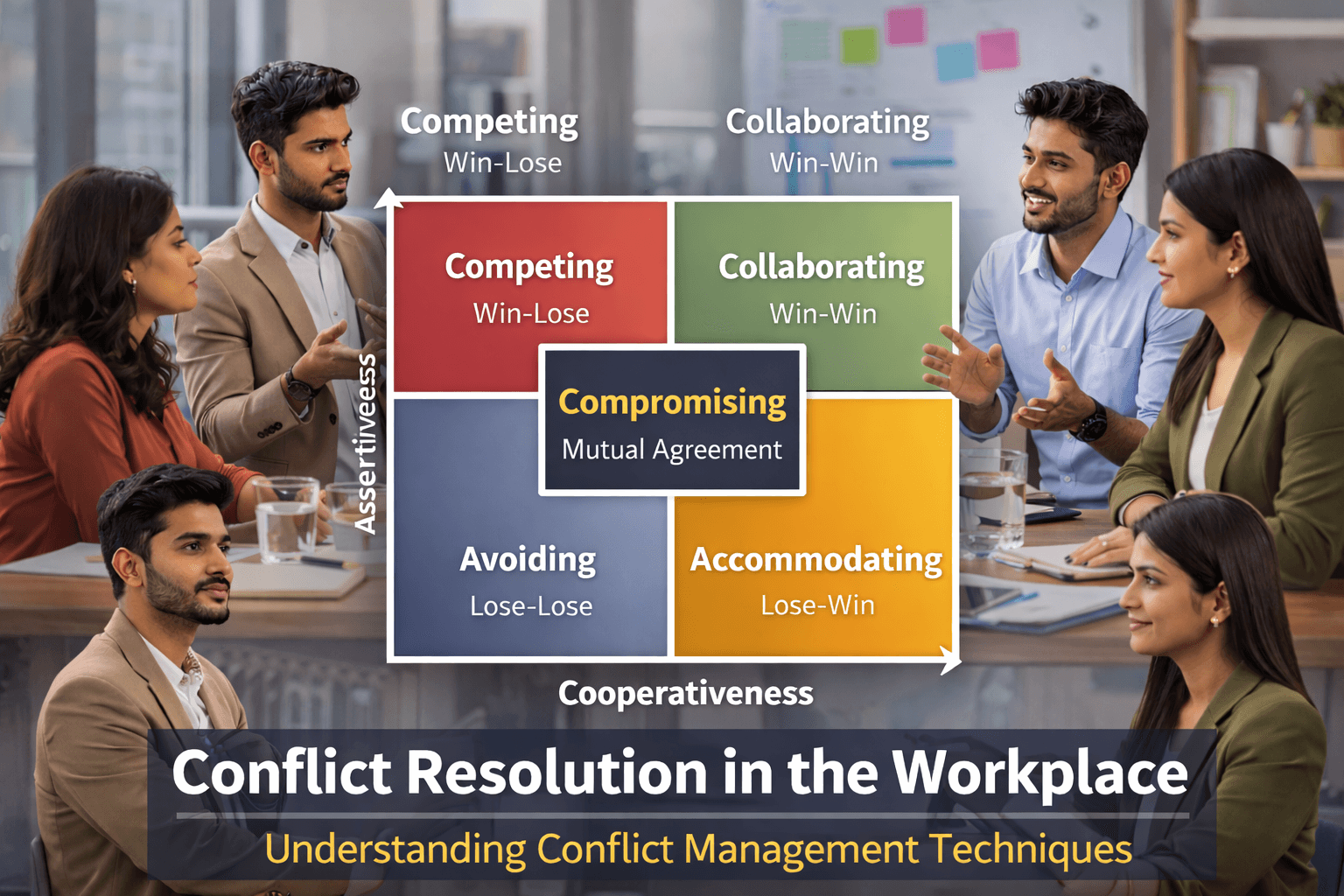
Avoiding means postponing or withdrawing from the conflict. It can be appropriate for minor issues or emotionally charged situations.
But repeated avoidance can lead to unresolved tension and decreased productivity.
4. Accommodating (Low Assertiveness, High Cooperativeness) Lose-Win
In this approach, one party prioritizes the other’s needs to maintain harmony.
While it helps preserve relationships, overuse may result in imbalance or suppressed concerns.
5. Compromising (Moderate Assertiveness and Cooperativeness) Partial Win-Win
Compromising involves both parties giving up something to reach a middle ground.
It is especially practical for time-sensitive workplace conflicts where quick resolution is needed.
Turning Conflict into Competitive Advantage: Strategic Methods of Conflict Resolution at Work
Organizations that apply structured methods of conflict resolution do more than settle workplace disputes , they use conflict as a tool for improvement. Instead of viewing disagreement as disruption, high-performing teams treat it as feedback that reveals gaps in communication, unclear roles, or process inefficiencies.
Understanding how to resolve conflict at work requires moving beyond quick fixes. After resolving workplace disputes, teams should evaluate the root cause:
Was responsibility clearly defined?
Were expectations aligned?
Did performance systems create unnecessary friction?
By analyzing patterns, organizations strengthen workplace conflict management and reduce recurring tension.
For example, if two departments repeatedly clash over deadlines, the issue may not be personal. It may indicate unclear workflow ownership or unrealistic timelines. Similarly, if team members argue about decision authority, the real problem could be undefined reporting structures.
When businesses integrate conflict management strategies into leadership training, performance systems, and communication frameworks, conflict becomes a driver of innovation rather than division. For instance, some companies conduct post-project reviews where disagreements are openly discussed and documented. This practice turns conflict into continuous process improvement.
As management expert Peter Drucker once said, “The most important thing in communication is hearing what isn’t said.” This insight highlights why effective methods of conflict resolution require deeper analysis , not just surface-level agreement.
Effective methods of conflict resolution don’t eliminate disagreement ,they transform it into a competitive advantage that improves collaboration, accountability, and long-term organizational growth.
Master Workplace Communication and Conflict Resolution with PlanetSpark’s Professional Training.
Strong communication skills are essential for effective conflict resolution in the workplace. In today’s fast-paced professional environment, the ability to communicate clearly, assertively, and strategically determines how successfully individuals manage workplace conflict.
At PlanetSpark, communication and critical thinking are core focus areas. Our structured communication training programs are specifically designed to strengthen workplace conflict management, leadership presence, and professional interaction skills.
Through practical, application-based learning, students, MBA graduates, and working professionals build the confidence needed for resolving workplace conflict in real-world scenarios ,not just theoretical discussions.
What Makes PlanetSpark’s Professional Communication Training Effective for Workplace Conflict Resolution?
Live interactive classes that encourage active participation and discussion
Expert communication coaches providing structured mentorship
Real workplace scenarios to practice conflict resolution strategies
Personalized feedback for continuous improvement
Confidence-building exercises to enhance assertiveness and clarity
Structured curriculum focused on professional communication development
Practical communication frameworks that can be directly applied at work
We provide both formal and informal communication training pathways , from early academic development to working professionals. Whether it is public speaking, leadership communication, personality development, or creative expression, PlanetSpark covers every critical dimension of communication skills that influence professional growth.
In competitive workplaces, communication is no longer optional , it is a career accelerator. Mastering communication is the foundation of learning how to resolve conflict at work effectively and sustainably.
From Reaction to Resolution: Transforming Workplace Conflict into Growth
Conflict is not a sign of failure , it’s a sign of diversity in thought.
Conflict resolution in the workplace is not just a professional skill. It is a leadership skill that defines career success. Professionals who understand conflict management techniques build stronger relationships, communicate confidently, and create positive work environments.
Learning how to resolve conflict at work helps individuals grow personally and professionally. Every conflict presents an opportunity to improve communication, emotional intelligence, and leadership ability.
By practicing structured conflict resolution methods consistently, professionals develop confidence, influence, and long term career success.
What matters is the approach.
By applying these 10 strategies of conflict resolution in the workplace, organizations can turn disagreements into opportunities for growth, learning, and stronger collaboration.
The next time conflict arises, ask yourself: Am I reacting or resolving?
Ready to strengthen your workplace culture? Start implementing proven methods of conflict resolution today and transform conflict into collaboration. Book you FREE TRIAL today with Planetspark.
Frequently Asked Questions
Resolve conflict by identifying the problem, listening actively, discussing solutions, and agreeing on action steps.
The five methods are avoiding, accommodating, competing, compromising, and collaborating.
Identify issue, understand perspectives, discuss openly, find common goals, explore solutions, agree on plan, follow up.
Communication, collaboration, compromise, control emotions, and commitment.