
Speech Clarity Tips for Better Communication and Public Speaking


Table of Contents
- How to Improve Speech Clarity – 15 Proven Tips for Students
- How to Speak More Clearly in Specific Situations
- Common Mistakes Students Make (And How to Fix Them)
- Daily 10-Minute Routine to Improve Speech Clarity
- Additional Exercises to Strengthen Speech Clarity
- Student Success Story: From Shy Speaker to Confident Communi
- Why Speech Clarity Matters for Students
- Overcoming Stage Fear to Enhance Speech Clarity
- PlanetSpark: The Trusted Hub for Clear, Confident, and Effec
- Speak Boldly, Grow Stronger with PlanetSpark
Speech clarity is the ability to express ideas clearly so listeners understand every word. This guidance provides practical tips, exercises, and proven techniques to help students speak confidently and communicate with ease in any situation. With expert trainers, interactive sessions, and personalized feedback, PlanetSpark supports students in improving clarity, strengthening articulation, and building strong public speaking skills for lifelong success.
How to Improve Speech Clarity – 15 Proven Tips for Students
Below are the most effective and student-friendly strategies to develop strong, crisp, and confident speech.
1. Slow Down Your Pace
One of the biggest causes of unclear speech is talking too fast. When students rush through sentences, articulation becomes sloppy and words blend together.
How to fix it:
- Pause between thoughts.
- Use natural breaks after commas and full stops.
- Take a breath before important points.
Speaking slower not only improves clarity but also shows confidence and control.
2. Open Your Mouth Fully When Speaking
Mumbling happens when the mouth stays partially closed. Clear speech requires full jaw movement.
Try this exercise:
- Read a paragraph aloud while exaggerating mouth movements.
- Then repeat it normally and your clarity will automatically improve.

3. Strengthen Articulation With Daily Drills
Articulation refers to how clearly you pronounce sounds like t, d, k, p, and s.
Articulation exercises:
- Repeat tongue twisters slowly:
“Clear speech gives smart students success.” - Practice challenging consonant combinations:
ta-ka-pa-sa - Record yourself to check improvement.
4. Improve Your Breathing Technique
Good breath control helps you speak clearly without sounding breathless, rushed, or too soft.
Practice diaphragmatic breathing:
- Sit straight and place one hand on your stomach.
- Inhale deeply through your nose.
- Exhale slowly while speaking a sentence.
This technique is essential for strong and steady speech.
5. Reduce Filler Words (Um, Uh, Like, You Know)
Filler words make speech sound hesitant and unclear.
How to reduce them:
- Replace fillers with brief pauses.
- Plan your key points before you speak.
- Practice speaking slowly so you don’t need fillers to think.
6. Strengthen Your Vocabulary
Students often speak unclearly when they’re unsure of the right words. Vocabulary growth improves confidence and fluency.
Simple ways to expand vocabulary:
- Learn 5 new words daily.
- Read aloud from books or editorials.
- Practice using new words in conversation.
7. Work on Your Tone and Pitch
A monotone voice or sudden pitch changes can distract listeners. Clear speech is more than pronunciation, it's musicality.
Practice tone variation:
- Emphasize key words.
- Ask questions with a rising tone.
- Use a calm, steady voice for explanations.
Help Your Child Communicate Clearly with Expert-Led Training at PlanetSpark!
8. Stand or Sit With Good Posture
Slouching compresses your diaphragm and affects clarity.
Posture tips:
- Keep your back straight.
- Relax your shoulders.
- Maintain eye contact with your listener.
Good posture supports better breathing and vocal projection.
9. Record Your Voice Regularly
Self-awareness is essential if you want to improve speech clarity.
What to look for:
- Are you speaking too fast?
- Are certain words unclear?
- Are fillers dominating your speech?
Recordings help you track improvement week by week.
10. Practice Enunciation Daily
Enunciation focuses on pronouncing each syllable correctly.
Try this method:
Say each sentence like this:
“I / will / prac-tice / clear-er / speech.”
Even 5 minutes a day makes a huge difference.
11. Read Aloud Every Day
Reading aloud strengthens fluency, pronunciation, pace control, and articulation all at once.
Choose:
- News articles
- Storybooks
- Speeches
- Debates
Read for 10 minutes daily and you’ll notice faster improvement.
12. Improve Listening Skills
To speak clearly, you must hear clearly.
Listen to:
- Skilled speakers
- Podcasts
- Debates
- TED talks
Observe their clarity, pauses, and pronunciation style.
13. Learn to Emphasize Key Words
Not every word in a sentence needs equal importance. Emphasis helps your message land.
For example:
“I didn’t say you failed the exam.”
“I didn’t say you failed the exam.”
Each version means something different.
14. Drink Enough Water
A dry mouth reduces speech clarity and causes unclear pronunciation.
Hydration tips:
- Sip water before speaking.
- Avoid too much caffeine just before a presentation.
Support Your Child in Developing Confident Everyday Communication Skills!
15. Practice Public Speaking Regularly
The more you speak in front of others, the clearer you become.
Try these:
- Participate in debates
- Practice mock presentations
- Join public speaking clubs
- Speak up in group discussions
Real-life practice is the ultimate clarity trainer.
How to Speak More Clearly in Specific Situations
Speech clarity is especially important in academic and student-focused contexts. Here is how to apply these tips in real scenarios.
1. Class Presentations
Speech clarity helps maintain attention and ensures your message is understood.
Tips:
- Start with a slower pace.
- Use hand gestures to support ideas.
- Insert micro-pauses between points.
- Make eye contact every few seconds.
2. GDs and Debates
In competitive speaking environments, clarity helps you stand out.
Tips:
- Highlight key points with emphasis.
- Avoid fillers because they weaken your argument.
- Speak confidently even if others interrupt.
3. Viva and Oral Exams
Clarity shows confidence and mastery of your subject.
Tips:
- Use a calm and steady tone.
- Avoid rushed answers.
- If unsure, pause briefly before speaking.
4. Everyday Peer Conversations
Speech clarity helps you build better communication habits.
Tips:
- Listen actively before responding.
- Articulate full sentences instead of mumbling.
- Practice speaking at a moderate pace.
Give Your Child Access to Engaging Communication Skill-Building Activities!
Common Mistakes Students Make (And How to Fix Them)
Students often repeat simple speaking errors without realizing it. These mistakes can affect confidence, clarity, and audience engagement. Here’s a quick guide to avoid them and improve communication.
1. Speaking too fast
Fix: Count to “1” mentally after each sentence.
2. Mumbling
Fix: Focus on opening your mouth fully and articulating consonants.
3. Not making eye contact
Fix: Look at different corners of the room every few seconds.
4. Using too many filler words
Fix: Replace fillers with silent pauses.
5. Running out of breath while speaking
Fix: Practice diaphragmatic breathing daily.
Daily 10-Minute Routine to Improve Speech Clarity
A short, consistent routine can dramatically sharpen your clarity. By practising just 10 minutes a day, students can build stronger articulation, confidence, and vocal control. Consistency creates noticeable improvement.
- Minute 1–3: Deep breathing
- Minute 3–5: Tongue twisters
- Minute 5–7: Read aloud
- Minute 7–9: Record & playback
- Minute 9–10: Speak a short summary of your day
Do this for 30 days and you’ll speak more clearly, confidently, and effectively. Students can click this link and learn tips to improve communication skills.
Let Your Child Grow as a Confident, Fluent, and Expressive Communicator!
Additional Exercises to Strengthen Speech Clarity
The additional practical exercises help students strengthen articulation, improve vocal clarity, and develop confident speech habits. With consistent practice, each technique sharpens pronunciation, enhances control, and makes everyday communication clearer and more effective.
1. Pencil Exercise
This simple yet powerful exercise helps strengthen your articulation muscles.
How to do it:
- Place a pencil horizontally between your teeth.
- Read a paragraph aloud while keeping the pencil in place.
- Focus on forcing your mouth to work harder to pronounce each word.
- Remove the pencil and read the same paragraph again.
You will instantly notice your words becoming clearer and more defined. This is because the exercise trains your jaw, lips, and tongue to move with greater precision.
2. Mirror Speaking Exercise
The mirror exercise helps improve confidence, facial expressions, and clarity.
How to do it:
- Stand in front of a mirror.
- Speak about any topic for two minutes about your day, a story, or your opinion.
- Observe your posture, lip movements, clarity, and overall expression.
- Adjust your mouth movements if you notice mumbling or unclear pronunciation.
This exercise builds self-awareness and helps you correct unclear speech habits in real time.
3. Sound Isolation Exercise
This practice strengthens consonant clarity by isolating and exaggerating difficult sounds.
How to do it:
Say each consonant sound clearly and forcefully:
- Ta
- Da
- Ka
- Pa
- Sa
Repeat each sound 10 times.
These sharp consonants require precise tongue and lip movement, making this an excellent daily workout for improving articulation.
4. Pausing Practice
Pausing is one of the most important tools for clarity, yet many students rush through sentences when speaking. This exercise teaches you to control your pacing and use pauses effectively.
How to do it:
- Take a short paragraph and rewrite it by adding slashes ( / ) where natural pauses should occur.
Example:
“Clear speech / helps people understand your ideas / and makes you sound confident.” - Read the paragraph aloud, taking a short pause at each slash.
- Focus on breathing comfortably during every pause.
- Repeat the paragraph again, this time without the slashes, but maintaining the same calm pacing.
Pausing also gives your listeners time to absorb information which is an essential skill in public speaking, presentations, and classroom discussions. Click this link to get complete guide to master communication skills.
Student Success Story: From Shy Speaker to Confident Communicator
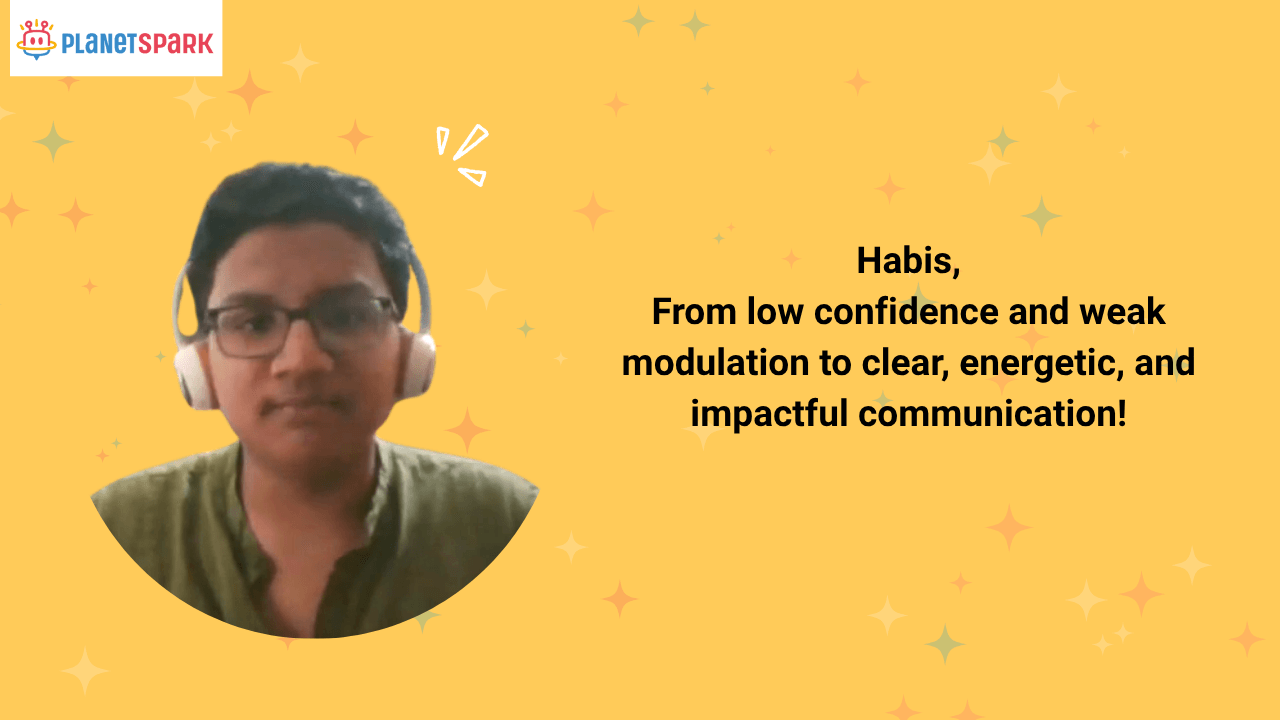
Meet Habis: once a shy speaker, now delivering every message with clarity, confidence, and impressive stage presence.
Through consistent practice and guided training, he transformed his voice, sharpened his articulation, and built the courage to speak in front of any audience.
If you want your child to experience the same powerful transformation, join PlanetSpark’s communication and public speaking classes today and help them become confident, clear, and fearless speakers just like Habis!
Why Speech Clarity Matters for Students
Before moving into techniques, it’s important to understand why speech clarity is essential especially if you are still in school or college.
1. Improves Academic Performance
Clarity helps when delivering answers, oral assessments, group discussions, and presentations. Teachers evaluate not just your content but how effectively you communicate it.
2. Builds Confidence
When students articulate their thoughts clearly, they feel more in control. Good speech clarity reduces anxiety and makes talking in front of groups far less intimidating.
3. Strengthens First Impressions
Whether it’s a debate, a new class, a competition, or an interview, how clearly you speak influences how confidently others perceive you.
4. Enhances Social Communication
Strong speech clarity makes conversations smoother, reduces misunderstandings, and helps build better relationships with peers.
5. Opens Future Career Opportunities
Clear communication is essential in all professions like engineering, medicine, business, law, teaching, media, and more. Starting early gives students an advantage.
Overcoming Stage Fear to Enhance Speech Clarity
Anxiety often causes unclear speech. Students can overcome this with simple steps:
- Practice in smaller groups before large crowds
- Prepare your script and rehearse multiple times
- Use breathing exercises before going on stage
- Visualize success
- Remind yourself that the audience wants you to succeed
Once fear reduces, clarity naturally increases.
PlanetSpark: The Trusted Hub for Clear, Confident, and Effective Speaking
PlanetSpark empowers children to become clear, confident, and effective communicators through personalised training and interactive learning methods. With expert mentors and engaging practice modules, students develop articulation, fluency, active listening, and expressive skills that shape their communication for life.
Why PlanetSpark Is the Top Choice for Speech Clarity Training
- 1:1 personalised communication coaching focused on improving clarity, tone, expression, and confident interaction.
- Certified communication coaches guiding children through structured, engaging, and practical learning sessions.
- Conversation-building and expression modules that help students communicate ideas confidently in both formal and informal settings.
- Live discussions, dialogues, and group interactions that enhance listening skills, quick thinking, and respectful communication habits.
- SparkX AI video-based feedback offering detailed insights on voice, tone, pace, and clarity for continuous improvement.
- Gamified communication learning with SparkBee to strengthen vocabulary, sentence formation, and linguistic accuracy.
- AI-led speaking and conversation practice sessions to help students improve articulation and expression independently anytime.
- Creative clubs, storytelling events, and communication showcases giving children real platforms to practise interaction and express ideas effortlessly.
Speak Boldly, Grow Stronger with PlanetSpark
Speech clarity is not just a communication skill but a life skill. As a student, learning how to improve speech clarity and understanding how to speak more clearly will give you lifelong advantages. It will help you excel academically, communicate more effectively with peers and teachers, perform confidently in presentations and debates, and prepare you for future career opportunities.
Every clear sentence you speak strengthens your voice, shapes your identity, and boosts your ability to influence, inspire, and lead. Begin with small daily steps, follow the exercises consistently, and soon speaking clearly will feel natural and effortless. Your ideas deserve to be heard and clear speech is the key to making sure they are.
Frequently Asked Questions
Speech clarity helps students express ideas confidently, participate effectively in class, and make strong impressions during presentations or discussions. Clear communication also reduces misunderstandings and builds long-term confidence in both academic and real-world situations.
Slowing down, practising articulation exercises, reading aloud, and recording your voice regularly help improve clarity quickly. Consistent practice with these simple techniques strengthens pronunciation, improves pacing, and helps you speak more clearly in everyday situations.
Mumbling usually happens when you speak too fast or don’t open your mouth enough. Practising mouth-opening drills, pronunciation exercises, and speaking slowly helps strengthen clarity and ensures each word is pronounced fully and distinctly.
PlanetSpark offers personalized coaching, interactive speaking activities, and expert feedback that help students strengthen articulation, confidence, and fluency. Their structured modules make clarity-building enjoyable and effective, helping every child speak with precision and impact.
Yes. PlanetSpark’s comprehensive communication program builds clarity, confidence, voice modulation, expression, and presentation skills. Students receive real-time guidance, stage practice, and confidence training that prepare them for debates, interviews, and all public speaking situations.
With daily practice like reading aloud, articulation drills, and breathing exercises, students can notice improvement within a few weeks. Consistency, awareness, and regular speaking opportunities make the biggest difference in achieving long-term clarity and confidence.