

Your Complete Guide to Mastering Communication Skills
Learn key communication skills to speak, listen, and express confidently in every situation with clarity and impact.
Are your words helping you stand out - or holding you back?
Strong communication builds understanding, reduces confusion, and helps you connect meaningfully with others, making it one of the most essential skills for personal and professional success. This ultimate guide will walk you through practical strategies, tips, and exercises to significantly improve your communication skills and become a more confident, effective communicator.
What are Communication Skills?
Communication skills refer to the ability to convey information clearly through speaking, writing, listening, and nonverbal cues. Strong communication skills improve understanding, teamwork, and problem-solving. They involve clarity, active listening, empathy, and confidence in both personal and professional interactions.
Strong communication skills help kids express themselves, teens build social confidence, and adults succeed in personal and professional settings. Whether you want to improve English communication skills, learn the types of communication, or develop effective communication techniques, mastering these skills helps you connect and communicate with clarity in every situation.
Types of Communication Skills
The types of communication skills include verbal and non-verbal communication, written, and visual communication. Together, they help you express ideas clearly, connect confidently, and build strong relationships in any setting.
How to Improve Communication Skills
Improving communication skills takes practice, awareness, and consistency. Whether you want to improve English communication skills, strengthen verbal and non-verbal communication, or develop more effective communication techniques, the process starts with understanding your current abilities and working on key areas step by step.
Here are some practical ways to improve your communication skills:
Practice Active Listening: Pay full attention to what others say before responding. Good communication starts with understanding, not just talking.
Work on Vocabulary and Clarity: Expanding your vocabulary helps you express ideas accurately and confidently. Reading books and listening to good speakers can help improve language flow.
Focus on Body Language: Maintain eye contact, smile, and use gestures naturally, these non-verbal cues make your message more powerful.
Read and Speak Daily: Reading aloud or summarizing articles helps improve pronunciation, tone, and fluency.
Record and Review Yourself: Listening to your own speech helps identify areas like speed, clarity, and confidence that need improvement.
Engage in Group Discussions: Joining conversations, debates, or public speaking sessions helps overcome hesitation and builds social confidence.
Seek Feedback: Ask friends, teachers, or mentors to share what you can improve, feedback helps refine your speaking and listening habits.
If you’re looking for guided improvement, joining a structured communication skills course can accelerate learning. Platforms like PlanetSpark offer interactive sessions where learners practice verbal and non-verbal communication, public speaking, and interpersonal skills through real-time feedback and personalized coaching.
Consistent practice and reflection turn communication from a skill into a strength. The more you speak, listen, and observe, the more naturally confident you become.
Enhance your confidence and fluency with proven strategies — explore
The 7 C's of Effective Communication - Practical Ways to Improve Each Skill
The Seven Cs of Communication form the foundation of all effective communication skills. Whether it’s verbal, non-verbal, or visual communication, these principles ensure your message is clear, professional, and impactful. Understanding and applying them can help learners of all ages express ideas confidently in any setting - from classrooms to workplaces.
Here’s how you can practice and improve each of the Seven Cs:
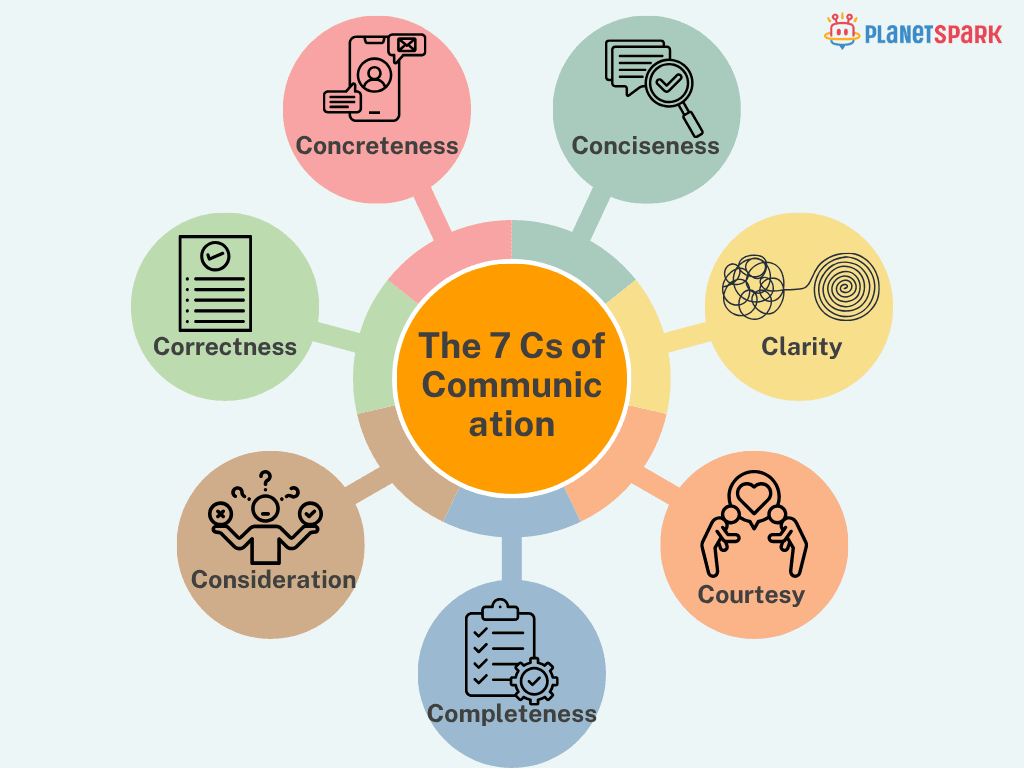
1. Clarity: Express Your Ideas Simply and Clearly
Meaning: Clarity ensures your message is understood easily and prevents confusion.
How to Improve:
Organize your thoughts before speaking or writing.
Avoid jargon or complicated terms unless necessary.
Practical Tips:
Before sending a message, read it once from your listener’s perspective.
Ask someone to summarize what you said - if they can’t, simplify it further.
Recommended Books:
“Made to Stick” by Chip Heath and Dan Heath
“Everyone Communicates, Few Connect” by John C. Maxwell
Learn practical ways to express yourself with clarity and confidence in daily interactions in our blog
How to Achieve Clear Communication in Everyday Conversations.
2. Conciseness: Say More with Fewer Words
Meaning: Conciseness means delivering your message in the fewest, most meaningful words.
How to Improve:
Focus on your key idea and eliminate unnecessary details.
Use short sentences to keep your message direct.
Practical Tips:
Replace long phrases like “due to the fact that” with “because.”
Summarize your main point in one clear sentence before elaborating.
Recommended Books:
“On Writing Well” by William Zinsser
“Brief: Make a Bigger Impact by Saying Less” by Joseph McCormack
3. Concreteness: Support Ideas with Facts and Examples
Meaning: Concreteness gives your message strength and reliability by adding real examples or evidence.
How to Improve:
Use data, visuals, or examples to make your message believable.
Avoid vague terms like “many” or “some.”
Practical Tips:
Back every statement with a fact, story, or visual proof.
When presenting, show examples instead of just describing them.
Recommended Books:
“The Pyramid Principle” by Barbara Minto
“DataStory” by Nancy Duarte
4. Correctness: Ensure Accuracy in Language and Information
Meaning: Correctness ensures your communication is grammatically sound and factually accurate.
How to Improve:
Always proofread your messages for grammar and tone.
Verify facts, figures, and references before sharing.
Practical Tips:
Use tools like Grammarly or Hemingway for quick language checks.
Double-check pronunciations and meanings of difficult words before speaking.
Recommended Books:
“Eats, Shoots & Leaves” by Lynne Truss
“The Elements of Style” by William Strunk Jr. and E.B. White
5. Consideration: Understand Your Audience’s Needs
Meaning: Consideration means keeping your audience’s emotions, background, and expectations in mind.
How to Improve:
Adapt your message to match your listener’s level of understanding.
Be empathetic in tone and content.
Practical Tips:
Ask questions to understand your audience’s needs before communicating.
Use relatable examples and inclusive language to build connection.
Recommended Books:
“Emotional Intelligence” by Daniel Goleman
“Talk Like TED” by Carmine Gallo
6. Completeness: Deliver the Whole Message
Meaning: Completeness ensures your message includes all necessary details and context.
How to Improve:
Provide supporting information like data, sources, or instructions.
Make sure your message answers the “who, what, when, where, and why.”
Practical Tips:
End conversations with clear next steps or action points.
Review your message to ensure no key information is missing.
Recommended Books:
“The Art of Explanation” by Lee LeFever
“Presentation Zen” by Garr Reynolds
7. Courtesy: Communicate with Respect and Empathy
Meaning: Courtesy involves showing respect, kindness, and understanding in every interaction.
How to Improve:
Use polite and inclusive language.
Avoid harsh criticism or negative tone.
Practical Tips:
Express gratitude in every conversation, a simple “thank you” goes a long way.
When giving feedback, start with appreciation before suggesting improvements.
Recommended Books:
“How to Win Friends and Influence People” by Dale Carnegie
“Crucial Conversations” by Kerry Patterson et al.
Dive deeper into the core principles of effective communication in our blog -
7 Cs of Communication: Meaning, Importance, and Examples
Explore expert tips, tools, and guides to strengthen your speaking, writing, and listening abilities in our blog -
Resources to Improve Communication Skills
Understand the key elements that make communication clear, confident, and effective in our blog -
Importance of Communication Skills
The importance of communication skills goes far beyond speaking well. It is the foundation of learning, teamwork, leadership, and personal growth. Whether it’s a classroom discussion, a business meeting, or a casual conversation, good communication helps you express your ideas clearly and understand others better.
Strong communication skills improve confidence, reduce misunderstandings, and build trust. For students, they encourage participation and better academic performance. For professionals, they enhance presentation and leadership abilities. And for adults, they strengthen relationships and decision-making.
Developing effective communication skills also improves listening, empathy, and clarity of thought, qualities that make interactions smoother and more impactful. In a world where collaboration and connection matter, communication is not just a skill, but a life asset.
To understand how communication shapes learning, confidence, and success, explore our detailed guide -
Practice What You Learn
Communication Skills for Different Age Groups
Communication skills evolve as we grow, and each age group needs a different approach to learning them. For kids, communication begins with expressing thoughts clearly and building confidence in speaking. Encouraging storytelling, reading aloud, and simple group discussions help children improve their English communication skills naturally.
For teens, communication becomes a tool for self-expression and connection. They need guidance on verbal communication, body language, and listening to express opinions confidently in school, social settings, and public speaking activities.
For adults, communication skills are crucial for professional success. Strong interpersonal communication and the ability to present ideas clearly improve leadership, teamwork, and workplace relationships. Continuous learning through communication skills courses and practice in real-world scenarios helps adults refine their skills over time.
Discover how communication skills grow and adapt through different life stages in
Modes of Learning
There are multiple modes of learning communication skills, each designed to match different learning preferences and goals.
Interactive Online Classes: Virtual platforms like PlanetSpark offer live sessions where learners practice speaking, listening, and presentation through fun, guided lessons.
Self-Learning Resources: Books, videos, and podcasts on communication skills allow learners to explore topics like verbal and non-verbal communication, effective communication, and confidence-building at their own pace.
Workshops and Group Activities: Real-time group interactions help in developing listening, collaboration, and feedback-based learning.
Practical Application: Speaking daily, joining debates, and presenting in front of others help convert theory into confidence.
A mix of structured guidance and independent practice ensures consistent improvement in English communication skills for both kids and adults.
Boost your speaking, listening, and confidence with expert-recommended reads — check out
Benefits of Communication Skills
Developing strong communication skills offers lifelong advantages. It enhances the ability to express thoughts clearly, build confidence, and connect with people effectively.
For students, good communication improves classroom participation and boosts academic success. For professionals, it strengthens leadership, teamwork, and business communication skills. On a personal level, it builds empathy and understanding in relationships.
With strong verbal and non-verbal communication skills, individuals can adapt easily to different social and professional situations. Effective communication also helps in problem-solving, decision-making, and self-presentation, qualities essential in every stage of life.
To explore how strong communication impacts personal, academic, and professional growth, check out our detailed guide
5 Key Benefits of Communication Skills & How to Nurture Them.
Future Aspect of Communication Learning
The future of communication skills learning is becoming more dynamic and technology-driven. With AI-based feedback tools, interactive learning apps, and global online classrooms, learners can now practice speaking and improve pronunciation in real-time.
In the coming years, communication skills will be one of the most in-demand abilities for students and professionals alike. Skills like public speaking, digital communication, storytelling, and emotional intelligence will play a major role in personal and professional growth.
Learning communication early ensures adaptability in any career path. Platforms like PlanetSpark are shaping this future by combining technology, personalized feedback, and engaging learning experiences to build confident, effective communicators for tomorrow.
Discover how communication skills are evolving with technology and why they’ll remain essential for future success in our blog
Future Aspects of Communication Skills Explained.
Discover how understanding your natural communication rhythm can transform the way you connect -
- 5 Effective Communication Skills for Better Connections
- Read Your Flow: The Secret to Powerful Communication Skills
- How Effective Communication Improves Quality of Life
- Informal Communication: Meaning, Types, Benefits & Examples
- Workplace Communication: Why It Matters More Than Ever
- What Is Grapevine Communication? How to Use It Effectively
Continue Your Learning Journey with Expert Resources
PlanetSpark Communication Skills Course for Kids
The PlanetSpark Communication Skills Course for Kids is designed to make learning communication fun, engaging, and practical. Through live interactive sessions, children learn to express ideas confidently, improve vocabulary, and develop public speaking and presentation skills.
The program focuses on verbal communication, non-verbal communication, storytelling, and creative thinking, helping kids overcome stage fear and become articulate speakers. Each session includes hands-on practice, feedback, and real-world speaking tasks that make learning effective and enjoyable.
PlanetSpark’s structured curriculum helps kids not only speak better but also listen actively, think critically, and express emotions clearly. It lays the foundation for future leadership and success in academics and beyond.
PlanetSpark Communication Skills Course for Adults
The PlanetSpark Communication Skills Course for Adults is designed to help professionals, educators, and learners refine their speaking, listening, and presentation abilities. The course focuses on practical improvement in verbal and non-verbal communication, business communication skills, and public speaking, helping adults express ideas clearly and confidently in any environment.
Through interactive sessions, real-time feedback, and engaging activities, learners build essential workplace and social communication skills. The program also emphasizes English communication skills, including tone, pronunciation, vocabulary, and fluency.
PlanetSpark’s online platform makes it easy for adults to learn at their own pace while getting personalized guidance from expert mentors. Each session helps learners become better speakers, leaders, and collaborators, preparing them for both professional success and personal growth.
Common Communication Skills Interview Questions and Answers
Communication skills interview questions often explore how well you listen, express ideas, resolve conflicts, and adapt to different audiences. Employers look for clarity, confidence, empathy, and professionalism in your responses. By preparing with real workplace examples that show active listening, constructive feedback, and teamwork, candidates can highlight their communication strengths effectively. This helps them stand out as someone who collaborates well, handles pressure, and builds positive relationships at work.
Explore the complete list of communication skills interview questions with smart sample answers in our detailed guide -
How to highlight your communication skills
To highlight your communication skills effectively, focus on showcasing how you listen actively, articulate ideas clearly, and collaborate with others to achieve results. Use real examples that demonstrate your ability to provide feedback, handle conflicts calmly, and adapt your message according to the audience. Emphasizing positive outcomes like smoother teamwork, improved customer satisfaction, or successful presentations helps employers see the practical impact of your communication strengths.
Learning Outcomes
By the end of this communication skills learning journey, learners will be able to:
Understand the Core of Communication: Define communication and identify its types - verbal, non-verbal, written, and visual.
Apply Effective Communication Techniques: Use tone, clarity, and active listening to improve everyday interactions.
Build Strong English Communication Skills: Speak fluently, choose the right words, and express ideas with confidence.
Enhance Public Speaking and Presentation Skills: Deliver structured speeches and presentations that engage and persuade audiences.
Develop Interpersonal Skills: Communicate with empathy, handle conflicts respectfully, and collaborate better in groups.
Adapt Communication to Different Situations: Modify style and tone to suit academic, professional, or personal contexts.
Use Non-Verbal Communication Effectively: Understand the role of body language, gestures, and facial expressions in strengthening messages.
Gain Confidence Through Practice: Participate actively in discussions, storytelling, and role plays to build real-world communication confidence.
This comprehensive approach ensures that every learner - child, teen, or adult - becomes a confident, articulate, and thoughtful communicator, ready to thrive in any environment.
Meet Our Superstars
At PlanetSpark, thousands of learners have transformed their communication skills. From students excelling in academics to professionals gaining confidence in global workplaces, our success stories prove that with the right guidance, anyone can achieve fluency.
PlanetSpark – Making Headlines Nationwide
Your Journey to Effective Communication Starts Here
Communication is more than just speaking, it’s the foundation of confidence, connection, and success in every part of life. With PlanetSpark’s expert-led programs and interactive learning approach, you can master the art of clear expression, active listening, and confident presentation. Start your journey today and build communication skills that empower your voice, strengthen relationships, and open doors to endless opportunities.
For a complete guide to building fluency, confidence, and clarity, explore our main Spoken English pillar page.
For a complete understanding of rules, usage, and examples, explore our English Grammar pillar page.
For techniques, practice tips, and confidence building strategies, explore our Public Speaking pillar page.
For workplace ready communication, confidence, and people skills, explore our Soft Skills pillar page for working professionals.