
Thomas Kilmann Conflict Model for Professionals
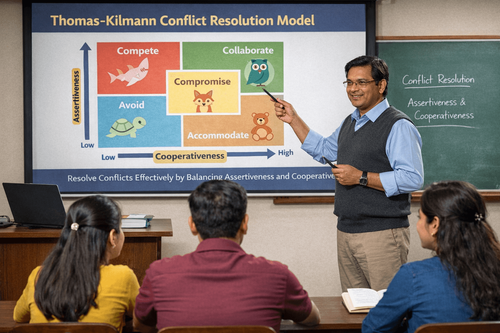

Table of Contents
- What Is the Thomas Kilmann Conflict Model?
- Why the Thomas Kilmann Conflict Model Matters in Professiona
- The Five Styles in the Thomas Kilmann Conflict Resolution Mo
- Understanding Conflict Styles Through the Thomas Kilmann Mod
- Role of Communication Skills in Conflict Resolution
- Thomas Kilmann Conflict Model in Leadership and Teams
- Applying the Thomas Kilmann Conflict Model in Real-Life Scen
- Developing Conflict Management Skills Through Practice
- Why PlanetSpark for Communication Skills and Conflict Resolu
- Building Conflict Competence Through Communication
The Thomas Kilmann Conflict Model explains how individuals respond to conflict based on assertiveness and cooperativeness. Conflict is unavoidable in professional and personal environments, but the way it is handled determines outcomes, relationships, and long-term success. This blog addresses the search intent behind understanding the Thomas Kilmann Conflict Model, explains its five conflict-handling styles, explores real-world applications, and highlights how structured communication skills help individuals manage conflict effectively, ethically, and confidently.

What Is the Thomas Kilmann Conflict Model?
The Thomas Kilmann Conflict Model, also known as the Thomas Kilmann model of conflict resolution, is a widely used framework that categorizes conflict-handling behavior into five distinct styles. Developed by Kenneth Thomas and Ralph Kilmann, the model helps individuals understand how they approach conflict and how alternative approaches can lead to better outcomes.
At its foundation, the model is based on two dimensions:
Assertiveness - the extent to which a person pursues their own concerns
Cooperativeness - the extent to which a person attempts to satisfy others’ concerns
The interaction of these two dimensions results in five conflict management styles.
Why the Thomas Kilmann Conflict Model Matters in Professional Life
Conflict in professional environments is not a sign of failure. It is often a result of differing goals, perspectives, values, or communication styles. The real challenge lies in how conflict is managed.
Why Conflict Management Skills Are Critical
Poor conflict handling damages trust and morale
Unresolved conflicts reduce productivity
Escalated disputes affect team dynamics and leadership credibility
The Conflict resolution model Thomas Kilmann provides a structured way to recognize conflict behaviors and choose responses intentionally rather than emotionally.
Join PlanetSpark’s Communication Skills Course to build clarity and impact.
The Five Styles in the Thomas Kilmann Conflict Resolution Model
Each style in the Thomas kilmann conflict resolution model is appropriate in specific situations. No single style is universally correct or incorrect.
1. Competing (High Assertiveness, Low Cooperativeness)
The competing style focuses on winning the conflict at the expense of others.
Key Characteristics
Firm and decisive
Focused on results
Prioritizes own position
When Competing Is Effective
During emergencies requiring quick decisions
When enforcing rules or standards
When unpopular but necessary actions are needed
Risks of Overusing Competing
Creates resentment
Damages long-term relationships
Reduces collaboration
2. Collaborating (High Assertiveness, High Cooperativeness)
Collaborating aims for a win-win outcome by addressing the concerns of all parties.
Key Characteristics
Open communication
Mutual respect
Problem-solving mindset
When Collaborating Works Best
When relationships matter
When long-term solutions are required
When trust and innovation are priorities
Collaborating is often considered the most constructive style but requires strong communication and emotional intelligence.
3. Compromising (Moderate Assertiveness, Moderate Cooperativeness)
Compromising seeks a middle ground where each side gives up something.
Key Characteristics
Practical and flexible
Focused on fairness
Time-efficient
When Compromising Is Useful
When time is limited
When goals are moderately important
When equal power exists
While compromise resolves conflict quickly, it may not address root causes.
4. Avoiding (Low Assertiveness, Low Cooperativeness)
Avoiding involves withdrawing from the conflict without addressing it.
Key Characteristics
Delay or withdrawal
Emotional distancing
Minimal engagement
When Avoiding Is Appropriate
When the issue is trivial
When emotions are high and cooling-off is needed
When more information is required
Excessive avoidance can lead to unresolved tension and long-term issues.
5. Accommodating (Low Assertiveness, High Cooperativeness)
Accommodating prioritizes others’ needs over one’s own.
Key Characteristics
Empathy-driven
Relationship-focused
Self-sacrificing
When Accommodating Makes Sense
When preserving harmony is critical
When the issue matters more to the other party
When maintaining goodwill is essential
Overuse can result in frustration and unmet personal needs.
Understanding Conflict Styles Through the Thomas Kilmann Model of Conflict Resolution
The Thomas kilmann model of conflict resolution emphasizes adaptability. Effective conflict managers do not rely on a single style but choose the most appropriate approach based on context, people involved, and desired outcomes.
Key Insight
Strong conflict management is not about avoiding conflict but about responding strategically through communication.
Role of Communication Skills in Conflict Resolution
Conflict is rarely about facts alone. It is deeply rooted in communication patterns.
How Communication Breakdowns Escalate Conflict
Assumptions replace clarity
Emotions overpower logic
Intent is misinterpreted
Developing communication skills allows individuals to:
Express concerns calmly
Listen actively
Reframe disagreements constructively
Thomas Kilmann Conflict Model in Leadership and Teams
Leaders play a crucial role in shaping how conflict is perceived and handled within teams.
How Leaders Use the Model Effectively
Diagnose conflict styles within teams
Encourage collaboration over competition
Balance authority with empathy
Impact on Workplace Culture
Builds psychological safety
Encourages open dialogue
Reduces passive-aggressive behavior
Leaders trained in conflict resolution foster resilient and high-performing teams.
Applying the Thomas Kilmann Conflict Model in Real-Life Scenarios
In the Workplace
Performance feedback discussions
Cross-functional disagreements
Role and responsibility conflicts
In Education
Teacher-student communication
Group project disputes
Peer interactions
In Personal Relationships
Boundary setting
Value-based disagreements
Expectation management
The model provides a universal framework adaptable across contexts.
Join PlanetSpark’s Communication Skills Course to build clarity and impact.
Developing Conflict Management Skills Through Practice
Understanding the model is only the first step. Skill development requires practice.
Key Practices for Mastery
Self-assessment of default conflict style
Reflecting after conflicts
Practicing assertive yet empathetic communication
Why PlanetSpark for Communication Skills and Conflict Resolution
PlanetSpark focuses on building structured communication, emotional intelligence, and real-world conflict management skills. Through guided practice, learners understand models like the Thomas Kilmann Conflict Model and apply them confidently in academic, professional, and social situations.
What Learners Develop
Assertive communication
Active listening
Emotional regulation
Ethical conflict resolution strategies
Building Conflict Competence Through Communication
The Thomas Kilmann Conflict Model offers a powerful lens to understand how individuals respond to conflict and how those responses impact outcomes. Conflict itself is neither good nor bad, it is the approach to conflict that defines its consequences. By understanding the Thomas Kilmann conflict resolution model and developing strong communication skills, individuals can move from reactive behavior to intentional conflict management.
Effective conflict resolution requires awareness, adaptability, and empathy. Communication skills form the foundation of this process, enabling individuals to express themselves clearly, listen actively, and choose the right conflict style for the situation. With structured learning and consistent practice, conflict can become a tool for growth rather than a source of stress.
You may also read:
Frequently Asked Questions
The Thomas Kilmann Conflict Model explains five ways individuals respond to conflict based on assertiveness and cooperativeness. For professionals, it provides a practical framework to handle disagreements strategically rather than emotionally, improving leadership effectiveness and workplace relationships.
Leaders use the model to assess situations and choose appropriate conflict styles. It helps them balance authority with collaboration, ensuring decisions are effective without damaging trust or morale.
No single style is superior. The effectiveness of each style depends on context, urgency, and relationship value. The conflict resolution model Thomas Kilmann proposed emphasises flexibility over preference.
Yes. Teams that understand conflict styles communicate more openly, resolve disagreements faster, and reduce friction. This leads to better collaboration, innovation, and productivity.
PlanetSpark integrates the Thomas Kilmann framework into its communication skills course, helping professionals practise real-world conflict conversations, strengthen leadership presence, and manage workplace challenges with confidence.