
What is Project Based Learning? Meaning, Benefits, and Examples
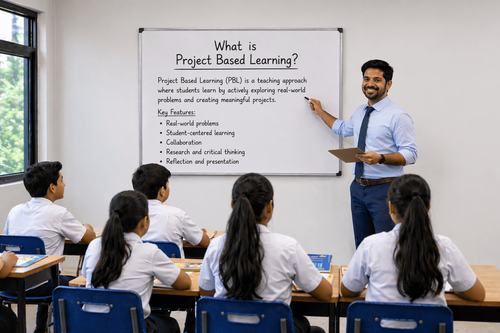

Table of Contents
- What is Project Based Learning?
- Meaning of Project Based Learning in Education
- Core Principles of the PBL Teaching Method
- How Project Based Learning Works Step by Step
- Step 1: Introduce the Driving Question
- Step 2: Plan the Project
- Step 3: Research and Explore
- Step 4: Build Solutions
- Step 5: Present to an Audience
- Step 6: Reflect and Improve
- Benefits of Project Based Learning
- 1. Better Engagement
- 2. Deeper Understanding
- 3. Stronger Communication Skills
- 4. Improved Critical Thinking
- 5. Collaboration Skills
- 6. Confidence Building
- 7. Real-World Readiness
- 8. Supports Different Learning Styles
- Why PBL Supports an Experiential Learning Approach
- Why PBL Promotes Student Centered Learning
- Project Based Learning Examples
- Science Project Examples
- Maths Project Examples
- English Project Examples
- Social Studies Project Examples
- Technology Project Examples
- Project Based Learning for Different Age Groups
- For Primary Students
- For Middle School Students
- For High School Students
- For College Students
- For Adults and Professionals
- Role of Teachers in the PBL Teaching Method
- How to Assess Project Based Learning
- Challenges of Project Based Learning and Solutions
- Challenge 1: Time Management
- Challenge 2: Unequal Team Participation
- Challenge 3: Limited Resources
- Challenge 4: Presentation Anxiety
- Tips to Implement Project Based Learning Successfully
- Start Small
- Choose Relevant Topics
- Build Communication Skills
- Encourage Reflection
- Use Technology Wisely
- Celebrate Outcomes
- Why Communication Skills Matter in PBL
- PlanetSpark Communication Skills Course
- Why Project Based Learning Matters
What is project based learning, and why is it transforming modern education? Project Based Learning (PBL) is a teaching approach where students learn by actively exploring real-world problems, creating solutions, and presenting outcomes. Instead of only memorising facts, learners build knowledge through hands-on tasks, collaboration, and critical thinking. In this blog, you will understand the meaning of PBL, how the PBL teaching method works, key benefits, project based learning examples, and why it supports a strong experiential learning approach and student centered learning for future success.
What is Project Based Learning?
Project Based Learning is an instructional model where students gain knowledge and skills by working on meaningful projects over an extended period. Instead of passively receiving information, learners investigate questions, solve problems, create products, and present findings.
This method shifts education from “learning about” a topic to “learning through doing.”
Simple Definition
Project Based Learning means students learn academic concepts by completing real tasks such as:
- Designing a science model
- Creating a business plan
- Producing a documentary
- Solving a community issue
- Conducting surveys and presenting data
- Writing and performing a play
Why It Matters Today
Modern careers demand more than textbook knowledge. Employers and universities value:
- Communication skills
- Teamwork
- Problem-solving
- Creativity
- Adaptability
- Leadership
PBL helps learners practise these skills early.
Meaning of Project Based Learning in Education
Traditional education often focuses on lectures, worksheets, and exams. PBL adds relevance by connecting learning to real situations.
For example:
- Instead of only reading about pollution, students design awareness campaigns.
- Instead of only learning budgeting formulas, students plan a mock startup budget.
- Instead of only studying storytelling, students create podcasts or presentations.
This makes learning memorable, practical, and engaging.
Core Principles of the PBL Teaching Method
The PBL teaching method is built around purposeful learning experiences. Strong projects usually include the following elements.
1. Real-World Question or Challenge
Students work on a meaningful driving question such as:
- How can we reduce plastic waste in school?
- How can we design a low-cost eco-friendly home?
- How can we encourage reading habits among children?
2. Inquiry and Research
Learners collect information through:
- Books
- Articles
- Interviews
- Surveys
- Experiments
- Observations
3. Student Voice and Choice
Students may choose:
- Project format
- Team roles
- Research methods
- Presentation style
- Creative direction
This strengthens student centered learning.
4. Collaboration
Many projects involve group work, where learners practise:
- Listening
- Negotiation
- Responsibility
- Conflict resolution
- Shared decision-making
5. Creation of a Final Product
Students build something valuable, such as:
- Prototype
- Report
- Campaign
- Video
- App idea
- Presentation
- Exhibition
6. Reflection and Feedback
Students review:
- What worked well
- What could improve
- What they learned
- How they contributed
How Project Based Learning Works Step by Step
Step 1: Introduce the Driving Question
Teachers begin with a challenge that sparks curiosity.
Example: How can we make our neighbourhood cleaner?
Step 2: Plan the Project
Students define:
- Goals
- Tasks
- Timeline
- Team roles
- Needed resources
Step 3: Research and Explore
They gather facts, data, and ideas through inquiry.
Step 4: Build Solutions
Students create their final output.
Step 5: Present to an Audience
They present to classmates, teachers, parents, or community members.
Step 6: Reflect and Improve
Feedback helps deepen learning.
Strong ideas deserve strong communication. Join PlanetSpark Communication Skills Course to help students and adults speak clearly, present confidently, and express ideas with impact.
Benefits of Project Based Learning
PBL offers academic and life-skill advantages.
1. Better Engagement
Students are more motivated when learning feels meaningful.
Instead of asking, “Why do I need this?” they see direct application.
2. Deeper Understanding
Learners connect concepts rather than memorising isolated facts.
For example, a sustainability project can combine:
- Science
- Maths
- Writing
- Presentation skills
- Research
3. Stronger Communication Skills
Students regularly practise:
- Speaking
- Writing
- Explaining ideas
- Persuasion
- Presenting findings
4. Improved Critical Thinking
Projects require analysis, decision-making, and evaluation.
5. Collaboration Skills
Students learn how to work effectively with others.
6. Confidence Building
Completing and presenting projects increases self-belief.
7. Real-World Readiness
PBL mirrors real workplace situations involving deadlines, teamwork, and problem-solving.
8. Supports Different Learning Styles
Visual, auditory, kinesthetic, and verbal learners can all participate meaningfully.
Why PBL Supports an Experiential Learning Approach
An experiential learning approach means learning through experience and reflection. PBL naturally fits this model because students actively participate in tasks instead of only consuming information.
Experiential Learning in Action
Students do not just study entrepreneurship, they create a business model.
Students do not just learn communication theory, they deliver a persuasive pitch.
Students do not just read history, they produce a historical documentary.
This “learn by doing” process improves retention and understanding.
Why PBL Promotes Student Centered Learning
Student centered learning places the learner at the heart of education. Instead of the teacher controlling every step, students take ownership.
In Student Centered Learning, Students:
- Ask questions
- Make decisions
- Explore interests
- Solve challenges
- Reflect on progress
- Create original work
The teacher becomes a guide, mentor, and facilitator.
This increases responsibility and intrinsic motivation.
Project Based Learning Examples
Below are practical project based learning examples across subjects.
Science Project Examples
Build a Water Filter
Students design a simple filtration system and explain the science behind it.
Climate Change Awareness Campaign
Teams research causes, effects, and solutions, then create awareness posters or videos.
Plant Growth Investigation
Students test how sunlight, water, or soil affects plant growth.
Maths Project Examples
School Budget Planning
Students calculate costs for an event.
Design a Dream Room
Use area, perimeter, and budgeting concepts.
Data Survey Project
Conduct a survey and represent findings through graphs.
English Project Examples
Podcast Creation
Students script and record episodes.
Storybook Writing
Create illustrated storybooks for younger children.
Debate Presentation
Research a topic and present arguments.
Social Studies Project Examples
Mini Election Campaign
Students create policies, speeches, and voting systems.
Community Mapping
Map local resources and suggest improvements.
Cultural Heritage Exhibition
Present traditions, food, language, and history.
Technology Project Examples
App Idea Prototype
Students identify a problem and design a digital solution.
Website for Awareness
Build a simple website on a social issue.
Digital Safety Campaign
Create educational content about online safety.
Projects become powerful when learners can present with confidence. PlanetSpark Communication Skills Course helps students and adults master speaking, storytelling, debates, and structured expression.
Project Based Learning for Different Age Groups
For Primary Students
Projects should be simple, visual, and creative.
Examples:
- My family tree
- Plant diary
- Healthy food chart
- Storytelling puppet show
For Middle School Students
Projects can include research and teamwork.
Examples:
- Waste management model
- Local history documentary
- Budget challenge
- Science fair project
For High School Students
Projects can involve deeper analysis.
Examples:
- Startup pitch
- Public policy proposal
- Robotics challenge
- Market research presentation
For College Students
Projects may align with careers.
Examples:
- Brand campaign
- Business strategy case study
- Community impact research
- Product prototype
For Adults and Professionals
PBL is also useful in corporate learning.
Examples:
- Solve a business process issue
- Create sales strategy presentations
- Build training modules
- Team innovation challenge
Role of Teachers in the PBL Teaching Method
Teachers remain essential, but their role changes.
Teachers in PBL:
- Design meaningful projects
- Set learning outcomes
- Provide resources
- Guide research
- Monitor progress
- Give feedback
- Assess performance
They help students stay focused while encouraging independence.
How to Assess Project Based Learning
Assessment in PBL goes beyond exams.
Common Assessment Methods
- Rubrics
- Presentations
- Portfolios
- Peer feedback
- Self-reflection
- Research quality
- Creativity
- Team contribution
What Should Be Evaluated?
- Knowledge accuracy
- Problem-solving ability
- Communication
- Collaboration
- Innovation
- Final product quality
Challenges of Project Based Learning and Solutions
Challenge 1: Time Management
Projects may take longer than lectures.
Solution:
Use clear timelines and milestones.
Challenge 2: Unequal Team Participation
Some students may contribute less.
Solution:
Assign defined roles and peer evaluations.
Challenge 3: Limited Resources
Not every project needs expensive tools.
Solution:
Use digital tools, recycled materials, and local research.
Challenge 4: Presentation Anxiety
Some learners fear public speaking.
Solution:
Offer practice sessions, supportive feedback, and communication coaching.
Tips to Implement Project Based Learning Successfully
Start Small
Begin with mini-projects before long-term projects.
Choose Relevant Topics
Pick challenges connected to real life.
Build Communication Skills
Students should learn how to explain and present ideas.
Encourage Reflection
Ask students what they learned and how they improved.
Use Technology Wisely
Use videos, slides, surveys, and collaboration tools.
Celebrate Outcomes
Showcase projects publicly to motivate learners.
Why Communication Skills Matter in PBL
Even the best ideas can fail if learners cannot communicate them clearly.
Students need to:
- Present findings
- Explain research
- Defend solutions
- Collaborate in teams
- Ask thoughtful questions
- Speak confidently before audiences
That is why communication training complements project-based education perfectly.
PlanetSpark Communication Skills Course
PlanetSpark helps students become confident speakers, expressive writers, and future-ready communicators, making it an excellent companion to project based learning. Every learner receives 1:1 personal trainers who customise sessions based on learning style, pace, and confidence level. The platform offers a personalised curriculum and roadmap that targets fluency, grammar, vocabulary, storytelling, and public speaking growth.
With SparkX AI video analysis, children receive detailed feedback on voice clarity, body language, confidence, grammar, and idea flow. AI-led practice sessions allow independent speaking practice with instant feedback. Through Spark Diary, students build regular writing habits using prompts, reflections, speeches, and stories.
Learning stays exciting through gamified modules like vocabulary games, grammar challenges, spelling tasks, and quizzes. Parents stay informed with structured PTMs and comprehensive progress reports covering content quality, critical thinking, delivery, confidence, and structure.
Beyond classes, learners join clubs and communities such as Debate Club, Story Writing Club, Poetry Circles, Comedy Club, Podcasting Club, and Writers Guild. With Sparkline, children safely share creative work and speeches in a moderated environment. Frequent contests, showcases, and recognitions give students real opportunities to perform and grow.
Want stronger speaking, better presentations, and confident communication for school or career success? Explore PlanetSpark today.
Why Project Based Learning Matters
Project Based Learning is more than a classroom trend, it is a smarter way to prepare learners for the future. It combines academic knowledge with practical application, helping students think critically, collaborate effectively, and solve meaningful problems. Through real tasks and reflection, learners gain deeper understanding and stronger confidence.
Whether in schools, colleges, or workplaces, the PBL teaching method supports an experiential learning approach and student centered learning that makes education relevant and memorable. When paired with strong communication skills, learners can not only create great ideas but also present them powerfully. If you want future-ready growth, Project Based Learning is a proven path worth adopting.
You can also read:
Frequently Asked Questions
Project Based Learning is a method where students learn by completing real projects instead of only reading textbooks. They research, solve problems, create solutions, and present outcomes. It makes learning active, practical, and engaging while developing communication, teamwork, and critical thinking skills.
The main benefits include deeper understanding, better engagement, stronger collaboration, improved confidence, practical problem-solving, and real-world readiness. Students remember concepts better because they apply them in meaningful situations rather than memorising information for exams.
Traditional learning often focuses on lectures, worksheets, and tests. The PBL teaching method focuses on inquiry, hands-on tasks, teamwork, presentations, and reflection. Instead of passively receiving information, students actively build knowledge through experience.
Yes, PBL is effective for adults, college learners, and professionals. It is widely used in workplace training, leadership programs, innovation tasks, and business problem-solving activities. Adults learn faster when they solve realistic challenges linked to their goals.
Communication skills help learners explain ideas, collaborate in teams, ask better questions, and present confidently. Even great projects need clear expression. Platforms like PlanetSpark help students and adults improve speaking, storytelling, writing, and presentation skills, making project based learning outcomes stronger and more impactful.