
Fun Science Experiments Children Can Try at Home | Easy Ideas
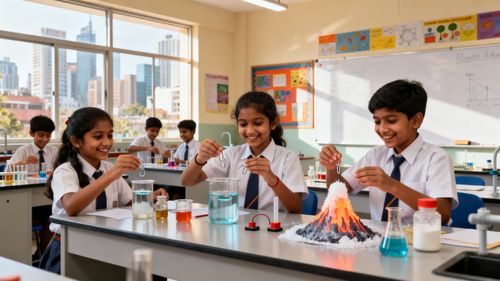

Table of Contents
- Why Try Science Experiments at Home?
- Simple & Fun Science Experiments You Can Try at Home
- How These Experiments Help Kids Learn & Grow
- How to Make Science Experiments a Daily Learning Habit at Ho
- Safety Tips for Doing Science Experiments at Home
- More Than Just Science: Add Creativity with PlanetSpark Crea
- Why PlanetSpark’s Personalized Approach Matters
- Ignite Curiosity, Inspire Expression, Shape the Future
If you’re a parent, guardian, educator, or simply someone who loves nurturing a child’s natural curiosity, you already know that the best learning often happens outside textbooks. Children learn most effectively when they observe, explore, and experiment , and that is exactly what fun science experiments children can try at home offer.
This blog brings you a thoughtfully curated collection of safe, engaging, and easy-to-do experiments using everyday household items. These activities introduce kids to real scientific concepts like chemical reactions, density, air pressure, forces, light, sound, magnetism, and states of matter , all through playful, hands-on exploration. Whether your child is a budding scientist, a curious explorer, or someone who just loves trying new things, these experiments will keep them entertained while strengthening their understanding of how the world works.
You’ll also learn why at-home science play is so beneficial, how it improves creativity, problem-solving ability, observation skills, and scientific thinking, and how simple experiments can turn regular afternoons into exciting discovery sessions filled with learning.
Why Try Science Experiments at Home?
Thinking beyond textbooks can truly be a game-changer for children. At-home science experiments turn abstract concepts , such as density, chemical reactions, buoyancy, air pressure, light, and states of matter , into hands-on, visible experiences that children can see, touch, and understand. These real-world moments of discovery spark curiosity and make learning memorable.
Here’s why these experiments matter so much:
Builds Curiosity and Critical Thinking
Children are naturally inquisitive. Experiments give them a safe and structured way to ask questions like:
Why did the colour change?
Why does this float while that sinks?
Why did it fizz?
This helps them develop hypothesis-building, testing, and reasoning skills.
Makes Learning Tangible and Real
Concepts like surface tension, density, and chemical reactions become crystal clear when children see them happen. Watching vinegar erupt out of a volcano or pepper scatter across water helps them understand cause and effect immediately.
Boosts Scientific Vocabulary and Literacy
Kids begin using words like:
dissolve
react
evaporate
force
density
hypothesis
This early exposure to scientific language strengthens academic readiness.
Enhances Motor Skills and Observation
Pouring liquids, stirring mixtures, measuring ingredients, recording results , experiments make children more coordinated and detail-oriented.
Builds Creativity, Resilience, and Confidence
When an experiment doesn’t work the first time, children learn to adjust and try again. These small challenges teach resilience, patience, creativity, and self-confidence.
Develops an Early STEM Mindset
At-home science helps children connect naturally with STEM concepts. They begin understanding the world using scientific thinking , learning to question, test, observe, and conclude.
Encourages Sensory Exploration
Many experiments engage multiple senses:
Touching Oobleck
Watching colours mix
Hearing sound vibrations
Observing light refraction
This sensory input supports memory, attention, and early brain development.
Teaches Responsibility and Lab Safety Basics
Children learn:
to follow steps in order
use tools carefully
avoid spills
clean up after experiments
handle materials responsibly
This builds discipline and respect for scientific processes.
Strengthens Communication Skills
As children describe what they observed, they automatically practice sequencing, storytelling, vocabulary expansion, and expressive communication.
Makes Learning Social and Fun
When done with siblings, friends, or parents, experiments become joyful group activities. Children compare observations, discuss results, and collaborate , making science meaningful and social.
Simple & Fun Science Experiments You Can Try at Home
Below are engaging, safe, and easy science experiments children can enjoy at home. Most require everyday materials you already have.
Chemical Reaction + Volcanoes & Fizzy Fun
Baking-Soda Volcano
This exciting chemical reaction happens when baking soda (a base) meets vinegar or lemon juice (an acid). Kids watch a fizzy eruption caused by carbon dioxide gas forming rapidly.
Enhance it by:
Adding food colouring for realistic “lava”
Building a volcano shape using clay or dough
Asking kids to predict what happens with more or less vinegar
Mentos & Soda / DIY Lava Lamp
Dropping Mentos into soda creates an explosive fountain due to nucleation sites on the Mentos surface.
A safer indoor option is making a lava lamp:
Fill a bottle with oil
Add coloured water
Drop effervescent tablets
Kids observe rising and falling blobs caused by density differences and gas formation.
States of Matter & Weird Fluids
Oobleck (Cornstarch + Water “Magic”)
Oobleck behaves like a solid when pressed but flows like a liquid when held gently. This teaches children about non-Newtonian fluids.
Questions to ask:
What happens if you punch Oobleck?
What happens if you let it sit?
Can you roll it into a ball?
Oil + Water Density Layers
Fill a glass with honey, water, oil, and dish soap to create colourful density layers. Children learn that heavier liquids sink while lighter ones float.
Drop objects like beads or buttons to discover which level they settle at.
Surface Tension, Floatation & Physics Fun
Pepper + Soap Surface Tension Trick
Sprinkle pepper over water.
When soap touches the surface, the pepper shoots away because soap disrupts water’s surface tension.
This teaches concepts related to:
molecular interactions
hydrophobic vs. hydrophilic properties
Egg in a Bottle / Buoyancy Tests
Using heat to pull an egg into a bottle shows how warm air expands and cool air creates pressure differences.
Floating and sinking tests teach density, buoyancy, and displacement.
Growth, Crystallization & Environmental Learning
Grow Your Own Crystals
Dissolve salt or sugar in warm water until saturated.
Let it sit in a jar with a string dipped inside.
Over days, crystals form beautifully.
Kids learn about:
evaporation
saturation
crystallization
Water Cycle in a Bag / Plant Transpiration
Seal water in a zip-lock bag and place it in sunlight.
Children observe mini evaporation, condensation, and rainfall inside the bag.
Covering a plant leaf with plastic shows water droplets forming, demonstrating transpiration.
Light & Shadow Experiments
Shadow Size Discovery
Use flashlights and objects to explore how shadow size changes as distance changes.
Kids learn about:
angles
blocking of light
opacity and transparency
DIY Rainbow with a Glass of Water
Shining light through a glass of water creates a rainbow due to refraction.
This teaches children about:
light bending
colour spectrum
Sound & Vibration Experiments
Rubber Band Guitar
Different rubber band thicknesses create different sounds.
Children learn that vibration produces sound and pitch depends on thickness and tension.
Dancing Rice Experiment
Stretch cling film over a bowl, place rice on top, and put it over a speaker.
When music plays, rice jumps due to sound waves transferring energy.
Magnetism Experiments
Magnetic Treasure Hunt
Hide metal objects in a rice tray. Let kids find them using a magnet wand.
This builds:
prediction skills
categorization
understanding of magnetic metals
Magnet vs. Non-Magnet Sorting
Children test objects like coins, spoons, toys, keys, and clips to classify items as magnetic or non-magnetic.
How These Experiments Help Kids Learn & Grow
Science experiments at home give children a learning advantage far beyond academics. Here’s how they support holistic development:
Improves Understanding and Retention
Children remember what they experience. Hands-on activities make concepts stick.
Encourages Inquiry & Scientific Thinking
Kids naturally follow the scientific method:
question
hypothesize
test
observe
conclude
Builds Confidence & Creative Problem-Solving
When kids adjust ingredients or fix failed attempts, they build strong creative and analytical abilities.
Strengthens Cognitive & Motor Skills
Recording results, stirring, pouring, measuring , these actions strengthen both mind and body.
Teaches Patience & Focus
Experiments like growing crystals teach patience and the ability to stay engaged over days or weeks.
Boosts Communication Skills
Explaining what they saw builds expressive language, sequence formation, and confidence in speaking.
Reinforces Mathematical Thinking
Children practice:
counting
estimating
measuring
comparing
charting results
Improves Emotional Regulation
They learn that failure isn’t the end , it’s a step toward discovery.
Encourages Innovation
Kids start experimenting independently , changing quantities, steps, or tools to explore more.
How to Make Science Experiments a Daily Learning Habit at Home
Create a Simple “Science Box”
Fill a box with basics like baking soda, food colouring, vinegar, cornstarch, balloons, spoons, and cups.
This makes experiments a go-to activity anytime.
Set Weekly “Science Time”
Choose a specific time once or twice a week.
Routine builds anticipation and consistency.
Encourage a Science Journal
Children can record:
predictions
materials
diagrams
results
This also strengthens writing skills and memory.
Allow Kids to Lead Experiments
Let them choose materials, decide what to test, or create their own versions.
This builds independence and confidence.
Display and Celebrate Their Creations
Take pictures, create a “science wall,” or share their projects with family.
Celebration is a powerful motivator.
Safety Tips for Doing Science Experiments at Home
Always supervise young children.
Use protective eyewear for fizzing or popping experiments.
Avoid mixing strong or unknown chemicals.
Keep liquids and powders away from eyes and face.
Ensure good ventilation during chemical reactions.
Clean the space before and after experiments.
Store all materials safely out of reach after use.
Dispose of experiment mixtures responsibly.
Teach children never to taste or smell unknown liquids.
Have a “safety first” discussion before every experiment.
More Than Just Science: Add Creativity with PlanetSpark Creative Writing Course
If your child enjoys exploring and experimenting , whether with science or stories , the PlanetSpark Creative Writing Course is an excellent companion to STEM learning. It offers a different kind of creative outlet: language, imagination, expression.
What the Course Offers
Genre-Based Curriculum
The course covers short stories, poetry, journal writing, essays, book reviews, and persuasive letters , each with a dedicated lesson plan to help your child explore various writing styles and forms.
Writing + Speaking Integration
Children don’t just write , they also present their written work orally. This helps build expressive confidence, clarity in thought, and narrative flow. The program uses a comprehensive LSRW (Listening, Speaking, Reading, Writing) approach.
Editing, Feedback & Rewriting
Writing isn’t just about the first draft. Students receive real-time teacher feedback, peer reviews, and multiple rounds of editing , teaching them the value of revision, refinement, and improved expression.
Real Publishing Opportunities
Children get chances to publish on PlanetSpark’s blog, e-magazine, or coauthored anthologies , a great confidence boost and a tangible reward for their creativity.
Creativity-Stimulus Activities
Through tools like story dice, writing prompts, image-based exercises, and guided imagination sessions, the course encourages original thinking and creative exploration.
Why PlanetSpark’s Personalized Approach Matters
One size doesn’t fit all , and that’s where the strength of PlanetSpark lies.
1:1 Personal Trainers: Every child is paired with a certified communication expert who understands their learning style, pace, and personality. This ensures individual attention, meaningful feedback, and motivation that’s tailored.
Personalised Curriculum & Learning Roadmap: Starting with an assessment, PlanetSpark crafts a unique path for each learner , covering grammar, vocabulary, fluency, content structure, and confidence-building. The roadmap evolves with the child’s progress.
Advanced AI Learning Tools: With tools like SparkX, students can record speeches or storytelling exercises. The AI analyses elements like voice clarity, body language, grammar, pacing, and confidence , giving a detailed progress report to help improve faster.
AI-Led Practice Sessions: Outside live class hours, students can practice with a virtual AI coach , doing speeches or narrating stories , and get instant feedback. This reinforces learning and builds consistency.
Spark Diary for Writing Habit: A personal digital journal where kids write daily reflections, stories, essays, and poems. Regular journaling fosters clarity of thought, structured writing, and self-expression over time.
Gamified & Engaging Learning: From vocabulary quizzes to grammar challenges, every session is interactive and fun. Kids look forward to learning.
Ignite Curiosity, Inspire Expression, Shape the Future
From bubbling volcanoes to dancing rice, from growing crystals to creating rainbows , every science experiment opens a doorway to curiosity. These simple activities transform everyday moments into opportunities for exploration, imagination, and discovery.
When children combine scientific thinking with strong writing and communication skills, they grow into confident, expressive, and analytical learners. If you want your child to not only do experiments but also explain, narrate, and present their ideas with clarity, the PlanetSpark Creative Writing Course is the perfect next step.
You may also read:
Frequently Asked Questions
Experiments like baking-soda volcanoes, Oobleck, density towers, pepper-soap tension tests, and growing crystals are safe and simple.
Most activities suit ages 4+ with supervision, while older kids can handle more detailed physics or chemistry experiments.
They build curiosity, critical thinking, vocabulary, observation, fine motor skills, patience, and scientific reasoning.
Not at all. Most require common household items like baking soda, vinegar, cornstarch, water, balloons, and food colouring.
Use science journals, ask prediction-based questions, let them lead experiments, repeat activities with variations, and celebrate their curiosity.