
Use Strong Verbs Instead of Weak Verbs to Improve Your Writing
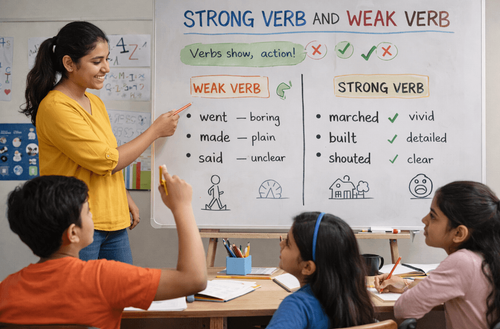

Table of Contents
- What Are Strong Verb and Weak Verb in Writing
- How to Identify Weak Verbs in Sentences
- How to Identify Strong Verbs in Writing
- How to Use Strong Verbs Effectively in Writing
- Examples of Replacing Weak Verbs
- Additional Tips to Build Strong Writing Skills
- Improve Your Child’s Creative Writing Skills with PlanetSpar
- Write Better, Express More, Grow Confidently
Good writing is not just about grammar or vocabulary. It is about how clearly and powerfully you express your ideas. One of the easiest ways to make your writing more engaging is by choosing the right verbs. This is where understanding strong verb and weak verb becomes important.
Many students use common verbs like “went,” “made,” or “did” without realizing that stronger alternatives can make their sentences more vivid and interesting. Strong verbs add energy, clarity, and emotion to your writing, while weak verbs often make sentences sound dull or unclear.
If you want to improve your creative writing skills, learning the difference between strong and weak verbs is a great place to start. In this blog, you will explore how to identify weak verbs, how to identify strong verbs, and how to use them effectively. You will also discover practical examples and a helpful strong and weak verbs list to guide your practice.
What Are Strong Verb and Weak Verb in Writing

A strong verb and weak verb differ mainly in how much meaning and detail they add to a sentence. This difference may seem small at first, but it has a huge impact on how your writing sounds and feels to the reader.
A weak verb is usually simple and general. Words like “go,” “make,” “do,” and “have” are commonly used in everyday language. While they are correct, they do not give a clear picture of the action. Readers may understand the sentence, but they do not feel it.
A strong verb, on the other hand, is more specific and descriptive. It shows exactly what is happening and often adds emotion or intensity to the sentence. Strong verbs help readers imagine the scene clearly, almost like watching a movie in their mind.
Examples to understand the difference
- Weak: She went to the stage
- Strong: She marched to the stage
- Weak: He made a drawing
- Strong: He sketched a drawing
- Weak: The boy looked at the painting
- Strong: The boy admired the painting
Why strong verbs matter in writing
- They make your writing more vivid and interesting
- They help readers visualize actions clearly
- They reduce unnecessary words in sentences
- They improve storytelling and creativity
Deeper understanding
When you use weak verbs, you often need extra words to explain the action. For example, “ran quickly” uses both a verb and an adverb. A strong verb like “sprinted” replaces both and makes the sentence sharper.
Over time, using strong verbs helps students become better writers. It improves not just vocabulary but also confidence in expressing ideas.
How to Identify Weak Verbs in Sentences
Identifying weak verbs is the first step toward improving your writing. Since weak verbs are commonly used, many students do not realize when they are using them.
Common weak verbs to watch for
- Go
- Make
- Do
- Have
- Get
- Say
These verbs are not incorrect, but they are often too broad. They do not tell the reader exactly what is happening.
Signs that a verb is weak
- The sentence feels plain or boring
If the sentence does not create a strong image, the verb may be weak - The action is unclear
Words like “do” or “make” can mean many things - You need extra words to explain the action
Weak verbs often depend on adverbs or phrases
Example comparison
- Weak: She went slowly to the door
- Strong: She crept to the door
- Weak: He made a loud noise
- Strong: He yelled
Why students overuse weak verbs
- They are easier to remember
- They are used frequently in daily conversation
- Students may not know stronger alternatives
Practice strategy
Take a paragraph from your writing and underline all the verbs. Check if any of them are weak. Try replacing them with stronger verbs that better describe the action.
This simple habit can quickly improve your writing quality.
How to Identify Strong Verbs in Writing
Strong verbs are powerful tools that bring life to your sentences. Learning to identify them helps you improve both reading and writing skills.
Characteristics of strong verbs
- They are specific
Strong verbs describe exactly how an action happens - They add emotion
Words like “whispered,” “shouted,” or “grinned” show feelings - They create clear images
Readers can easily imagine the action - They reduce extra words
A strong verb often replaces a weak verb and an adverb
Examples of strong verbs
- Walk → Stroll, march, tiptoe
- Look → Gaze, stare, glance
- Eat → Devour, nibble, munch
- Speak → Whisper, shout, explain
Understanding through comparison
- Weak: The girl looked at the stars
- Strong: The girl gazed at the stars
- Weak: The dog ran quickly
- Strong: The dog darted across the yard
How to build a strong verb habit
- Read storybooks and notice action words
- Maintain a personal vocabulary notebook
- Practice replacing verbs in daily writing
Advanced tip
Try to imagine the action in your mind. Then choose a verb that best describes what you see. This technique helps you naturally pick stronger verbs.
Over time, identifying strong verbs becomes easier, and your writing becomes more expressive and engaging.
How to Use Strong Verbs Effectively in Writing
Using strong verbs effectively is about making your writing clearer, not more complicated. It requires careful selection and understanding of context.
Tips to use strong verbs effectively
- Match the verb to the situation
Choose verbs that fit the tone and meaning of your sentence - Avoid overusing dramatic verbs
Not every sentence needs a powerful verb. Balance is important - Keep sentences natural
Do not force a strong verb if it does not fit - Focus on clarity
The main goal is to make your writing easy to understand
Example transformation
- Weak: She made a happy face
- Strong: She smiled
- Weak: He went quickly to his seat
- Strong: He hurried to his seat
Why this matters
Using strong verbs correctly improves readability and makes your writing more enjoyable. It also helps you communicate ideas more effectively.
Common mistakes
- Replacing verbs without checking meaning
- Using very complex words unnecessarily
- Overloading sentences with too many strong verbs
Practice tip
Write a short paragraph and then revise it by replacing weak verbs. Compare both versions to see the difference.
Examples of Replacing Weak Verbs
Examples make learning easier and more practical. Let us explore how weak verbs can be replaced with stronger ones.
Sentence improvements
- Weak: He went to the playground
Strong: He ran to the playground - Weak: She said something softly
Strong: She whispered - Weak: The baby cried loudly
Strong: The baby wailed - Weak: The teacher looked at the notebook
Strong: The teacher examined the notebook
Why these changes are effective
- They make sentences shorter and clearer
- They add emotion and detail
- They improve reader engagement
Strong and weak verbs list
| Weak Verb | Strong Verb Options |
|---|---|
| Go | Run, walk, rush, stroll |
| Say | Whisper, shout, explain |
| Make | Create, build, design |
| Look | Stare, glance, observe |
| Eat | Devour, nibble, chew |
Practice exercise
Pick five sentences and replace weak verbs with stronger ones. Try to use different verbs each time.
Regular practice using a strong and weak verbs list helps students improve faster and build confidence in writing.
Additional Tips to Build Strong Writing Skills
Improving verb usage is just one part of becoming a good writer. Here are some extra tips to help students grow.
Useful habits
- Read books regularly to learn new words
- Write short stories or daily journals
- Learn synonyms for common verbs
- Ask for feedback from teachers or parents
Why practice matters
Writing is a skill that improves with time. The more you practice, the more natural it becomes to use strong verbs.
Fun activity
Play a word replacement game where you change weak verbs into strong ones. This makes learning enjoyable and interactive.

Improve Your Child’s Creative Writing Skills with PlanetSpark
PlanetSpark’s creative writing programs are designed to help children become confident and expressive writers. The focus is not just on grammar but on building creativity, imagination, and storytelling ability.
- Live 1:1 sessions with expert teachers
Each child gets personalized attention. Teachers identify individual gaps and help improve writing step by step with focused guidance - Creative writing through storytelling practice
Children learn how to use strong verbs naturally by writing stories, descriptions, and narratives that make their ideas come alive - Focus on vocabulary and expression
Special exercises are designed to replace weak verbs with stronger alternatives, helping children build a richer vocabulary - AI-powered feedback system
Kids receive instant and detailed feedback on their writing. This helps them understand mistakes and improve quickly - Interactive and engaging classes
Lessons are fun and activity-based, ensuring children stay interested while learning important writing skills - Confidence-building exercises
Children learn to express their ideas clearly and creatively, which improves both writing and speaking confidence - Structured curriculum for long-term growth
The program is designed to take students from basic writing skills to advanced storytelling in a step-by-step manner
Why PlanetSpark stands out
PlanetSpark focuses on real improvement, not just theory. It combines expert teaching, practical exercises, and technology to create a powerful learning experience. Children do not just learn writing rules but learn how to apply them effectively.

Write Better, Express More, Grow Confidently
Understanding the difference between strong verb and weak verb is one of the simplest yet most powerful ways to improve writing. It helps children move from basic sentences to expressive and engaging storytelling.
When students start using strong verbs, their writing becomes clearer, more creative, and more enjoyable to read. They learn to express ideas with confidence and develop a stronger connection with their readers.
Encourage your child to practice regularly, explore new words, and experiment with different ways of expressing ideas. Small improvements, like replacing weak verbs, can create a big impact over time.
With consistent effort, the right guidance, and a love for learning, every child can become a confident writer who communicates ideas effectively and creatively.
Frequently Asked Questions
A strong verb clearly shows action and adds detail, while a weak verb is more general and less descriptive. Strong verbs improve the quality of writing. Weak verbs often need extra words to explain meaning.
Strong verbs make writing more interesting and clear. They help readers imagine the action better. They also improve storytelling skills.
Look for common verbs like “go,” “make,” or “do.” If the sentence feels unclear or needs extra words, the verb may be weak.
It is a list that shows weak verbs and their stronger alternatives. It helps students improve vocabulary and writing skills.
Yes, strong verbs often replace weak verbs and adverbs. For example, “ran quickly” can be replaced with “sprinted.”
Kids can practice by rewriting sentences and replacing weak verbs. Reading books also helps them learn new words.
Strong verbs are useful, but they should be used correctly. The verb must match the meaning and context of the sentence.