
What Is PEEL Method in Writing Explained


Table of Contents
- What is the PEEL Method in Writing with Structure and Exampl
- Understanding the PEEL Paragraph Structure
- How to Write a Paragraph Using the PEEL Method
- Common Mistakes to Avoid in PEEL Writing
- Using the PEEL Method in Essay Writing Structure
- Practical Tips to Master the PEEL Method
- Build Powerful Writing Skills with PlanetSpark Creative Writ
- Your Journey to Confident Writing Starts Here
Struggling to turn your ideas into clear, high-scoring paragraphs? You are not alone. Many learners have great thoughts but lack the structure to express them effectively. That is exactly where the PEEL method becomes a game-changer.
If you have been wondering what the PEEL method in writing is, this guide will give you a complete, practical understanding of how to use it. You will learn the peel method in writing, explore the peel paragraph structure, see real examples, and discover how to apply it in essays and daily writing.
By the end, you will not just understand the method but confidently use it to improve your writing clarity, structure, and impact.
What is the PEEL Method in Writing with Structure and Example
The PEEL method is a structured framework for writing clear, focused, and persuasive paragraphs. If you are wondering what the PEEL method is for writing, it is a practical technique that helps you organise your ideas step by step, making your writing logical, easy to follow, and impactful.
Many learners struggle not because they lack ideas, but because they do not know how to present those ideas effectively. Their writing may feel scattered, incomplete, or difficult to understand. The PEEL method solves this problem by giving a clear structure that guides your thinking and writing.
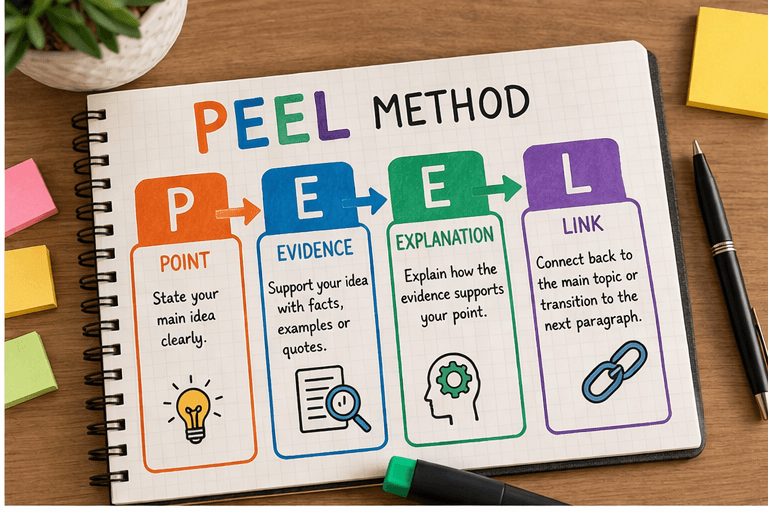
PEEL stands for:
- Point
- Evidence
- Explanation
- Link
Each of these elements plays a specific role in building a strong paragraph. When combined, they create writing that is clear, convincing, and well-organised.
Why the PEEL Method Matters
Using the peel method in writing ensures that every paragraph is complete and meaningful rather than vague or confusing. It helps you focus on one idea at a time and develop it fully.
When you follow this method, each paragraph:
- Focuses on one clear idea instead of multiple scattered thoughts
- Supports that idea with strong and relevant evidence
- Explains the reasoning so the reader understands your thinking
- Connects back to the main topic, maintaining flow throughout the writing
This improves both clarity and logical flow, which are essential for effective communication in academics and beyond.
Key Benefits
1. Improved Structure and Organisation
One of the biggest advantages of the PEEL method is that it brings structure to your writing. Instead of writing randomly, you follow a clear sequence of steps.
This makes your writing:
- More organized
- Easier to plan
- Clear direction
For example, when you start with a point, you know exactly what the paragraph will discuss. Then, each sentence has a purpose, which avoids confusion and keeps your writing focused.
2. Stronger Arguments with Evidence
Without evidence, writing often sounds like an opinion. The PEEL method ensures that you always support your ideas with facts, examples, or research.
This makes your writing:
- More convincing
- More credible
- More impactful
For instance, instead of simply saying “exercise is important,” you provide data or examples to prove it. This shows a deeper understanding and strengthens your argument.
3. Better Readability
Readability means how easily a reader can understand your writing. A well-structured paragraph is much easier to read than one with random or disconnected ideas.
The PEEL method improves readability because:
- Ideas are presented in a logical order
- Each sentence connects smoothly to the next
- The reader always knows what to expect
This is especially important in exams and academic writing, where clarity plays a major role in scoring well.
4. Higher Academic Performance
Teachers and examiners look for structured, logical, and well-supported answers. The PEEL method naturally includes all these qualities.
When you use PEEL:
- Your answers look organised
- Your arguments are supported with evidence
- Your explanations show critical thinking
As a result, your writing stands out and often receives higher marks.
5. Builds Confidence for Self-Learners
For self-learners, writing can feel confusing because there is no clear starting point. The PEEL method removes this uncertainty by giving you a simple formula to follow.
Instead of asking “What should I write next?”, you follow:
Point → Evidence → Explanation → Link
Over time:
- Writing becomes faster
- Mistakes reduce
- Confidence increases
This makes the peel method in writing a powerful tool for independent learners.
Are you missing out on structured writing skills?
Book a FREE trial class today and secure a brighter communication future. Limited seats.
Understanding the PEEL Paragraph Structure
The peel paragraph structure divides a paragraph into four logical parts. Each part plays a crucial role in building a strong and complete argument.
1. Point (Topic Sentence)
The point is the first sentence of your paragraph. It clearly states the main idea and tells the reader what the paragraph will discuss.
A strong point:
- Is clear and direct
- Focuses on one idea
- Sets the direction for the paragraph
Example:
Reading daily improves language skills.
This sentence works because it immediately tells the reader what the paragraph will explain. It acts like a mini introduction to your idea.
2. Evidence (Support)
Evidence is what makes your writing believable. It supports your point with real information, which strengthens your argument.
Types of evidence include:
- Statistics
- Quotes
- Real-life examples
- Case studies
Evidence is important because it shows that your idea is not just a personal opinion but is backed by facts or experience.
For example, if you say reading improves language skills, adding research or examples makes your claim stronger and more convincing.
3. Explanation (Analysis)
Explanation is where you show your understanding. It connects the evidence to your point and explains why it matters.
Many learners skip this step, but it is the most important part because it shows your thinking process.
In this step, you:
- Interpret the evidence
- Explain its significance
- Connect it back to your main idea
You answer questions like:
- Why is this important?
- How does this support my point?
This step turns basic writing into analytical and high-quality writing.
4. Link (Conclusion or Transition)
The link is the final sentence of your paragraph. It brings everything together and gives a sense of completion.
A good link:
- Reinforces the main idea
- Connects back to the overall topic
- Prepares the reader for the next paragraph
Without a link, the paragraph may feel unfinished or disconnected.
How to Write a Paragraph Using the PEEL Method
Learning how to write a paragraph using the PEEL method becomes much easier when you follow a clear and systematic approach. Instead of guessing what to write next, the PEEL framework guides you step by step, ensuring your paragraph is logical, structured, and impactful.
Step-by-Step Approach
Step 1: Identify Your Main Idea
Before you begin writing, take a moment to fully understand the topic or question. Ask yourself what the paragraph should focus on. This step is important because a clear understanding of the topic helps you stay focused and avoid going off track.
For example, if the topic is about the benefits of reading, your main idea could focus on vocabulary improvement, knowledge gain, or creativity. Choose one clear idea for each paragraph.
Step 2: Write the Point
Start your paragraph with a strong topic sentence that clearly states your main idea. This is the foundation of your paragraph and serves as a mini-thesis.
A good point should be:
- Direct and easy to understand
- Relevant to the topic
- Focused on one idea
Example: Reading regularly improves a student’s vocabulary.
Step 3: Add Evidence
Once your point is clear, support it with evidence. This makes your writing more convincing and credible. Evidence shows that your idea is not just an opinion but is backed by facts or examples.
You can use:
- Real-life examples
- Statistics or data
- Personal experiences
- Research findings
Example: Students who read daily learn thousands of new words each year.
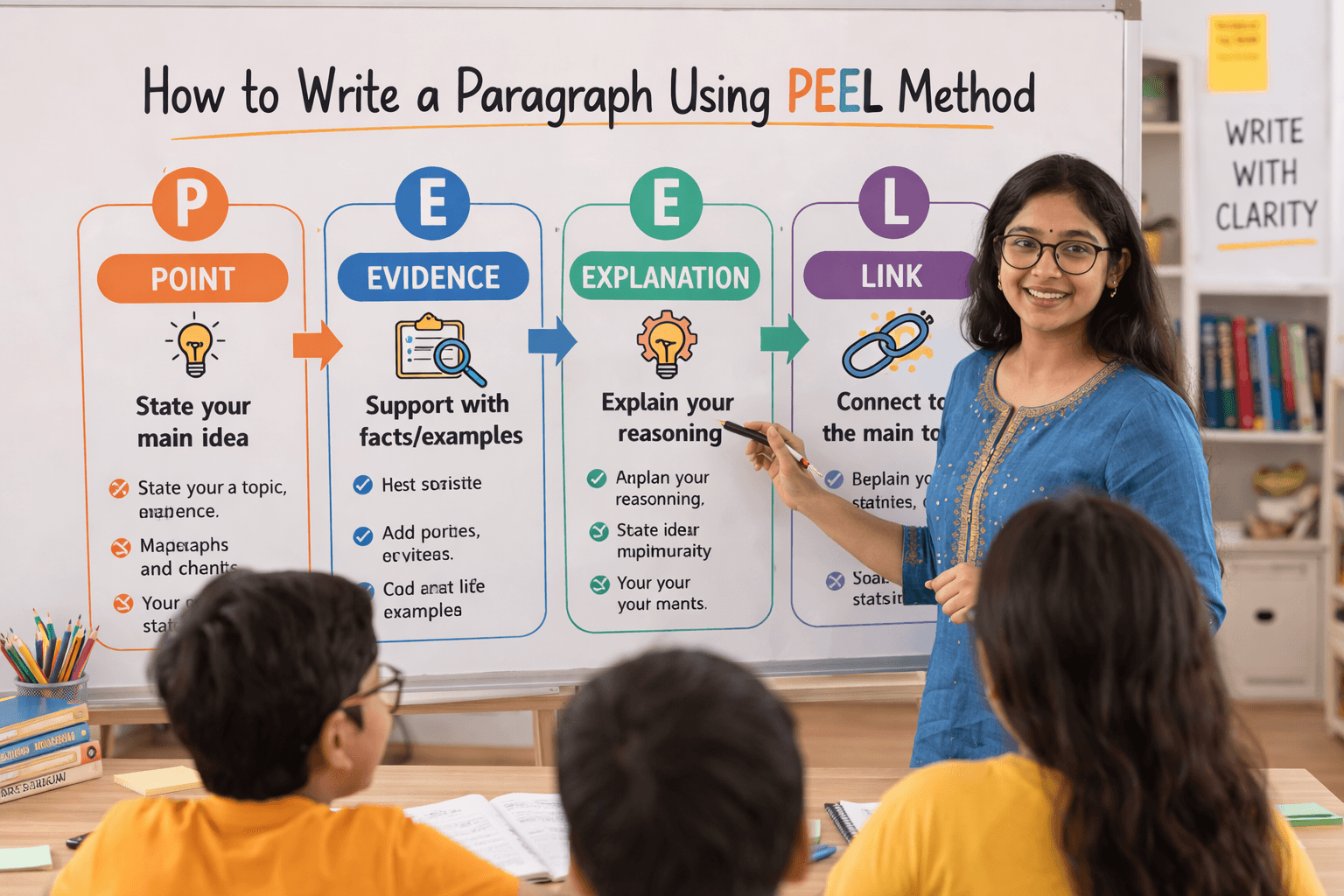
Step 4: Explain Clearly
This is one of the most important steps. Many learners skip this part or do it weakly. Explanation helps the reader understand why your evidence matters.
Here, you connect your evidence to your point and show your understanding.
Example: This exposure helps students understand how words are used in context, improving both their vocabulary and communication skills.
Step 5: Link Back
Finally, close your paragraph by linking it back to the main topic or transitioning to the next idea. This gives your paragraph a complete and polished feel.
Example: Therefore, reading regularly plays a key role in improving language skills.
Quick Checklist
Before finishing your paragraph, always review it using this checklist:
- Does it have a clear and focused point?
- Is there strong and relevant evidence?
- Have I explained the idea properly?
- Does the paragraph link back to the main topic?
Using this checklist ensures that your paragraph follows the complete peel paragraph structure and maintains clarity throughout.
Still unsure if your paragraphs are structured correctly?
Book your demo session now and get expert feedback instantly. Limited slots available.
Common Mistakes to Avoid in PEEL Writing
Even though the peel method in writing is simple and effective, learners often make common mistakes that weaken their paragraphs. Understanding these mistakes can help you improve faster.
1. Writing a Weak Point
A vague or unclear topic sentence makes it difficult for the reader to understand your idea. Your point should always be specific and directly related to the topic.
Weak example: Reading is good. Strong example: Reading regularly improves vocabulary and comprehension skills.
2. Skipping Evidence
Without evidence, your paragraph lacks credibility. It becomes an opinion rather than a strong argument. Always support your point with relevant examples or facts.
3. Poor Explanation
Many learners include evidence but fail to explain it properly. This creates confusion. Explanation is about showing your understanding and connecting ideas clearly.
4. Missing the Link
A paragraph without a link feels incomplete. The link helps connect your idea back to the main topic and improves flow between paragraphs.
5. Adding Too Many Ideas
Trying to include multiple ideas in a single paragraph makes it messy and hard to follow. Stick to one main idea per paragraph.
6. Repetition
Repeating the same idea in different words does not add value. Instead, focus on developing your idea with a meaningful explanation.
By avoiding these mistakes, you can strengthen your paragraph writing techniques and make your writing more effective and engaging.
Want to write essays that stand out in school and competitions?
Start your PlanetSpark journey today and build real writing confidence.
Using the PEEL Method in Essay Writing Structure
The PEEL method is not just limited to paragraphs. It plays a crucial role in creating a strong, well-organised essay structure.
How It Works in Essays
An essay is usually divided into three main parts:
- Introduction
- Body paragraphs
- Conclusion
The body paragraphs are where the PEEL method is applied. Each paragraph focuses on one main idea and follows the PEEL structure.
Example Flow
Introduction
The introduction presents the topic and gives a brief overview of what the essay will discuss. It sets the direction for the reader.
Body Paragraphs
Each paragraph follows the PEEL structure:
- Point: Introduces the main idea
- Evidence: Supports the idea
- Explanation: Explains the reasoning
- Link: Connects back to the topic
This structure ensures that each paragraph contributes meaningfully to the essay as a whole.
Conclusion
The conclusion summarises the key points and reinforces the essay's main argument. It gives a sense of closure to the reader.
Benefits of Using PEEL in Essays
- Maintains clarity across all paragraphs
- Ensures smooth logical flow
- Strengthens arguments with proper support
- Makes essays easier to read and understand
When you use the peel paragraph structure in essays, your writing becomes more organised, professional, and impactful. It also helps you score better in academic assessments because your ideas are presented clearly and logically.
Practical Tips to Master the PEEL Method
Mastering the peel method in writing does not happen overnight. It requires consistent practice, awareness of structure, and a willingness to improve. The good news is that with the right strategies, anyone can become confident in using the PEEL method effectively.
Effective Tips
1. Practice Writing Daily
Consistency is key to improving writing skills. Try writing at least one paragraph every day using the PEEL structure. Start with simple topics and gradually move to more complex ones. Over time, this practice will help you naturally organise your thoughts without effort.
2. Read Well-Structured Essays
Reading high-quality essays helps you understand how experienced writers use the peel method in writing. Pay attention to how each paragraph is structured. Notice how the point is introduced, how evidence is used, and how ideas are explained and linked. This observation builds your understanding and improves your own writing style.
3. Use Simple and Clear Language
Many learners believe that using complex words improves writing. In reality, clarity matters more than complexity. Focus on expressing your ideas in a simple and direct way so that your reader can easily understand your message.
4. Focus on One Idea at a Time
A strong paragraph focuses on a single idea. Avoid trying to include too many points in one paragraph, as this can confuse the reader. The PEEL method works best when each paragraph has a clear and focused purpose.
5. Edit Your Work Carefully
Writing is only the first step. Editing is where improvement happens. After writing your paragraph, review it using the PEEL checklist:
- Is the point clear?
- Is the evidence relevant?
- Is the explanation strong enough?
- Does the paragraph link back properly?
Editing helps you refine your work and identify areas for improvement.
6. Seek Feedback Regularly
Getting feedback from teachers, mentors, or peers can significantly improve your writing. Others can point out mistakes or gaps that you may not notice yourself. Constructive feedback helps you grow faster and avoid repeating the same errors.
7. Use Templates Initially
If you are a beginner, using a simple PEEL template can be very helpful. For example:
- Point: One sentence stating the idea
- Evidence: One or two supporting lines
- Explanation: Two to three lines explaining the idea
- Link: One concluding sentence
As you become more comfortable, you can adapt and personalise this structure to suit your writing style.
Advanced Tip
Rewrite Weak Paragraphs Using PEEL
One of the most effective ways to improve is to take a poorly written paragraph and rewrite it using the PEEL method.
For example:
- Identify what is missing in the paragraph
- Add a clear point
- Include strong evidence
- Improve the explanation
- Add a proper link
This exercise helps you understand the difference between weak and strong writing. It also trains your mind to think more structurally.
Why These Tips Work
These strategies are designed to build both skill and confidence. With regular practice and proper guidance, the writing peel method becomes second nature. You will start organising your ideas automatically, leading to clearer and more impactful writing.
Over time, you will notice that your paragraph writing techniques improve, your essays become more structured, and your overall communication becomes stronger.
Are you practising writing but still not seeing real improvement?
Book a trial class now and get a personalised learning plan before seats fill up. Limited spots available.
Build Powerful Writing Skills with PlanetSpark Creative Writing
PlanetSpark creative writing classes are designed to help learners master structured writing techniques like the PEEL method while building confidence, clarity, and creativity.
Whether you are struggling with grammar, paragraph structure, or public speaking, PlanetSpark provides a complete learning ecosystem that ensures long-term improvement.
Why Choose PlanetSpark?
- 1:1 personal creative writing for all
- Personalised curriculum and learning roadmap
- SparkX AI-powered video analysis for performance tracking
- AI-led practice sessions for continuous improvement
- Spark Diary to build daily writing habits
- Gamified learning tools like SparkBee for fun practice
- Regular PTMs with detailed feedback and progress reports
- Creative clubs like Debate, Story Writing, Podcasting, and more
- Sparkline platform for safe content sharing and confidence building
- Competitions and showcases for real-world exposure
- SparkShop with engaging eBooks for skill development
These features ensure that learning is not just theoretical but practical, engaging, and result-driven.

Your Journey to Confident Writing Starts Here
Writing is a skill that shapes how you express your thoughts, ideas, and creativity. The PEEL method gives you a clear path to organise your thinking and communicate effectively.
With consistent practice and the right guidance, you can transform your writing from basic to powerful. Keep practising, stay curious, and focus on clarity. Over time, structured writing will become your natural strength, helping you succeed in academics and beyond.
Also Read: Build Strong Expressive Writing Skills for Confident Young Writers
How to Be More Confident: Practical Tips for Professional Growth
Frequently Asked Questions
At PlanetSpark, we teach that the PEEL method is a structured way to write paragraphs using Point, Evidence, Explanation, and Link for clarity and impact.
It helps learners organise ideas logically, making writing clearer and more effective.
It involves presenting an idea, supporting it with evidence, explaining it, and linking it back to the topic.
Start with a point, add evidence, explain it clearly, and end with a link to the main topic.
Yes, it strengthens the essay's structure by ensuring that each paragraph is clear and well-supported.
Some techniques include descriptive, narrative, and analytical writing, but PEEL offers the best structure.
Practice regularly, follow the structure, and get expert feedback for improvement.