
Fix Common Sentence Mistakes Easily for Kids


Table of Contents
- What Are Common Sentence Mistakes?
- Why Do Students Make Grammar Errors in Speaking and Writing?
- Top Common Sentence Mistakes and How to Fix Them
- Incorrect Sentence Examples Students Must Avoid
- Fixing Grammar Mistakes Easily with Daily Habits
- Sentence Correction Exercises for Students
- How Parents and Teachers Can Help Children Improve Faster
- Build Error-Free English with PlanetSpark’s English Grammar
- Conclusion: Strong Sentences Create Strong Futures
Do your sentences sound right but still get marked wrong in school? Many students make common sentence mistakes while speaking or writing without even noticing. These small grammar errors can reduce marks, create confusion, and affect confidence in communication.
The good news is that grammar improvement does not have to feel difficult. With the right guidance and regular practice, students can fix mistakes quickly and start speaking and writing with clarity.
In this detailed guide, you will learn the most common grammar errors students make, why they happen, how to correct them, and simple exercises to improve accuracy. You will also discover how structured learning through PlanetSpark english grammar classes helps children become confident communicators.
What Are Common Sentence Mistakes?
Common sentence mistakes are errors in grammar, punctuation, sentence structure, or word choice that make writing or speaking unclear, confusing, or incorrect. These mistakes are especially common among school students because English has many rules that take time and practice to learn. When children understand these mistakes early, they can improve their communication skills, score better in exams, and speak with more confidence.
Even small mistakes can change the meaning of a sentence. For example, saying She go to school instead of She goes to school sounds incorrect and may confuse the listener. That is why learning to identify and fix common sentence mistakes is an important step in mastering English.
Students often make errors in the following areas:
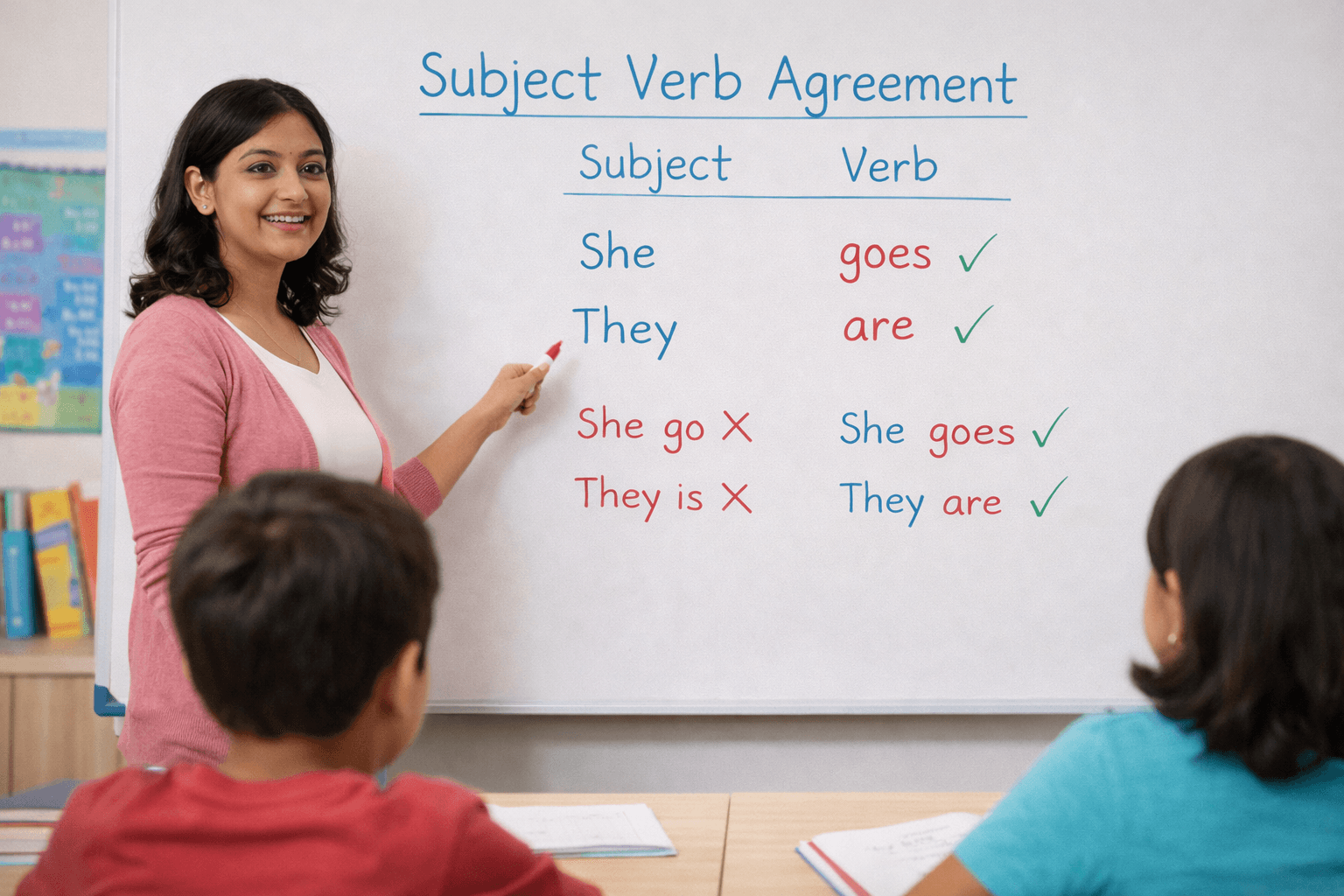
1. Subject Verb Agreement
This means the subject and the verb must match in number.
- Singular subject = singular verb
- Plural subject = plural verb
Incorrect:
She go to school every day.
Correct:
She goes to school every day.
More Examples:
- He play cricket. → He plays cricket.
- They is happy. → They are happy.
When students learn this rule, sentences sound natural and grammatically correct.
2. Pronoun Usage
Pronouns are words like I, me, he, she, they, we. Students often confuse when to use I and me.
Use I when you are doing the action.
Use me when the action happens to you.
Incorrect:
Me and Riya played football.
Correct:
Riya and I played football.
More Examples:
- Me went home. → I went home.
- Teacher called I. → Teacher called me.
Correct pronoun use improves speaking and writing instantly.
3. Tense Errors
Tenses show when an action happens: past, present, or future.
Students often mix tenses in one sentence.
Incorrect:
He go yesterday.
Correct:
He went yesterday.
More Examples:
- I eat lunch now. → I am eating lunch now.
- She will came tomorrow. → She will come tomorrow.
Understanding tenses helps students speak clearly about time.
4. Capitalization Mistakes
Capital letters should be used:
- At the beginning of a sentence
- For names of people
- For cities, countries, places
- For days and months
Incorrect:
i live in Jaipur.
Correct:
I live in Jaipur.
More Examples:
- my friend rahul is here. → My friend Rahul is here.
- we went on monday. → We went on Monday.
Capitalization makes writing neat and professional.
Seats for personalized grammar batches fill quickly every week.
Book your FREE trial class now and start visible improvement early.
5. Punctuation Errors
Punctuation marks such as full stops, commas, and question marks help organize ideas.
Incorrect:
Where are you going
Correct:
Where are you going**?**
More Examples:
- I like apples oranges and bananas. → I like apples**,** oranges**,** and bananas.
- We played outside it rained later. → We played outside**.** It rained later.
Correct punctuation improves readability.
6. Word Order Mistakes
English sentences usually follow:
Subject + Verb + Object
Incorrect:
To school I every day go.
Correct:
I go to school every day.
More Examples:
- Very happy I am. → I am very happy.
- Playing she is outside. → She is playing outside.
Good word order makes sentences easy to understand.
7. Double Negatives
Using two negative words in one sentence creates confusion.
Incorrect:
I don’t need no help.
Correct:
I don’t need any help.
More Examples:
- I can’t find nothing. → I can’t find anything.
- We didn’t see nobody. → We didn’t see anybody.
Use one negative word only.
8. Run-on Sentences
A run-on sentence happens when two complete ideas are joined without proper punctuation.
Incorrect:
I love football it is exciting.
Correct:
I love football. It is exciting.
More Examples:
- She studied hard she passed. → She studied hard, so she passed.
Breaking long thoughts into shorter sentences improves clarity.
Why Students Make These Mistakes
Students usually make common sentence mistakes because:
- They are still learning grammar rules
- They translate directly from their first language
- They speak quickly without checking grammar
- They do not read enough English books
- They need more practice and correction
These mistakes are normal and can be corrected with consistent learning.
How to Improve Quickly
- Read English daily
- Write short paragraphs
- Practice sentence correction exercises
- Speak slowly and clearly
- Learn one grammar rule each day
- Get feedback from teachers or trainers
Recognizing these patterns is the first step in fixing grammar mistakes easily. Once students understand where they go wrong, they can improve faster and build confidence in English.
Still confused by grammar corrections?
Book a FREE PlanetSpark trial class today before slots fill this week.
Why Do Students Make Grammar Errors in Speaking and Writing?
Students are constantly learning language, so making mistakes is a natural part of the learning process. Every child goes through a stage where grammar rules feel confusing, especially when they are trying to speak quickly or write under pressure. However, when the same mistakes happen again and again, it usually points to certain habits or gaps in learning.
Understanding the reasons behind grammar mistakes helps parents, teachers, and students solve the problem faster. Once children know why they make errors, they can improve with the right practice and support.
1. Mother Tongue Influence
Many students think in their first language and then translate directly into English. Since sentence structure is different in every language, this often leads to awkward or incorrect English sentences.
Example:
Incorrect: I to market went.
Correct: I went to the market.
This happens because some languages place verbs at the end of the sentence, while English usually follows Subject + Verb + Object order.
How to Improve:
- Listen to natural English conversations
- Read simple English books
- Practice ready-made sentence patterns
2. Weak Grammar Basics
If children do not clearly understand verbs, pronouns, tenses, or sentence structure, forming correct sentences becomes difficult. They may know vocabulary words but not know how to place them correctly.
Example:
Incorrect: He have a pencil.
Correct: He has a pencil.
Without strong basics, even simple sentences can go wrong.
How to Improve:
- Learn one grammar concept at a time
- Revise basic rules weekly
- Practice with worksheets and exercises
3. Fast Speaking Habits
Many children speak very quickly because they are excited, nervous, or trying to respond fast. When they rush, they often forget grammar rules and make grammar errors in speaking.
Example:
Incorrect: She go there yesterday.
Correct: She went there yesterday.
Speaking too fast can lead to tense mistakes, missing words, or wrong verb forms.
How to Improve:
- Slow down while speaking
- Pause before answering
- Think of the sentence first, then speak
4. Lack of Reading Practice
Reading helps children absorb grammar naturally. When students read stories, articles, or books regularly, they begin to recognize correct sentence patterns without memorizing rules.
A child who reads often sees examples like:
- She goes to school every day.
- They were happy yesterday.
- Rahul and I played together.
Without reading exposure, children may repeat only spoken patterns, which are not always grammatically correct.
How to Improve:
- Read 15 minutes daily
- Choose age-appropriate books
- Read aloud for better retention
5. Fear of Being Corrected
Some students become nervous when others correct them. They may start speaking less, rushing their words, or avoiding English completely. This fear blocks progress.
Children need correction, but it should be encouraging and respectful.
Wrong Approach:
- Laughing at mistakes
- Scolding repeatedly
- Comparing with others
Better Approach:
- Correct gently
- Praise effort
- Let children try again confidently
When students feel safe, they learn faster.
Final Solution
Most grammar mistakes improve through:
- Consistent practice
- Positive correction
- Daily reading
- Speaking practice
- Guided expert support
When children learn in a supportive environment, they become confident communicators.
Top Common Sentence Mistakes and How to Fix Them
Students often repeat a few common mistakes. Once these patterns are understood, grammar becomes much easier.
Subject Verb Agreement
The subject and verb must match in number.
Incorrect:
She go to class.
Correct:
She goes to class.
Incorrect:
They is ready.
Correct:
They are ready.
Tip:
Use -s / -es with singular third-person subjects like he, she, it.
Pronoun Errors (Me vs I)
Use I when you are the subject doing the action.
Incorrect:
Me and Rahul went home.
Correct:
Rahul and I went home.
Tip:
Remove the other name and test it:
- Me went home ❌
- I went home ✅
Double Negatives
Use only one negative word.
Incorrect:
I don’t know nothing.
Correct:
I don’t know anything.
Tip:
Use words like anything, anybody, any help after negative verbs.
Apostrophe Errors
Many students confuse it’s and its.
- It’s = It is
- Its = possession
Incorrect:
The dog wagged it’s tail.
Correct:
The dog wagged its tail.
Capitalization Mistakes
Use capital letters for:
- First word of a sentence
- Names
- Places
- Days and months
Incorrect:
my brother lives in delhi.
Correct:
My brother lives in Delhi.
Run-on Sentences
Two complete ideas should not be joined without punctuation.
Incorrect:
I love cricket it is exciting.
Correct:
I love cricket. It is exciting.
Tip:
Use a full stop, comma with conjunction, or semicolon.

Incorrect Sentence Examples Students Must Avoid
Reviewing incorrect sentence examples daily helps children remember correct structures faster.
Want your child to stop repeating the same grammar mistakes?
Book a PlanetSpark demo now and get expert correction from day one.
Fixing Grammar Mistakes Easily with Daily Habits
Grammar improves through routine, not memorization alone. Small daily habits often work better than long study sessions.
Read 15 Minutes Daily
Storybooks, newspapers, and articles expose children to correct grammar naturally.
Speak Slowly and Clearly
Thinking before speaking reduces mistakes instantly.
Maintain a Grammar Notebook
Write:
- Wrong sentence
- Correct sentence
- Rule learned
Learn One Rule Per Day
Example:
- Today: Subject verb agreement
- Tomorrow: Punctuation
- Next day: Pronouns
Practice with Parents
Parents can ask children to speak about their day in English for five minutes.
Use Corrections Immediately
If corrected once, repeat the correct sentence aloud three times.
These small habits create long-term fluency.
Read more tips to speak English easily.
Sentence Correction Exercises for Students
Correct these sentences:
- She don’t like mangoes.
- Me and Riya are friends.
- they live in mumbai.
- I did not went there.
- We was happy.
- He have two books.
- I don’t need no water.
Answers
- She doesn’t like mangoes.
- Riya and I are friends.
- They live in Mumbai.
- I did not go there.
- We were happy.
- He has two books.
- I don’t need any water.
Regular sentence correction exercises sharpen grammar awareness quickly.
How Parents and Teachers Can Help Children Improve Faster
Children learn grammar best when mistakes are corrected positively. Supportive guidance builds confidence and motivation.
What Parents Can Do
- Encourage reading aloud
- Correct gently without embarrassment
- Appreciate improvement
- Practice conversation daily
- Ask children to rewrite incorrect sentences
What Teachers Can Do
- Use real-life speaking activities
- Give instant feedback
- Use grammar games
- Focus on patterns, not punishment
- Build confidence first
Children improve faster when learning feels safe and enjoyable.
Worried your child understands rules but cannot apply them?
Reserve a PlanetSpark trial today and turn grammar into real speaking confidence.
Build Error-Free English with PlanetSpark’s English Grammar Classes
PlanetSpark english grammar classes are designed for school students who struggle with grammar mistakes, weak sentence formation, hesitation in speaking, and low confidence in writing.
Instead of rote memorization, PlanetSpark teaches grammar through real usage, communication practice, storytelling, writing tasks, and live feedback. Children learn how grammar works in everyday speaking and school success.
Students move from basics like nouns, punctuation, and tenses to advanced skills like sentence structure, fluency, editing, and expression.
Why Structured Learning Matters
Many students know grammar rules but cannot apply them while speaking or writing. PlanetSpark bridges this gap through guided practice.
Features and USPs
- Live interactive online classes
- Certified expert trainers
- Personalized feedback after every class
- Speaking + writing integrated practice
- Confidence-building curriculum
- Regular progress tracking
- Age-appropriate grammar roadmap
Who It Is For
- School students
- Kids struggling in English exams
- Students making repeated grammar mistakes
- Children afraid to speak English
- Learners wanting polished communication skills
Why Strong Grammar Builds Lifelong Confidence
Grammar is not only about marks. It is about expressing ideas clearly and being understood.
Children with strong grammar often:
- Write better answers in exams
- Speak confidently in class
- Perform better in interviews later
- Build stronger vocabulary
- Communicate clearly with others
Good grammar gives students a long-term advantage in academics and life.

Conclusion: Strong Sentences Create Strong Futures
Every great communicator starts with clear sentence building. When students learn to fix common sentence mistakes, they become stronger writers, sharper thinkers, and more confident speakers.
Grammar improvement does not happen overnight, but daily practice creates lasting change. With the right habits and expert support, every child can master English confidently.
Start today, stay consistent, and watch confidence grow sentence by sentence.
Also Read: 30 Common Grammar Mistakes in English and How to Correct Them
Frequently Asked Questions
Common sentence mistakes include tense errors, subject verb agreement issues, punctuation mistakes, wrong pronouns, and incorrect word order.
Daily reading, sentence correction exercises, and guided feedback from experts help children improve faster.
Many children understand grammar in theory but need practice applying it in speaking and writing.
Yes. PlanetSpark offers live interactive classes with expert trainers and personalized feedback.
PlanetSpark classes are suitable for school-going children across multiple grades based on skill level.
You may see improvement within a few weeks, but strong grammar develops with consistent effort over time.
No. PlanetSpark also supports public speaking, creative writing, reading fluency, and communication skills.