
Fix Incomplete Sentences to Make Your Writing Clear and Effective
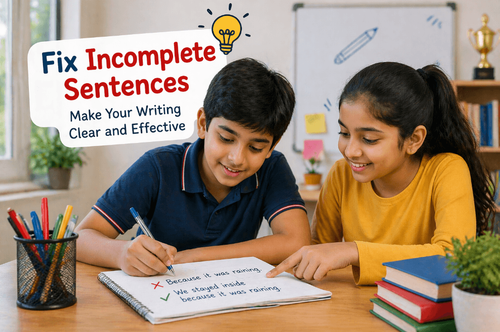

Table of Contents
- What is an Incomplete Sentence and Why It Matters
- Identify the Fragment in a Sentence
- Methods to Fix Fragments and Incomplete Sentences
- Examples of Corrections for Better Understanding
- Tips for Clear and Effective Writing
- Practice Exercises to Master Sentence Completion
- Fun Activities to Practice Complete Sentences
- Common Mistakes Kids Should Avoid
- Your Child’s Grammar Skills Can Grow with PlanetSpark
- Build Strong Writing Skills for a Brighter Future
Have you ever written a sentence that felt unfinished or confusing? That is often because of an incomplete sentence. Many children and early learners struggle with sentence formation, especially when they are still learning grammar rules. Writing an incomplete sentence can make ideas unclear and difficult for readers to understand.
An incomplete sentence happens when a sentence is missing a subject, verb, or complete idea. It leaves the reader confused and makes writing less effective. Learning how to correct such mistakes helps you express your thoughts clearly and confidently.
Understanding how to identify and fix such mistakes is an important step toward becoming a confident writer. When you know how sentences work, you can express your thoughts clearly and creatively. This is especially helpful in school assignments, storytelling, and everyday communication.
What is an Incomplete Sentence and Why It Matters
An incomplete sentence is a group of words that does not express a complete thought. It is often called a sentence fragment. A complete sentence must have a subject and a verb and must make sense on its own. Understanding what an incomplete sentence is helps kids avoid common writing mistakes. It also builds a strong foundation in grammar, which is essential for school assignments and communication.
For example:
- “Running in the park.”
This is an incomplete sentence because it does not tell us who is running or what is happening fully.
Key reasons why incomplete sentences are a problem
- They confuse the reader and make the message unclear
- They make writing look unorganized and weak
- They reduce marks in exams and assignments
- They affect confidence while writing
Common causes of incomplete sentences
- Missing subject
- Missing verb
- Dependent clauses standing alone
- Thought not fully expressed
Example
- Incomplete: Because I was late.
- Complete: I missed the bus because I was late.
When you understand how incomplete sentences work, you can avoid them easily. This improves both your writing quality and your confidence.
Why learning this concept is important
- Improves clarity in writing
Complete sentences make your ideas easy to understand. - Builds strong grammar foundation
Learning sentence structure helps in all areas of language. - Boosts confidence in communication
When you write correctly, you feel more confident sharing your thoughts. - Helps in exams and assignments
Correct sentence formation is important for scoring well.
Sometimes students come across exercises like incomplete sentence blank, where they need to fill in missing parts. These exercises are useful because they help you practice completing ideas correctly.
Understanding this concept early helps children avoid common mistakes and become better writers over time.
Identify the Fragment in a Sentence
Before you can fix an incomplete sentence, you need to identify it. A fragment is a group of words that looks like a sentence but is missing something important.
A complete sentence must have:
- A subject
- A verb
- A complete idea
If any of these are missing, the sentence is incomplete.
Common types of sentence fragments
- Missing subject
Example: “Went to the store.”
We do not know who went to the store. - Missing verb
Example: “The boy in the playground.”
There is no action in this sentence. - Incomplete thought
Example: “Because it was raining.”
This leaves the reader wondering what happened next.
How to identify fragments easily
- Ask yourself: Does this sentence make complete sense?
- Check if there is a subject and a verb
- Read it aloud to see if it sounds complete
Children often make mistakes while writing quickly or when they are unsure about sentence structure. Recognizing fragments is the first step toward improvement.
Practice idea
Look at your school notebook and try to find sentences that feel incomplete. This simple activity can help you become more aware of your writing. You can also read your sentence aloud, and if it sounds unfinished or confusing, it is likely a fragment.
Learning to identify fragments is like solving a puzzle. Once you practice regularly, it becomes easy and fun.
Methods to Fix Fragments and Incomplete Sentences
Fixing an incomplete sentence is not difficult once you understand the basic rules. The goal is to turn a fragment into a complete and meaningful sentence. Once you identify an incomplete sentence, the next step is to fix it. There are several simple ways to turn fragments into complete sentences.
Simple methods to fix fragments
- Add a subject
Incomplete: Running fast.
Complete: The dog is running fast. - Add a verb
Incomplete: The girl with a red bag.
Complete: The girl is carrying a red bag. - Complete the thought
Incomplete: Because it was raining.
Complete: We stayed indoors because it was raining. - Join with another sentence
Incomplete: When I reached school.
Complete: When I reached school, the class had already started.
Complete the thought
Sometimes a sentence starts but does not finish the idea. Add more information to make it complete.
- Fragment: “Because he was late.”
- Correct: “He missed the bus because he was late.”
Join with another sentence
Fragments can often be fixed by joining them with a complete sentence.
- Fragment: “When I reached school.”
- Correct: “When I reached school, the class had already started.”
Rewrite the sentence
If a fragment is too confusing, rewrite it completely. This helps you express your idea more clearly.
Why these methods work
These methods help you create sentences that are clear, complete, and meaningful. With practice, fixing fragments becomes easy and natural.
Examples of Corrections for Better Understanding
Learning through examples is one of the best ways to understand grammar. Let us look at some common incomplete sentence corrections.
Example 1
- Fragment: “After the movie ended.”
- Correct: “We went home after the movie ended.”
Example 2
- Fragment: “The girl with the red bag.”
- Correct: “The girl with the red bag is my friend.”
Example 3
- Fragment: “While playing in the garden.”
- Correct: “He found a coin while playing in the garden.”
Example 4
- Fragment: “Because it was too hot.”
- Correct: “We stayed indoors because it was too hot.”
Example 5
- Incomplete: When the bell rang.
- Complete: When the bell rang, the students left the classroom.
What you can learn from these examples
- Every sentence needs a complete idea
- Adding small details can make a big difference
- Practice helps you avoid repeating mistakes
Why examples are important
- They help you understand real usage
- They make learning simple and clear
- They improve your ability to correct mistakes independently
Encourage children to create their own examples and correct them. This builds understanding and improves writing skills. Try writing your own sentences and check if they are complete. If not, apply the correction methods you learned.
Tips for Clear and Effective Writing
Good writing is not just about correct grammar. It is also about clarity and expression. Avoiding incomplete sentence errors is an important step toward clear writing.
Practical tips for kids
- Use simple sentences first
Start with basic sentence structures before trying complex ones - Read your writing aloud
This helps you identify mistakes and incomplete ideas - Check for subject and verb
Always make sure your sentence has both - Avoid very long sentences
Short sentences are easier to understand - Practice regularly
Writing daily improves your skills over time
Building good writing habits
Children who practice writing regularly become more confident. They learn to organize their thoughts and express them clearly.
Why clarity matters
Clear writing helps readers understand your ideas quickly. It also makes your work more enjoyable to read.
Practice Exercises to Master Sentence Completion
Practice is the best way to improve grammar skills. The more you practice, the better you become at identifying and fixing incomplete sentences.
Exercise 1: Identify the fragment
- Because it was sunny
- The girl in the classroom
- Running towards the bus
Exercise 2: Fix the sentences
- After finishing homework
- The dog in the garden
- While reading a book
Exercise 3: Create your own sentences
Write 5 complete sentences using:
- Because
- When
- After
Learning outcome
These exercises help kids apply what they have learned. They also build confidence and improve writing skills over time.
Fun Activities to Practice Complete Sentences
Learning grammar does not have to be boring. Fun activities can make it exciting and engaging for kids.
Activity ideas
- Sentence building game
Give words and ask children to form complete sentences - Fill in the blanks
Use incomplete sentence blank exercises to practice - Story completion
Start a story and let children complete it using full sentences - Error correction challenge
Provide incorrect sentences and ask kids to fix them
Benefits of these activities
- Makes learning interactive
- Improves understanding through practice
- Builds confidence in writing
Children learn best when they enjoy the process. Adding fun to learning helps them stay interested and motivated.

Common Mistakes Kids Should Avoid
While learning sentence formation, children often make similar mistakes. Being aware of these can help them improve faster.
Frequent errors
- Writing without a subject
- Forgetting the verb
- Leaving sentences unfinished
- Using too many words without clarity
How to overcome these mistakes
- Practice writing daily
- Review and edit your work
- Learn from feedback
- Focus on one concept at a time
Avoiding these mistakes will help children develop strong grammar skills and improve their writing quality.
Your Child’s Grammar Skills Can Grow with PlanetSpark
PlanetSpark’s English grammar programs are designed to help children master concepts like incomplete sentences in a fun and engaging way. The focus is on building strong fundamentals while making learning enjoyable.
- Live 1:1 classes with expert teachers
Personalized attention ensures that each child learns at their own pace and gets proper guidance - Interactive and engaging sessions
Lessons are designed to keep children interested and motivated to learn - Practice-based learning approach
Children learn by doing, which helps them understand concepts better - Real-time feedback and improvement
Immediate feedback helps correct mistakes and build confidence - Structured curriculum for grammar mastery
Lessons are planned to cover all important topics step by step - Focus on writing and communication skills
Children learn how to express their ideas clearly and effectively - Fun activities and exercises
Learning becomes enjoyable through games and creative tasks
Make PlanetSpark your all-time great choice
PlanetSpark combines expert teaching, interactive methods, and practical learning. It helps children not only understand grammar but also apply it confidently in real life.

Build Strong Writing Skills for a Brighter Future
Learning to fix an incomplete sentence is an important step toward becoming a confident writer. When children understand sentence structure, they can express their ideas clearly and creatively.
With regular practice and the right guidance, writing becomes easier and more enjoyable. Encourage children to keep learning, experimenting, and improving their skills every day.
Strong writing skills open doors to better communication, academic success, and creative expression. Start early, stay consistent, and watch your child grow into a confident communicator.
Frequently Asked Questions
An incomplete sentence is a group of words that does not express a complete thought. It may be missing a subject, verb, or complete idea. Fixing it makes writing clearer.
Kids can check if the sentence makes sense and has both a subject and a verb. Reading aloud also helps identify incomplete ideas.
It is a practice activity where children fill in missing parts of a sentence. This helps them learn how to complete thoughts correctly.
Children often make these mistakes because they are still learning grammar rules. Practice and guidance help them improve.
They can be fixed by adding missing words, completing the idea, or joining with another sentence. Practice makes it easier.
Parents can encourage daily writing, provide feedback, and use fun activities to make learning enjoyable.
Clear writing helps children express their ideas better. It also improves their performance in school and builds confidence.