
Printable Grade 8 English Worksheet: Synonyms, Antonyms & Analogies

Printable Grade 8 English Worksheet: Synonyms, Antonyms & Analogies
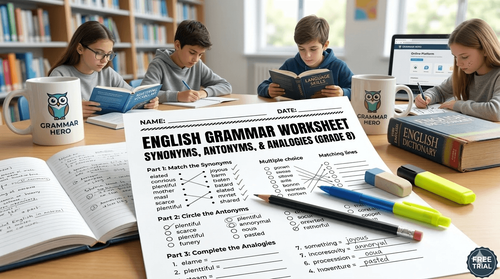
A strong vocabulary helps students read, write, and communicate with confidence. In Grade 8, learning how words relate to each other through synonyms, antonyms, and analogies is an important step in developing advanced language skills. This English grammar worksheet on Synonyms, Antonyms, and Analogies helps students recognize relationships between words, understand meanings more clearly, and use the right words in the right context. By practicing these exercises, students improve both their grammar accuracy and their ability to express ideas effectively.
What Is Synonyms, Antonyms, And Analogies?
Synonyms, antonyms, and analogies help students understand how words are connected.
A synonym is a word that has the same or nearly the same meaning as another word. For example, the words “strong” and “powerful” have similar meanings, so they are synonyms.
An antonym is a word that has the opposite meaning of another word. For example, “modern” and “ancient” show opposite ideas, so they are antonyms.
An analogy shows a relationship between two pairs of words. For example, “author : book” shows that an author writes a book. Analogies help students understand how two things are connected through meaning or function.
In Grade 8, students learn to recognize these relationships between words and apply them correctly while reading, writing, and answering exam questions. This English grammar worksheet focuses on identifying synonyms, antonyms, and analogies through different types of exercises.
What’s In This Worksheet?
This Grade 8 English grammar worksheet includes a variety of exercises that help students practice identifying word relationships.
1. Matching word relationships
Students match words with their correct synonym, antonym, or analogy to understand how words relate to each other.
2. Sorting word pairs
Students classify word pairs into two categories: synonyms and analogies. This helps them understand the difference between similar meanings and word relationships.
3. Fill in the blanks
Students complete sentences using a synonym, antonym, or analogy of the word given in brackets. This exercise improves vocabulary usage in context.
4. Multiple choice questions
Students choose the correct synonym, antonym, or analogy from several options. This helps them identify correct word meanings and relationships.
5. Sentence rewriting
Students rewrite sentences by replacing the underlined word with a synonym, antonym, or analogy as directed. This helps them practice using vocabulary accurately in sentences.
These exercises help students strengthen vocabulary, understand word relationships, and prepare for grammar questions that commonly appear in school exams.
Definitions, Examples, Techniques, And Tips
Definitions
Synonyms are words that have similar meanings.
Example:
strong – powerful
elated – joyous
Antonyms are words that have opposite meanings.
Example:
modern – ancient
mandatory – optional
Analogies show the relationship between two words or ideas.
Example:
author : book
painter : canvas
Examples
strong – powerful (synonym)
plentiful – scarce (antonym)
author – book (analogy)
These examples show how vocabulary words are connected through meaning or function.
Techniques
Read the sentence carefully before choosing a synonym or antonym.
Look at the context of the sentence to understand whether the word should have a similar meaning or an opposite meaning.
When solving analogy questions, think about the relationship between the first pair of words and apply the same relationship to the second pair.
Quick Learning Tips
Learn common synonym pairs to expand vocabulary.
Practice identifying opposite meanings to recognize antonyms easily.
Think about how two words are related when solving analogies.
Regular practice with exercises like this English grammar worksheet improves word recognition and vocabulary skills.
Why Is It Important To Learn This?
Learning synonyms, antonyms, and analogies is important because it strengthens vocabulary and improves communication skills.
Students who understand synonyms can use a variety of words while writing instead of repeating the same word again and again.
Understanding antonyms helps students clearly express opposite ideas and understand contrasts in reading passages.
Analogies improve logical thinking by helping students understand relationships between words.
For Grade 8 students, these skills are especially useful for grammar tests, comprehension passages, and vocabulary questions. Practicing with this English grammar worksheet builds confidence and helps students answer questions more accurately.
Where Will This Knowledge Help You?
Knowledge of synonyms, antonyms, and analogies is useful in many academic situations.
In exams, students often encounter vocabulary questions that ask them to identify similar or opposite meanings.
In writing tasks, students can improve sentence quality by using synonyms instead of repeating the same words.
During reading comprehension, understanding antonyms and synonyms helps students understand passages more clearly.
In class discussions and presentations, using varied vocabulary helps students communicate ideas more effectively.
Practicing with this Grade 8 English grammar worksheet helps students develop stronger language skills that support both academic learning and everyday communication.
How To Use This Worksheet?
1. Attempt the worksheet independently
Students should first try to solve all the questions without looking at the answers. This helps them test their understanding of synonyms, antonyms, and analogies.
2. Read each question carefully
Look at the words in the sentence and think about whether the answer requires a similar meaning, an opposite meaning, or a word relationship.
3. Review the answers carefully
After completing the worksheet, compare your responses with the answer key to check accuracy.
4. Correct mistakes and learn from them
If an answer is incorrect, understand why the correct answer works better in the sentence.
The solutions provided below follow the exact worksheet order. Students should compare their answers carefully with each question to understand the correct usage of synonyms, antonyms, and analogies.
Important Tips And Tricks
1. Read the instructions carefully
Each question clearly states whether you need a synonym, antonym, or analogy.
2. Focus on sentence meaning
Always read the entire sentence before choosing the correct word.
3. Understand word relationships
Analogies depend on relationships between words. Think about how the first pair is connected.
4. Avoid guessing randomly
Look carefully at the meaning of each option before selecting the correct answer.
5. Practice regularly
Vocabulary improves with practice. Worksheets like this English grammar worksheet help students strengthen their language skills.
6. Use context clues
The sentence often gives clues about whether the word should express a similar meaning or an opposite meaning.
Complete Answer Key
Exercise No. 1
1. arduous – difficult
2. profound – deep
3. elated – joyful
4. resilient – fragile
5. plentiful – scarce
6. mandatory – optional
7. ascend – descend
8. author – book
9. ancient – modern
10. painter – canvas
Exercise No. 2
Synonyms
1. strong / powerful
2. elated / joyous
3. profound / deep
4. resilient / tough
5. mandatory / compulsory
6. arduous / challenging
Analogies
1. catalyst / reaction
2. teacher / student
3. oxygen / breath
4. foundation / building
5. democracy / people
6. monarchy / king
7. painter / canvas
8. author / book
9. root / tree
Exercise No. 3
1. arduous
2. elated
3. profound
4. resilient
5. mandatory
6. plentiful
7. ascend
8. ancient
9. author
10. painter
Exercise No. 4
1. a) tough
2. b) elated
3. a) deep
4. a) fragile
5. a) compulsory
6. a) scarce
7. c) ascend
8. a) ancient
9. a) author
10. a) painter
Exercise No. 5
1. The exam was arduous.
2. His explanation was deep.
3. The soldier was resilient in battle.
4. She was elated at the prize ceremony.
5. Attendance was mandatory in court.
6. The harvest was plentiful after rains.
7. The temple is ancient.
8. The author wrote a biography.
9. The climbers began to ascend the path.
10. The painter painted a mural.
Practicing vocabulary through worksheets like this Grade 8 English grammar worksheet on Synonyms, Antonyms, and Analogies helps students become more confident readers and writers. Understanding word relationships improves both grammar accuracy and language expression. With regular practice, students can easily recognize similar meanings, opposite meanings, and logical word connections. Continue practicing these concepts to strengthen your vocabulary and perform better in English grammar assessments.