
Transferred Epithet Meaning Explained Simply with Examples
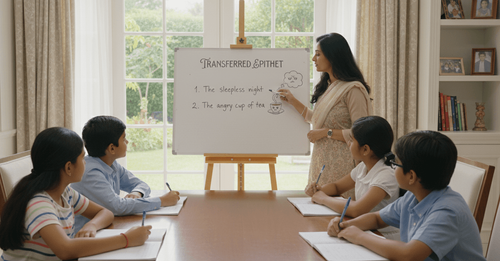

Table of Contents
- What Is Transferred Epithet?
- Transferred Epithet as a Poetic Device
- Where Is Transferred Epithet Used in a Poem?
- Transferred Epithet Examples
- Difference Between Metaphor and Transferred Epithet
- Transferred Epithet vs Metaphor Comparison Table
- Difference Between Transferred Epithet and Personification
- How to Form and Use Transferred Epithets
- How to Identify a Transferred Epithet
- PlanetSpark Success Story
- Why Choose PlanetSpark for Sentence Making in English?
- Master Your Figure of Speech Journey with PlanetSpark
Transferred epithet is a subtle yet powerful figure of speech that writers and poets often use, sometimes without even realising it. Understanding the Transferred Epithet meaning, its usage, and how it differs from other figures of speech can greatly improve both reading comprehension and writing skills, especially for school and exam preparation.
This guide by PlanetSpark explains transferred epithet in a clear, simple, and detailed manner, with examples, comparisons, identification tips, and practical usage.
What Is Transferred Epithet?
A transferred epithet is a figure of speech in which an adjective is grammatically attached to one noun but actually describes another noun in the sentence.
In simple words, the describing word is “transferred” from the person or thing that truly has the quality to another closely connected noun.
Simple Explanation: The adjective does not logically belong to the noun it describes, but it is placed there for emotional effect and vivid expression.
Examples:
He spent a sleepless night
👉 The night is not sleepless; he is.
She walked down the lonely road
👉 The road is not lonely; she feels lonely.
This shifting of description creates mood, tone, and emotional depth.
Transferred Epithet Figure of Speech
A transferred epithet is a figure of speech where a describing word (adjective) is used with the wrong noun, but we still understand the real meaning. The adjective actually describes a person’s feeling, but it is attached to an object, place, or time instead. Instead of directly saying how a person feels, the feeling is shifted (transferred) to something nearby.
Example- He had a sleepless night.
Sleepless describes him, not the night
But the adjective is used with night
So, “sleepless night” is a transferred epithet.
Why It Is Called a Figure of Speech
It does not follow strict logic
It adds feeling and imagination
It makes sentences more interesting and expressive
What Transferred Epithet Usually Shows
Human feelings (sad, lonely, anxious, tired)
Mental states (worried, angry, happy)
Emotions are shown indirectly
Transferred Epithet as a Poetic Device
In poetry, a transferred epithet is used to convey feelings without directly stating them. Instead of saying “I am sad” or “I am worried”, poets transfer that feeling to nature, objects, or places. This makes poetry short, deep, and emotional.
Why Poets Use Transferred Epithet
Poets use this device because:
- To create an atmosphere
It helps the reader feel the mood of the poem.
Example:
“a cheerless room”
→ The room is not sad; the person inside feels sad. - To show emotions indirectly
Poetry avoids direct explanation. Feelings are shown, not told.
Example:
“an anxious silence”
→ The silence is not anxious; people are anxious. - To use fewer words with more meaning
A single phrase can convey a multitude of emotions.
Example:
Instead of saying:
“He was disturbed and restless inside.”
Poet writes:
“the restless sea”
Easy Poetry Examples with Meaning
Example 1: “a restless sea”
The sea is not restless
The poet or character feels disturbed
✔ Feeling is transferred to the sea
Example 2: “a cheerless room”
A room cannot feel sadness
The person inside is sad
✔ Emotion is shifted to the room
Example 3: “an anxious silence”
Silence cannot feel fear
People are nervous
✔ Anxiety is transferred to silence
Support your child’s school and exam preparation with PlanetSpark - Book a Free Trial Now
Where Is Transferred Epithet Used in a Poem?
A transferred epithet is most commonly used in poems when a poet is describing scenes, nature, or objects, but actually wants to express human feelings or emotions.
Instead of directly saying how a person feels, the poet transfers that feeling to something around the person. This makes the poem more emotional, imaginative, and expressive.
- Transferred Epithet in Setting Descriptions
Poets often use transferred epithets while describing time or place, such as night, morning, streets, or rooms.
Examples:
a. sleepless night
b. lonely streets
c. cheerless morning
Easy Explanation:
A night cannot be sleepless.
Streets cannot feel lonely.
A morning cannot feel cheerless.
These feelings actually belong to people.
By transferring emotions to the setting, the poet shows the mood of the situation without directly talking about the person. This helps readers feel the atmosphere of the poem. - Transferred Epithet in Nature Imagery
Transferred epithet is very common in nature-related descriptions. Poets connect human emotions with natural elements to make the poem more lively.
Examples:
angry storm
kind sunlight
jealous moon
Easy Explanation:
A storm is not truly angry.
Sunlight is not kind.
The moon cannot feel jealousy.
These are human feelings that are transferred to nature. This makes nature reflect the inner emotions of the poet or character. Also, this technique helps poetry feel deep and emotional, even with simple words. - Transferred Epithet with Objects Linked to People
Poets also use transferred epithets with objects that people use or interact with, such as roads, mirrors, or tools.
Examples:
careless match
tired road
cruel mirror
Easy Explanation:
The person using the match is careless, not the match.
The traveller is tired, not the road.
The person’s thoughts or self-judgment are cruel, not the mirror.
The object carries the feeling of the person, which makes the expression more powerful and memorable.
Why Poets Use Transferred Epithets in These Places
Poets use transferred epithets in:
Settings
Nature
Objects
because these things:
Surround the character
Reflect emotions
Help create mood and imagery
Instead of explaining feelings in many words, one transferred epithet does the job beautifully.
Transferred Epithet Examples
First, remember this simple idea:
In a transferred epithet, the adjective is attached to the wrong noun grammatically, but logically, it describes a person or living being. The feeling or quality is shifted (transferred) to another noun to make the sentence more expressive and emotional.
Example 1: “He had a sleepless night.”
Easy explanation:
A night cannot stay awake.
He was sleepless, not the night.
The word “sleepless” is transferred from him to the night.
Example 2: “They walked along the tired road.”
Easy explanation:
A road cannot feel tired.
The people walking are tired.
The adjective “tired” is transferred to the road.
Example 3: “She gave a knowing smile.”
Easy explanation:
A smile cannot “know” anything.
She knows something, and the smile shows it.
The adjective “knowing” is transferred from the person to the smile.
Example 4: “The careless matchbox caused the fire.”
Easy explanation:
A matchbox cannot be careless.
The person using the matchbox was careless.
The adjective “careless” is transferred to match.
Example 5: “He sat through a tense meeting.”
A meeting is not tense.
The people in the meeting are tense.
“Tense” is a transferred epithet.
Example 6: “She walked into a silent room.”
Silence belongs to the people or situation, not the room itself.
The room reflects the mood.
“Silent” works as a transferred epithet.
Example 7: “He opened the worried letter.”
The letter is not worried.
The person reading it is worried.
“Worried” is transferred to a letter.
Literary-Style Transferred Epithet Examples
These sound a little poetic and are often found in poems or stories.
Example 8: “We waited in the anxious silence.”
Easy explanation:
Silence cannot feel anxious.
The people waiting are anxious.
“Anxious” is transferred to silence.
Example 9: “The city woke to a cheerless morning.”
Easy explanation:
Morning cannot feel sad.
The people living in the city feel cheerless.
The mood is transferred to morning.
Example 10: “He stared at the cruel mirror.”
Easy explanation:
A mirror is not cruel.
His thoughts or self-judgment are cruel.
The adjective “cruel” is transferred to the mirror.
Give your child regular practice and expert guidance in English- Book a Free Demo Class with PlanetSpark
Difference Between Metaphor and Transferred Epithet
Both metaphor and transferred epithet are figures of speech. They make language more interesting and expressive, but they work in different ways.
What Is a Metaphor?
A metaphor directly compares two different things by saying that one thing is another. It shows similarity between two things.
Easy examples of metaphor:
Time is a thief.
(Time is compared to a thief because it steals moments.)Life is a journey.
The classroom was a zoo.
In a metaphor:
Two different things are compared.
The comparison is imaginary, not literal.
What Is a Transferred Epithet?
A transferred epithet does not compare two things. Instead, it shifts an adjective from the person who actually has the feeling to another noun in the sentence. The feeling is transferred, not compared.
Easy examples of transferred epithet:
Sleepless night
(The person is sleepless, not the night.)Tired road
(The traveller is tired, not the road.)Careless match
(The person is careless, not the match.)
In transferred epithet:
The adjective is placed with the “wrong” noun.
Emotion or quality belongs to someone else.
Transferred Epithet vs Metaphor Comparison Table
Point | Metaphor | Transferred Epithet |
|---|---|---|
What it does | Compares two things | Transfers an adjective |
Main idea | Similarity | Emotional shift |
Sentence type | “X is Y” | “Adjective + Noun” |
Focus | Comparison | Feeling or mood |
Example | Time is a thief | Sleepless night |
Key Difference:
A metaphor compares two things.
Transferred epithet reassigns an adjective to another noun.
Metaphor = comparison
Transferred epithet = adjective shift
Easy Trick to Remember: Ask yourself:
Is something being compared to something else?
→ Metaphor
Is an adjective describing the wrong noun?
→ Transferred Epithet
Final One-Line Summary: A metaphor compares two things directly, while a transferred epithet shifts an adjective from the person who actually has the feeling to another noun.
Difference Between Transferred Epithet and Personification
Both personification and transferred epithet make writing more interesting by giving human feelings to non-human things.
But they do it in different ways. Let us understand them slowly and clearly.
What Is Personification?
In personification, a non-living thing or idea acts like a human being. The object does a human action or shows human behaviour.
Easy examples:
The wind whispered.
(Wind cannot whisper, but it is shown acting like a human.)
The sun smiled at us.
The leaves danced in the breeze.
Here, the object is acting like a person.
Transferred Epithet: In a transferred epithet, a human feeling or quality is shifted to another noun, usually an object, place, or time. The object does NOT act like a human. It only carries the feeling of a person.
Easy examples:
A tired road
(The road is not tired; the traveller is tired.)
A sleepless night
(The night is not sleepless; the person is.)
A careless match
(The person using the match is careless.)
The adjective belongs to someone else, not the noun it is attached to.
Personification vs Transferred Epiphet Comparison
Point | Personification | Transferred Epithet |
|---|---|---|
What happens | Object acts human | Adjective is shifted |
Human action? | Yes | No |
Main focus | Action | Feeling or quality |
Example | The wind whispered | Tired road |
Simple Trick to Identify: Ask yourself these questions:
Question 1: Is the object doing something like a human?
✔ Yes → Personification
Question 2: Is the adjective actually describing a person, not the noun?
✔ Yes → Transferred Epithet
Easy Side-by-Side Example
The angry sea roared. → Personification
(The sea is shown acting angrily.)They walked along the angry sea. → Transferred epithet
(The people are angry; the feeling is transferred to the sea.)
How to Form and Use Transferred Epithets
A transferred epithet is made when we shift a feeling or quality from the person who really has it to another noun, like a place, time, or object.
Step 1: Write a normal (literal) sentence
This sentence directly tells the feeling.
The students were nervous.
Here:
students → have the feeling
nervous → emotion
Step 2: Find the emotion or quality
Ask: What feeling is shown?
The feeling is nervous
Step 3: Transfer the emotion to a related noun
Now, shift the adjective to something connected to the person.
They entered the nervous hall.
✔ The hall is not nervous.
✔ The students are nervous.
✔ The feeling is transferred to the noun hall.
This makes the sentence more expressive and interesting
Common and Easy Patterns of Transferred Epithet
Transferred epithets are usually formed with three types of nouns:
1. Time Words (Night, Evening, Morning)
Example:
Literal: I felt sad in the evening.
Transferred epithet: It was a sad evening.
✔ Evening is not sad.
✔ The person is sad.
2. Place Words (Street, Room, Hall, Road)
Example:
Literal: People were restless in the street.
Transferred epithet: It was a restless street.
✔ Street is not restless.
✔ People are restless.
3. Object Words (Voice, Letter, Match, Road)
Example:
Literal: His voice sounded tired.
Transferred epithet: He spoke in a tired voice.
✔ Voice is not tired.
✔ The person is tired.
How to Identify a Transferred Epithet
Identifying a transferred epithet is simple if you follow three easy steps. You don’t need difficult grammar, just logic and common sense.
Step 1: Look for an Adjective + Noun
First, find a phrase where an adjective describes a noun.
Examples:
sleepless night
tired road
cruel mirror
anxious silence
Most transferred epithets appear in this form.
Step 2: Ask a Simple Question
Can this noun really have this quality?
Now, think logically.
Example:
Can a night be sleepless?
Can a road be tired?
Can silence feel anxious?
If the answer is NO, move to Step 3.
Step 3: Find Who Actually Has the Quality
Ask yourself: Who really feels or owns this quality?
Examples explained:
Sleepless night → the person is sleepless
Tired road → the traveller is tired
Cruel night → people are suffering
Anxious silence → people waiting are anxious
✔ When the adjective belongs to a person or living being, but is attached to something else, it is a transferred epithet.
Example Explained Clearly
Example:
“It was a cruel night.”
Night cannot be cruel
People suffered during the night ✔
The word “cruel” is transferred from people to the night.
✔ This is a transferred epithet.
PlanetSpark Success Story

With the right guidance and regular practice, Neel turned his interest in English into excellence. Through PlanetSpark’s structured lessons, simple explanations, and focused exam practice, he strengthened his grammar, writing skills, and confidence. His hard work paid off—Neel secured First Position in his class and achieved an impressive State Rank 810 in the International Olympiad of English Language.
Want your child to achieve similar success in English?
Join PlanetSpark today and help your child master grammar, writing, and communication with expert mentors and proven learning methods.
Why Choose PlanetSpark for Sentence Making in English?
Here’s what makes PlanetSpark different from other ed-tech platforms:
- Personalised 1:1 Classes: As every child learns differently, PlanetSpark provide personal communication experts for teaching spellings, grammar, and writing live, 1:1. The trainers get familiar with the child’s pace and provide instant feedback to the parents for improvement.
- Customised Learning Roadmap: Planetspark begins with a skills assessment and creates a personalised roadmap that focuses on grammar, vocabulary, and English fluency.
- Interactive Grammar Learning: Sentence Formation is taught by stories, role-play, dialogues, and error correction, making the class fun and interactive. The child can learn how tenses and grammar actually work in real-life speaking and writing.
- Gamified Learning: At PlanetSpark, children practice grammar with the help of gamified learning. We immerse fun, games, puzzles, and interactive quizzes like Grammar Guru Challenge and SparkBee. With the help of this, every lesson is a rewarding experience that brings points and badges for the learner.
- AI-supported Grammar Feedback: SparkX - AI-enabled Grammar Feedback tool by PlanetSpark checks your child’s speech and grammar usage, and their sentence flow during speaking exercises. Also, you receive clear reports showing where the child is strong and where they need to improve.
- Daily Grammar Practice Sessions: PlanetSpark offers story writing, journaling (Spark Diary), and AI-led storytelling sessions where kids use grammar in action daily. With this, the gap between knowing the rules and applying them naturally in communication gets filled.
- Detailed and Regular Progress Tracking: Every few weeks, parents receive a detailed progress report of their child that tracks the improvement in grammar accuracy, tense usage, sentence formation, and speaking skills.
Master Your Figure of Speech Journey with PlanetSpark
Learning and adapting literary devices in English is a powerful skill that helps in building the child’s confidence, creativity, and the ability of writing skills. Children with the proper ability to form sentences correctly help in their grammar and expressing thoughts clearly and fearlessly.
In this sentence formation journey, PlanetSpark becomes an integral part with its fun, structured, and highly effective learning method. The step-by-step approach of the courses designed by PlanetSpark ensures that every child progresses at their own pace and ability while building a strong foundation.
Frequently Asked Questions
If we write these sentences literally, they become flat and boring.
Literal version:
- “He was sleepless all night.”
- “The people were tired while walking.”
- “She knew something and smiled.”
With transferred epithet:
- “Sleepless night”
- “Tired road”
- “Knowing smile”
These sound stronger, more emotional, and more imaginative.