
What is Abstraction in Maths and How PlanetSpark Makes It Easy


Table of Contents
- Abstraction in Mathematics: Understanding Ideas Beyond Examp
- How Abstract Concepts Appear in Daily Maths
- What Is Abstract Algebra: Importance for Students
- Abstraction Principle and How It Helps Students Learn Maths
- How to Use Abstract Concepts in Math
- Why Students Struggle with Abstraction in Maths
- How PlanetSpark Simplifies Abstract Math for Students
- A Success Story That Inspires Young Math Thinkers
- How Abstract Math Helps Students Think Better
- Why PlanetSpark Is the Ultimate Destination for Maths Master
- Making Abstraction in Maths Simple and Powerful With PlanetS
Do maths concepts feel confusing because there’s too much information to process at once?
Abstraction in maths helps students understand complex problems by focusing on important ideas and ignoring unnecessary details. This guide explains the concept in a simple, child-friendly way with clear examples and practical understanding. It also shows how PlanetSpark supports students through interactive lessons, real-life applications, and expert guidance, making abstract concepts in math easy to grasp, enjoyable to learn, and useful for building strong logical thinking skills.
Abstraction in Mathematics: Understanding Ideas Beyond Examples
Abstraction helps students move from concrete examples to general mathematical ideas. By focusing on patterns, structures, and essential properties, learners gain a deeper understanding and can apply concepts across different problems and contexts.
Key Aspects of Abstraction in Mathematics
- Generalization: Identifying common ideas from specific examples, such as understanding “five” beyond counting objects.
- Decontextualization: Removing dependence on physical objects to study ideas independently.
- Symbolic Representation: Using numbers, variables, and symbols to express abstract concepts clearly.
- Focus on Structure: Studying relationships and rules that work across systems, like addition in numbers, vectors, or matrices.
Examples of Mathematical Abstraction
- Numbers: Shifting from counting items to understanding numbers as independent concepts.
- Geometry: Recognising shared properties in shapes like cubes, regardless of real-world form.
- Vector Spaces: Unifying different systems under common operations such as addition and scalar multiplication.
Why Abstraction Is Important
- Efficiency: Builds theories usable across many problems.
- Deeper Insight: Explains why mathematical rules work.
- Foundation for Modern Math: Supports advanced, universal mathematical frameworks.
How Abstract Concepts Appear in Daily Maths
Students use abstract concepts in maths more often than they realise.
Here are some simple examples:
Numbers: Numbers are ideas, not objects. The number 5 can represent five apples, five books, or five steps, showing the same quantity in different situations.
Symbols: Math symbols carry fixed meanings. The symbol “+” always shows addition, whether it connects small numbers or large values, helping students apply rules consistently.
Patterns: Patterns focus on rules rather than values. In 2, 4, 6, 8, the key idea is the rule “add 2,” which helps predict future numbers easily.
Equations: Equations represent balance. When both sides are equal, it teaches students that maths is about relationships, not just finding final answers.
What Is Abstract Algebra: Importance for Students
Abstract algebra is a branch of mathematics that studies patterns, structures, and rules instead of working only with numbers. It helps students understand how different mathematical systems work logically.
Here is a simple explanation using key points:
Focus on structure, not values
Abstract algebra looks at how operations like addition or multiplication behave, not the actual numbers used.Uses symbols and rules
Letters and symbols represent general ideas that work in many situations.Builds on basic algebra
It grows from concepts students already know, such as variables and equations.Improves logical thinking
Students learn to explain why a rule works, not just apply it.
Abstract algebra helps students develop strong problem-solving and reasoning skills that are useful in higher studies and real-life thinking.
Support your child with PlanetSpark’s advanced maths tools and teaching methods!
Abstraction Principle and How It Helps Students Learn Maths Better
The abstraction principle helps students focus on key ideas in maths, allowing them to understand patterns and rules clearly instead of memorising steps. This approach builds confidence and strengthens problem-solving ability.
It helps students focus on the main idea of a maths problem.
It teaches learners to ignore details that are not needed to find the solution.
It encourages students to recognise patterns across different questions.
It allows one concept or rule to be applied to many similar problems.
It reduces dependence on memorisation and repeated practice.
It develops logical and structured thinking skills.
It improves confidence when students face new or challenging questions.
It makes maths feel more connected, clear, and meaningful.
How to Use Abstract Concepts in Math
Abstract concepts in maths help students focus on ideas, patterns, and rules, making problem-solving easier, faster, and more meaningful across different types of mathematical questions.
Look for the main idea
Read the question carefully and understand what it is asking. Ignore extra words or numbers that are not needed to solve the problem.Use symbols to simplify thinking
Letters like x or y stand for unknown numbers. This makes problems easier to understand and solve.
Example: x + 4 = 9Apply rules instead of memorising answers
Maths rules work every time. Using rules like addition, subtraction, or multiplication helps solve many problems easily.Find patterns
Look for repeating steps in numbers or shapes. Patterns help predict what comes next.
Example: 3, 6, 9 follow the rule “add 3”.Think of equations as a balance
Both sides of an equation must stay equal, just like a balanced scale.Use one idea for many problems
Once you understand a concept, you can apply it confidently to new questions.
Using abstract concepts builds strong thinking skills and makes maths simple and enjoyable.
Give your child the advantage of structured maths learning designed for long-term success with PlanetSpark!
Why Students Struggle with Abstraction in Maths
Many students find abstraction in maths challenging because concepts are often taught without clarity or connection, making learning feel confusing, stressful, and difficult to apply in real problem-solving situations.
Overemphasis on rote learning
Students memorise formulas and steps without understanding the ideas behind them, which makes abstract concepts harder to grasp and apply.Lack of conceptual explanations
When teachers focus only on answers, students miss the reasoning process needed to understand abstract thinking.Teaching abstract ideas without context
Concepts taught without real-life examples feel meaningless and difficult to relate to everyday experiences.Fear of making mistakes
Students avoid trying new methods because they worry about being wrong, limiting creative and abstract thinking.Limited opportunities to explore ideas creatively
Without open-ended problems and exploration, students struggle to develop a deeper understanding.
When abstraction is introduced incorrectly, maths becomes intimidating rather than inspiring.
How PlanetSpark Simplifies Abstract Math for Students
PlanetSpark helps students understand abstract math by breaking complex ideas into simple concepts, using engaging methods that build clarity, confidence, and strong logical thinking skills from an early age.
PlanetSpark uses simple language and clear explanations so students can understand abstract math concepts without confusion.
Real-life examples and relatable situations help students connect abstract ideas with everyday experiences.
Lessons are structured step by step, allowing students to grasp the logic behind problems instead of memorising formulas.
Visual aids, symbols, and patterns are used to make abstract thinking easier and more meaningful.
Guided practice and expert teacher support ensure students apply abstract concepts confidently.
Personalised feedback helps learners improve at their own pace and build long-term problem-solving skills.
A Success Story That Inspires Young Math Thinkers
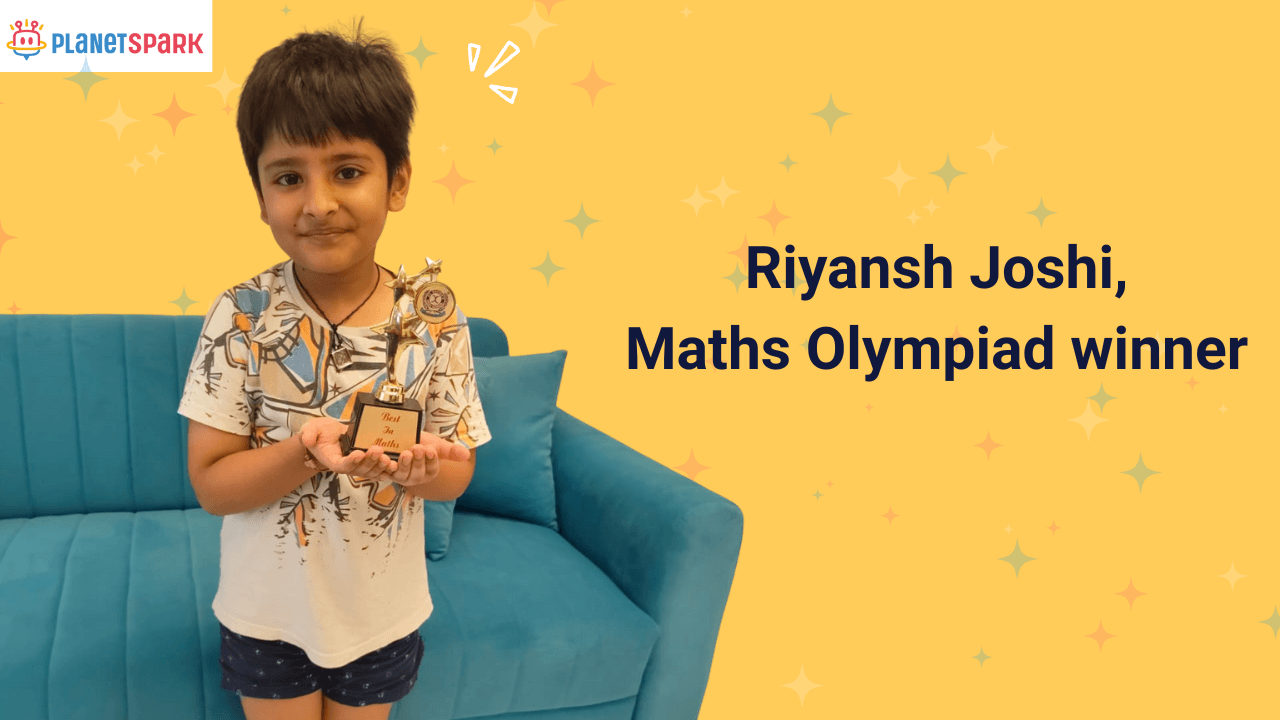
Riyansh Joshi, a proud Maths Olympiad winner, stands out for his clarity of thought, strong reasoning skills, and confident communication.
His journey shows how strong conceptual understanding and the right guidance can help students excel, not just in exams but in thinking clearly and confidently.
If you want to build the same skills in your child and help them succeed in maths and beyond, join PlanetSpark today and start their learning journey with confidence.
How Abstract Math Helps Students Think Better
Abstract math helps students understand the ideas behind numbers, symbols, and rules. It builds strong thinking skills, improves problem-solving, and prepares learners for higher-level maths with confidence.
Abstract math teaches students to think about ideas instead of fixed answers.
It helps learners solve problems even when numbers or situations change.
Students learn to explain their reasoning clearly.
It encourages comparing different problems to find similarities.
Symbols and expressions become easier to understand.
Students learn to break big problems into smaller ideas.
Logical thinking improves through reasoning and explanation.
Mistakes are used to learn, not fear.
Learners become more independent while solving questions.
Confidence grows when facing new or difficult maths problems.
Why PlanetSpark Is the Ultimate Destination for Maths Mastery
PlanetSpark delivers a complete learning experience that strengthens every aspect of a child’s mathematical understanding, accuracy, and confidence. With personalised one-on-one guidance, interactive practice, and real-world learning, students don’t just learn math—they master it.
Services That Build Strong Mathematical Skills
Personal Math Trainers for concept correction, problem-solving support, and skill enhancement
Customised Learning Roadmaps tailored to each child’s strengths and learning gaps
SparkX AI Analysis to assess accuracy, speed, and conceptual clarity
AI Guided Practice Sessions for computation, reasoning, and application-based learning
Spark Diary for daily maths practice and real-life number application
Gamified Learning Tools, including Speed Maths, Number Ninja, Logic Lab, and Fraction Quest
SparkBee Daily Quizzes to strengthen calculations, logic, and numerical fluency
SparkShop eBooks covering arithmetic, geometry, data handling, and reasoning
Progress Reports and PTMs offering clear, actionable insights
With PlanetSpark, your child builds mathematical confidence, logical thinking, and a future-ready foundation that lasts a lifetime.
Making Abstraction in Maths Simple and Powerful With PlanetSpark
Maths becomes easier when students stop memorising steps and start understanding ideas. Knowing what is abstract in math helps learners focus on patterns, rules, and relationships instead of getting confused by numbers. This way of learning builds clarity, confidence, and a deeper understanding of how maths works.
When students develop strong thinking skills early, maths feels less scary as they move to higher classes. They learn to connect ideas, solve new problems, and explain their answers clearly. With the right guidance and practice, students can enjoy maths and feel confident using it in school and daily life.
Also Read:
What are Prime Numbers? Learn Clearly With PlanetSpark Math Class
What Are The Best Math Activities For Preschoolers | PlanetSpark Guide
Frequently Asked Questions
Abstract math means understanding ideas, patterns, and rules behind numbers. It helps students think logically, solve new problems easily, and understand maths instead of memorising steps or formulas blindly.
Students find abstract math difficult when concepts are taught too quickly or without clear explanations. Symbols and letters feel confusing if students do not understand the ideas behind them first.
Students can improve abstract thinking by focusing on concepts, finding patterns, asking why a rule works, practising different problems, and explaining their thinking instead of memorising answers.
Students begin learning abstract math concepts from early grades through patterns, symbols, and simple rules. Learning these ideas early helps them feel confident and prepared as maths becomes more advanced.
PlanetSpark uses simple explanations, visuals, real-life examples, and guided thinking activities to help students understand abstract math concepts clearly, build confidence, and enjoy learning maths without fear or confusion.
PlanetSpark focuses on concept-based learning instead of rote memorisation. Its structured approach helps students develop strong thinking skills, master abstract ideas, and perform better in higher classes and problem-solving tasks.