
Class 8 Maths Square and Square Roots NCERT Concepts- PlanetSpark


Table of Contents
- What Are Squares?
- Understanding Perfect Squares
- Important Properties of Square Numbers
- Methods to Find Squares Easily
- What Are Square Roots?
- Methods to Find Square Roots
- Perfect Squares to Remember
- Applications of Squares and Square Roots
- Common Mistakes to Avoid
- NCERT Practice Questions
- Why Squares and Square Roots Are Important in Class 8
- Easy Strategies to Practice and Remember Squares
- How to Approach Square Root Problems with Confidence
- Tips to Master Squares and Square Roots
- Common Problem Areas in Squares and Square Roots
- Mistakes Students Make While Solving Questions
- Proven Tips to Improve Performance in Exams
- Why Choose PlanetSpark for Maths Learning
- Conclusion
Have you ever wondered how to quickly calculate the area of a square field or estimate numbers without a calculator? That’s exactly where squares and square roots come into play. These concepts are not just important for exams and they help you build strong problem-solving skills for real-life situations too.
In Class 8 Maths, the chapter on Squares and Square Roots is a foundational topic in NCERT. It introduces you to patterns, shortcuts, and logical thinking that make maths simpler and even fun! In this blog, we’ll break down every concept in an easy, conversational way so you can understand, practice, and master it confidently.
What Are Squares?
A square of a number means multiplying the number by itself.
Formula:
Square = Number × Number
Examples:
2² = 4
5² = 25
12² = 144
This concept is simple but very powerful. It forms the base for understanding square roots and many algebraic expressions later on.
Understanding Perfect Squares
A perfect square is a number that is the square of a whole number.
Examples:
1, 4, 9, 16, 25, 36, 49, 64, 81, 100
These numbers have exact square roots.
Key idea:
If a number has a whole number as its square root, it is a perfect square.
Important Properties of Square Numbers
1. Unit Digit Pattern
Square numbers can only end in certain digits.
Possible last digits: 0, 1, 4, 5, 6, 9
Numbers ending in 2, 3, 7, or 8 can never be perfect squares.
2. Even and Odd Squares
Square of an even number is always even.
Square of an odd number is always odd.
Example:
6² = 36 (even)
7² = 49 (odd)
3. Pattern in Differences
The difference between consecutive square numbers follows a pattern:
2² − 1² = 3
3² − 2² = 5
4² − 3² = 7
This pattern continues with odd numbers.
4. Number of Zeros in Square
If a number ends with zeros, its square will have even number of zeros.
Example:
10² = 100
100² = 10000
Methods to Find Squares Easily
1. Direct Multiplication
Example:
14² = 14 × 14 = 196
2. Using Identity
(a + b)² = a² + 2ab + b²
Example:
(20 + 3)² = 20² + 2×20×3 + 3²
= 400 + 120 + 9 = 529
3. Square of Numbers Ending in 5
Shortcut:
n5² = n × (n + 1) followed by 25
Example:
35² = 3 × 4 = 12 → 1225
85² = 8 × 9 = 72 → 7225
Help your child master squares and square roots with expert guidance and interactive learning.
What Are Square Roots?
A square root is the reverse of squaring a number. It tells you which number was multiplied by itself to get the given number.
Symbol: √
Examples:
√9 = 3
√64 = 8
√100 = 10
Methods to Find Square Roots
1. Prime Factorization Method
Steps:
Break the number into prime factors
Make pairs of the same numbers
Take one number from each pair
Example:
Find √144
144 = 2 × 2 × 2 × 2 × 3 × 3
Pairs: (2,2), (2,2), (3,3)
Square root = 2 × 2 × 3 = 12
2. Long Division Method
This method is useful for large numbers.
Example:
√2025 = 45
This method may look lengthy at first, but with practice, it becomes easy and accurate.
3. Estimation Method
Used when the number is not a perfect square.
Example:
Find √50
Closest squares are:
49 (7²) and 64 (8²)
So, √50 is slightly more than 7.
Make Maths Simple and Fun
Turn confusion into confidence with engaging sessions designed for Class 8 students. Book a free trial now.
Perfect Squares to Remember
Memorizing squares helps in faster calculations.
1² = 1
2² = 4
3² = 9
4² = 16
5² = 25
6² = 36
7² = 49
8² = 64
9² = 81
10² = 100
Students should try to remember squares at least up to 20 or 30.
Applications of Squares and Square Roots
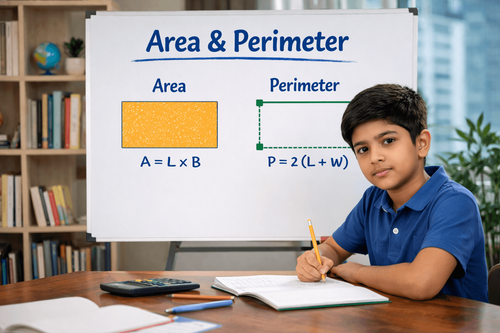
1. Area Calculation
Area of a square = side × side
If the side is 8 cm, area = 64 cm²
2. Finding Length
If the area is given, you can find the side using square roots.
Example:
Area = 121 cm²
Side = √121 = 11 cm
3. Real-Life Use
Used in construction, measurement, and design.
Also used in advanced topics like algebra and geometry.
Common Mistakes to Avoid
Students often make simple errors in this chapter.
Confusing square and square root
Forgetting to pair numbers in prime factorization
Making calculation errors
Not recognizing perfect squares
Avoiding these mistakes can improve accuracy significantly.
Improve Speed and Accuracy in Exams
Give your child the skills to solve maths problems faster and correctly. Book a free trial class today.
NCERT Practice Questions
1. Find the squares:
a) 16
b) 21
c) 35
2. Find the square roots:
a) 169
b) 256
c) 441
3. Check if the following are perfect squares:
a) 800
b) 900
c) 1225
4. Problem Solving
Find the smallest number by which 75 must be multiplied to make it a perfect square.

Tips to Master Squares and Square Roots
Practice regularly instead of memorizing everything at once.
Focus on understanding patterns.
Use shortcuts where possible.
Revise square tables daily.
Consistency is the key to mastering maths.
Common Problem Areas in Squares and Square Roots
Many Class 8 students find this chapter confusing at first. The biggest issue is not the difficulty of the topic, but the lack of conceptual clarity. Students often try to memorize squares instead of understanding patterns. This leads to errors during exams. Another common problem is mixing up squares and square roots, which creates confusion in solving questions. Building a strong base and practicing regularly can help overcome these challenges.
Mistakes Students Make While Solving Questions
One of the most common mistakes is incorrect prime factorization. Students either skip steps or fail to pair factors properly, which leads to wrong answers. Another issue is calculation errors while finding squares of larger numbers.
Many students also assume that any number close to a perfect square is itself a perfect square, which is not true. Careless mistakes and lack of revision also affect performance in this topic.
Proven Tips to Improve Performance in Exams
To score well in exams, focus on understanding concepts instead of rote learning. Practice a mix of easy and challenging questions to build confidence. Revise square tables daily and test yourself regularly. Pay attention to step-by-step solving methods, especially in long division and factorization. Most importantly, stay calm during exams and double-check your calculations to avoid simple errors.
Why Choose PlanetSpark for Maths Learning
PlanetSpark helps students move beyond rote learning and truly understand maths concepts with clarity and confidence. The focus is on making topics like squares and square roots simple, engaging, and easy to apply in exams. With expert mentors and structured sessions, students build strong problem-solving skills step by step.
Personalized learning plans based on student level
Interactive sessions with real-life examples
Focus on speed, accuracy, and concept clarity
Regular practice worksheets and doubt-solving support
Boosts confidence for school exams and beyond
Conclusion
Squares and square roots are one of the most important topics in Class 8 Maths. They build a strong foundation for higher-level maths and improve logical thinking.
By understanding the concepts, practicing regularly, and using the right methods, you can master this chapter without stress. Maths should feel like solving exciting puzzles. So, you will explore carefully explained math olympiad practice questions.
Frequently Asked Questions
Squares are numbers multiplied by themselves, while square roots are the reverse process of finding the original number.
Check if the number has a whole number square root and follows unit digit patterns like 0, 1, 4, 5, 6, or 9.
They build a strong foundation for algebra, geometry, and help improve logical and problem-solving skills.
Students can practice through structured programs like PlanetSpark, which offer guided learning, worksheets, and expert support.
Enrolling in a personalized learning program with regular practice, concept clarity, and expert feedback can boost performance.