
Combinatorics: Learn Smart Counting Techniques with PlanetSpark


Table of Contents
- What Is Combinatorics
- Basic Counting Principles in Combinatorics
- What Are Permutations and Combinations in Combinatorics?
- Permutations in Combinatorics Meaning and Formula
- Combinations in Combinatorics Meaning and Formula
- Key Differences Between Permutations and Combinations
- Relationship Between Permutations and Combinations in Combin
- Factorials in Combinatorics Meaning and Use
- Solved Examples with Solutions on Combinatorics
- Combinatorics in Probability Explained Simply
- Tips and Tricks for Combinatorics
- Why Choose PlanetSpark for Maths Course
Many students understand maths concepts but lose confidence when combinatorics questions appear in exams with tricky wording. Maths often feels intimidating when problems ask how many ways something can happen, especially when guessing leads to wrong answers and confidence drops. Combinatorics removes that fear by teaching smart counting instead of random thinking.
This blog explains what combinatorics means, why it matters in exams, how permutations and combinations work, and how students can practise efficiently. From basic counting principles to probability based applications, every section builds clarity step by step. The guide also shares tips, mistakes to avoid, solved examples, and practice questions. Towards the end, discover how PlanetSpark Maths Courses help learners master combinatorics with confidence and structured guidance.
What Is Combinatorics
Combinatorics is a branch of mathematics that focuses on counting, arranging, and selecting objects logically. Instead of calculating values, combinatorics answers how many possible outcomes exist in a situation. The combinatorics definition includes three core ideas counting possibilities, arranging items, and selecting groups.
For example, finding how many outfits can be made from three shirts and two trousers uses combinatorics. Choosing a team from a group or arranging books on a shelf also falls under what is combinatorics. This topic builds logical thinking and reduces guesswork. Combinatorics also connects with combinatorics graph theory, probability, and computer science, making it highly practical beyond classrooms.
Basic Counting Principles in Combinatorics
Counting principles form the foundation of combinatorics. These principles help count outcomes without listing each possibility.
Addition Principle in Combinatorics
The addition principle applies when a task can be done in multiple independent ways. If one event can occur in m ways and another in n ways, then the total ways equal m plus n. This principle works when events do not overlap.
Example selecting a red pen or a blue pen from separate boxes uses the addition principle.
Multiplication Principle in Combinatorics
The multiplication principle applies when a task involves multiple stages. If one event occurs in m ways and another follows in n ways, the total outcomes equal m multiplied by n.
Example choosing a shirt and trousers combination uses multiplication. This principle appears frequently in combinatorics formula based questions.
What Are Permutations and Combinations in Combinatorics?
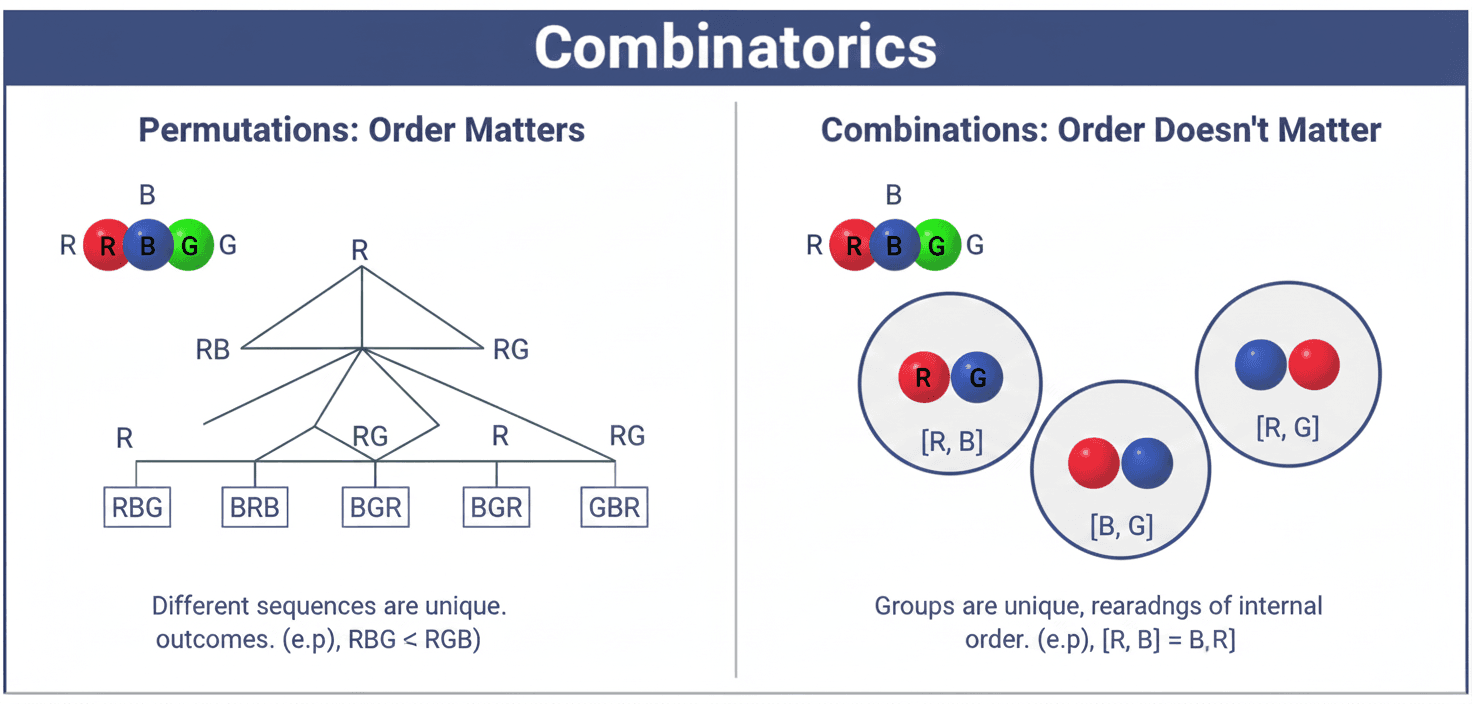
Permutations and combinations form the core of combinatorics. Both concepts deal with selecting objects, but the key difference lies in whether order matters. Understanding this distinction helps students choose the correct formula and avoid common exam mistakes.
Permutations in Combinatorics Meaning and Formula
Permutations focus on arrangements. When the order of selected items changes the outcome, permutations apply.
For example
Arranging students on chairs
Forming numbers using digits
Rearranging letters of a word
Types of Permutations in Combinatorics
Permutations of Distinct Objects
This type involves arranging unique items. Each object differs from the other. The formula applies directly without modification.
Permutations With Repetition
When objects repeat, the total arrangements reduce. The formula divides by factorials of repeated items. This concept appears in word arrangement questions.
Circular Permutations
Circular permutations involve arrangements in a circle. Rotations count as the same arrangement. The formula reduces total outcomes by fixing one position. This topic often challenges students but becomes manageable with visual explanation.
Combinatorics Formula in Permutations
The formula for permutations of r objects chosen from n distinct objects is
nPr = n! ÷ (n − r)!
Where
n represents the total number of objects
r represents the number of objects selected
! denotes factorial
This combinatorics formula counts every possible order of selection.
Start smart counting techniques with PlanetSpark expert maths mentors
Combinations in Combinatorics Meaning and Formula
Combinations focus on selection without order. When the order of chosen items does not change the outcome, combinations apply.
For example
Selecting a team from a group
Choosing subjects or questions
Picking cards from a deck
Combinatorics Formula in Combination
The formula for combinations of r objects chosen from n distinct objects is
nCr = n! ÷ [r! × (n − r)!]
This formula removes repeated arrangements that appear in permutations. That is why combinations divide by r factorial
Key Differences Between Permutations and Combinations
Relationship Between Permutations and Combinations in Combinatorics
Permutations and combinations are not isolated concepts. They connect mathematically, and understanding this relationship helps students move beyond memorisation.
How Permutations Are Built from Combinations
Combinations first select objects.
Permutations then arrange those selected objects.
This means permutations include extra arrangements that combinations remove.
Prepare for Olympiads using PlanetSpark structured maths curriculum
Mathematical Relationship in Combinatorics
The relationship is expressed as
nPr = nCr × r!
Explanation
nCr selects r objects from n
r! arranges those r selected objects
Multiplying both gives total permutations
Conceptual Flow Table
| Step | What Happens | Concept Used |
|---|---|---|
| Step 1 | Objects are selected | Combination |
| Step 2 | Selected objects are arranged | Factorial |
| Final | Total outcomes calculated | Permutation |
This relationship explains why combinations divide by r factorial in the formula.
Factorials in Combinatorics Meaning and Use
Factorials form the backbone of every combinatorics formula. Without understanding factorials, formulas appear mechanical and confusing.
What Is a Factorial in Combinatorics
A factorial represents the product of all positive integers up to a given number.
Examples
3! = 3 × 2 × 1 = 6
5! = 5 × 4 × 3 × 2 × 1 = 120
Why Factorials Matter in Combinatorics?
Factorials count arrangements.
Each multiplication represents one available choice reducing step by step.
Where Factorials Are Used
| Topic | Role of Factorial |
|---|---|
| Permutations | Counts total arrangements |
| Combinations | Removes repeated orders |
| Probability | Counts total outcomes |
| Circular permutations | Adjusts overcounting |
Factorial simplification also saves time during exams and reduces calculation errors.
Help children overcome maths fear and strengthen exam confidence with PlanetSpark live sessions
Solved Examples with Solutions on Combinatorics
This section strengthens the learn plus practise intent.
Example 1 Permutation Based Question
Question
How many ways can 4 different books be arranged on a shelf?
Solution
Total objects n = 4
All objects arranged
Formula
4! = 4 × 3 × 2 × 1 = 24
Answer
24 different arrangements
Example 2 Combination Based Question
Question
How many teams of 3 can be selected from 8 students?
Solution
n = 8
r = 3
Formula
8C3 = 8! ÷ (3! × 5!)
Calculation
8 × 7 × 6 ÷ (3 × 2 × 1) = 56
Answer
56 possible teams
Example 3 Permutation with Repetition
Question
How many arrangements of the word LEVEL are possible?
Solution
Total letters = 5
Repeated letters L = 2, E = 2
Formula
5! ÷ (2! × 2!)
Answer
30 arrangements
Encourage conceptual learning through PlanetSpark expert led maths classes
Combinatorics in Probability Explained Simply
Probability and combinatorics work together. Probability uses combinatorics to count outcomes logically.
Basic Probability Formula
Probability = Favourable outcomes ÷ Total outcomes
Combinatorics calculates both values.
Example Using Combinatorics
Question
What is the probability of choosing 2 red balls from 5 red and 3 blue balls?
Total ways
8C2
Favourable ways
5C2
Probability
5C2 ÷ 8C2
This approach avoids listing outcomes and saves time.
Where This Is Tested
| Exam Area | Application |
|---|---|
| School exams | Card and dice problems |
| Olympiads | Advanced counting |
| Competitive exams | Logical probability |
| Aptitude tests | Selection based probability |
Strong combinatorics skills simplify probability significantly.
Tips and Tricks for Combinatorics
This section improves exam performance and confidence.
Conceptual Tips
Understand whether order matters before choosing a formula
Visualise the situation instead of rushing to calculation
Break problems into selection and arrangement stages
Calculation Tips
Simplify factorials before multiplying
Cancel common terms early
Avoid calculating large factorials fully
Build Strong Maths Thinking Of your Child with PlanetSpark Live Classes
Exam Strategy Table
| Situation | Best Approach |
|---|---|
| Confusing question | Identify order sensitivity |
| Large numbers | Use factorial cancellation |
| Mixed concepts | Apply combination first |
| Probability questions | Count logically using nCr |
Consistent practice using these strategies improves speed and accuracy in combinatorics.
Meet Riyansh Joshi-Maths Olympaid Winner

"Riyansh Joshi, a proud Maths Olympiad winner, stands out for his clarity of thought, strong reasoning skills, and confident communication."
Hear how students have transformed their problem solving and confidence in maths
Book a free PlanetSpark demo class today and experience the difference firsthand!
Why Choose PlanetSpark for Maths Course
PlanetSpark Maths Courses focus on building strong conceptual clarity in combinatorics by moving beyond rote learning and formula memorisation. The course design follows a structured and age appropriate approach that helps learners understand the logic behind counting, permutations, and combinations before applying formulas. This foundation ensures long term retention and confident problem solving.
• Concept First Teaching Approach
• Visual explanations simplify abstract combinatorics ideas
• Real life examples connect maths with everyday situations
• Step by step reasoning replaces guesswork and confusion
• Grade Wise and Skill Based Progression
• Foundational counting and logic for primary learners
• Core permutations and combinations for middle school
• Advanced exam oriented problem solving for high school
• Aptitude and reasoning based applications for older learners
• Live Interactive Classes with Expert Mentors
• Experienced maths educators guide every session
• Interactive discussions encourage logical thinking
• Immediate clarification of doubts during classes
• Application Based Learning for Exams and Reasoning
• Board exam aligned combinatorics problems
• Olympiad and competitive exam focused practice
• Probability and logical reasoning integration
• Personalised Feedback and Continuous Support
• Individual performance tracking and insights
• Custom improvement plans based on learning gaps
• Regular doubt resolution sessions
• Worksheets and Structured Practice Material
• Concept wise worksheets for gradual mastery
• Mixed level questions to build speed and accuracy
• Practice aligned with school and competitive exam patterns
PlanetSpark focuses on clarity, confidence, and consistent improvement in combinatorics and beyond.
Combinatorics Made Simple with the Right Guidance
Combinatorics transforms guessing into logical thinking and builds strong problem solving skills across academic levels. From counting principles to permutations, combinations, and probability, this topic strengthens confidence and accuracy in exams. With the right teaching approach, combinatorics becomes intuitive rather than intimidating.
PlanetSpark Maths Courses focus on clarity, application, and personalised support to help learners master combinatorics effectively. Structured lessons, expert mentors, and continuous practice ensure steady progress. Booking a free PlanetSpark trial class marks the first step towards confident and smart maths learning.
Also Read: Our detailed guides on Decimals for Class 6 and Ratio and Proportions for Class 6 to strengthen foundational maths skills that support confident problem solving in combinatorics and beyond.
Frequently Asked Questions
Combinatorics studies counting, arranging, and selecting objects logically. It helps calculate possible outcomes without listing them individually.
Permutation considers order while combination ignores order. Understanding this difference prevents formula confusion.
PlanetSpark offers live interactive maths classes, personalised guidance, and exam focused practice for combinatorics mastery.
Yes, combinatorics appears frequently in aptitude, reasoning, and probability sections of competitive exams. It supports faster decision making and accurate counting under time pressure. Regular practice improves exam confidence. PlanetSpark prepares learners with exam oriented combinatorics problems and strategies.
Mastery depends on clarity of fundamentals and consistent practice. Basic counting principles can be understood quickly, while advanced applications require guided learning. A structured course accelerates progress. PlanetSpark provides level wise learning paths to support steady improvement.
Parents can encourage regular practice and logical discussions around everyday counting situations. Structured guidance helps learners stay consistent. PlanetSpark supports parents through progress tracking and expert led live classes.