
Cube Root Tricks Explained with Examples | PlanetSpark
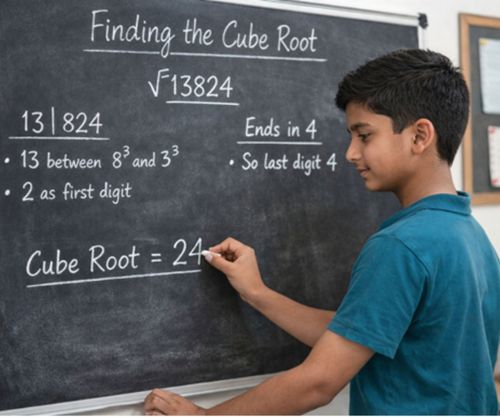

Understanding cube roots becomes simple when you learn the right patterns and logical techniques. Many students struggle with large numbers because they rely only on long division methods instead of applying cube short tricks that save time and reduce errors. With smart strategies, even complex four-digit numbers can be solved confidently.
At PlanetSpark, we believe strong mathematical reasoning builds analytical thinking and confidence. Just like communication skills, mathematics improves with structured guidance and practice. When students learn a reliable shortcut for cube root, they develop clarity, speed, and exam readiness that support overall academic success.

What is Cube Root?
A cube root of a number is a value that, when multiplied by itself three times, gives the original number. For example, 3 × 3 × 3 equals 27, so the cube root of 27 is 3. Similarly, the cube root of 216 equals 6 because 6³ equals 216.
Mathematically, if  , then the cube root of
  is
is  . Cube roots are essential in algebra, geometry, and competitive exams. Learning a quick cube root trick can help students solve such problems mentally without lengthy calculations. It’s important to understand and memorize the cubes of numbers 1 to 10, as these will assist you in using the following cube root tricks.
Table of Cube Root Numbers
Number (n) | What Does n³ Mean? | Cube (n³) | Cube Root Meaning |
1 | 1 × 1 × 1 | 1 | ∛1 = 1 |
2 | 2 × 2 × 2 | 8 | ∛8 = 2 |
3 | 3 × 3 × 3 | 27 | ∛27 = 3 |
4 | 4 × 4 × 4 | 64 | ∛64 = 4 |
5 | 5 × 5 × 5 | 125 | ∛125 = 5 |
6 | 6 × 6 × 6 | 216 | ∛216 = 6 |
7 | 7 × 7 × 7 | 343 | ∛343 = 7 |
8 | 8 × 8 × 8 | 512 | ∛512 = 8 |
9 | 9 × 9 × 9 | 729 | ∛729 = 9 |
10 | 10 × 10 × 10 | 1000 | ∛1000 = 10 |
Easy Tricks to Find Cube Roots
Learning cube roots becomes easier when students follow structured steps instead of guessing randomly. A clear short trick for cube root allows faster calculations, especially in competitive exams. These techniques focus on identifying patterns in digits and grouping numbers correctly.
At PlanetSpark, logical explanation and step-by-step learning strengthen conceptual clarity. When students understand how to find cube root short trick methods, they develop confidence to tackle both three-digit and four-digit numbers effectively. Here are the 3 major tricks you can apply to easily get the cube root of a number.
Stop struggling with lengthy calculations and start solving smarter. Teach your child powerful cube short tricks that turn complex cube root problems into quick, confident answers. Begin your child’s transformation with PlanetSpark today!
Digit by Digit Method
This method works best for perfect cubes, especially three-digit numbers.
Steps:
Separate the last three digits from the remaining number.
Identify the unit digit of the number.
Match the unit digit with cube patterns (e.g., 2³ ends in 8, 3³ ends in 7).
Find the largest cube smaller than the remaining left part.
Combine both digits to get the answer.
Examples:
Example 1: Find ∛512
Last digit is 2 → Cube root ends in 8 (since 8³ = 512).
Remaining part is 0 → Largest cube ≤ 0 is 0.
Answer = 8.
Example 2: Find ∛729
Last digit 9 → Cube root ends in 9.
Remaining number 0 → Largest cube ≤ 0 is 0.
Answer = 9.
Example 3: Find ∛343
Last digit 3 → Cube root ends in 7.
Remaining 0 → Largest cube ≤ 0 is 0.
Answer = 7.
This approach is considered the best short trick to find cube of three digit number.
Estimation Method
This method works best for 4–5 digit perfect cubes.
Steps:
Group digits into sets of three from the right.
Identify between which two nearest perfect cubes the number lies.
Determine the unit digit pattern.
Combine both observations to get the answer.
Examples:
Example 1: Find ∛4913
Group into sets of three from the right:
4 | 913
Now compare 4913 with the closest surrounding cubes:
16³ = 4096
17³ = 4913
18³ = 5832
4913 lies between 16³ and 18³, and it is exactly equal to 17³.
So the cube root must be between 16 and 18, specifically 17.
The unit digit of 4913 is 3.
We know:
7³ = 343 → ends in 3
So the cube root must end in 7.
Estimation tells us the number is between 16 and 18.
Unit digit rule confirms the answer ends in 7.
Final Answer = 17
Example 2: Find ∛8000
Group → 8 | 000
Check nearest cubes:
19³ = 6859
20³ = 8000
21³ = 9261
8000 equals 20³.
Unit digit 0 → Cube root must end in 0.
Answer = 20
Replace confusion with clarity and hesitation with speed. Learn the right shortcut for cube root through guided practice and expert mentoring designed for exam success. Book a free trial class now!
Example 3: Find ∛1728
Group → 1| 728
Check nearest cubes:
11³ = 1331
12³ = 1728
13³ = 2197
1728 equals 24³.
Unit digit 8 → Only 2³ ends in 8.
Answer = 12
This technique is a powerful shortcut for the cube root in competitive exams.
Using Prime Factorisation
This traditional yet reliable method works for larger numbers.
Steps:
Perform prime factorisation of the number.
Group factors into triplets.
Take one factor from each group.
Multiply them to get the cube root.

Examples:
Example 1: Find ∛1728
1728 = 2⁶ × 3³
Group: (2×2×2)(2×2×2)(3×3×3)
Cube root = 2×2×3 = 12.
Example 2: Find ∛3375
3375 = 3³ × 5³
Cube root = 3×5 = 15.
Example 3: Find ∛2744
2744 = 2³ × 7³
Cube root = 2×7 = 14.
Though longer, this method ensures accuracy when shortcuts are unclear.
To truly understand cube root short tricks, compare structured calculation with pattern-based reasoning. Exploring both traditional and Vedic methods reveals how logic and speed can work together effectively.
Finding Cube Roots: Traditional Vs Vedic Mathematical Method
Understanding cube root becomes easier when students compare traditional calculation methods with Vedic mathematical logic. Traditional techniques rely on systematic estimation and multiplication checks, while Vedic approaches emphasise pattern recognition and mental calculation. By comparing traditional vs Vedic math cube short tricks, learners can solve problems following the method that best suits them.
Type 1: Numbers Starting with 1
In the traditional method, students first compare the number with nearby perfect cubes such as 10³ = 1000, 11³ = 1331, and 12³ = 1728. They identify the closest smaller cube and then estimate carefully. In the Vedic approach, digits are grouped into sets of three, and the first group determines the leading digit of the answer through logical range analysis and structured reasoning.
Example: ∛13824
Traditional Method:
Check nearby cubes:
10³ = 1000
20³ = 8000
30³ = 27000
13824 lies between 20³ (8000) and 30³ (27000).
Now check exact values:
24³ = 13824
Answer = 24
Vedic Method:
Group digits → 13 | 824
13 lies between 8 (2³) and 27 (3³), so first digit = 2.
Last digit is 4 → cube root ends in 4 (since 4³ ends in 4).
Combine → 24
Answer = 24
Type 2: Numbers Ending with 1
Traditionally, learners calculate surrounding cubes and verify which value produces a number ending in 1. This may require multiple multiplication checks. In Vedic mathematics, students memorise cube ending patterns: only 1³ and 9³ end in 1. By identifying the unit digit first and then estimating the leading digit, the cube root short trick allows faster and more accurate solutions.
Example: ∛9261
Traditional Method:
Estimate between:
20³ = 8000
21³ = 9261
Check multiplication → 21 × 21 × 21 = 9261
Answer = 21
Vedic Method:
Last digit is 1.
Only cubes ending in 1 come from 1 or 9.
Group digits → 9 | 261
9 lies between 8 (2³) and 27 (3³), so first digit = 2.
Final digit must be 1.
Answer = 21
Type 3: Numbers Having Same Digit
Using traditional estimation, students compare the number with memorised cube values and confirm through multiplication. Repeating digits often indicate structured patterns but still require verification. In the Vedic system, repeated or symmetric digits are analysed visually. Learners quickly identify nearest cube ranges and apply digit logic, reducing steps and improving mental calculation efficiency significantly.
Example: ∛8000
Traditional Method:
Recognise 20³ = 8000.
Answer = 20
Vedic Method:
Group → 8 | 000
8 equals 2³.
Last digit 0 → cube root ends in 0.
Answer = 20
Help your child move from guesswork to logical accuracy in cube root calculations. With personalised 1:1 mentoring and AI-powered practice sessions, PlanetSpark builds strong mathematical thinking that reflects in exam performance. Talk to our experts today!
Type 4: Numbers Having Different Digit
In conventional methods, students rely on grouping digits, estimating between two perfect cubes, and verifying the answer by cubing it again. This process ensures accuracy but consumes time. The Vedic approach of cube root short trick simplifies this by separating digits into groups of three, determining the first digit through range comparison, and using ending-digit logic to finalise the solution confidently.
Example: ∛5832
Traditional Method:
Check cubes:
17³ = 4913
18³ = 5832
Answer = 18
Vedic Method:
Group → 5| 832
5 lies between 1 (1³) and 8 (2³), so first digit = 1.
Last digit 2 → cube root ends in 8.
Combine → 18
Answer = 18
Along with mastering cube short tricks, students must recognise the common errors that slow them down. Identifying these mistakes early builds accuracy, speed, and stronger conceptual understanding.
Common Mistakes to Avoid When Calculating Cube Roots
Applying proper cube short tricks helps reduce confusion and improve both speed and accuracy in examinations. But many students struggle with cube roots, not because the concept is difficult, but because they overlook small logical steps. When learners attempt problems without understanding patterns or structured estimation, these errors become frequent.
Ignoring unit digit patterns is a severe mistake. Every cube has a fixed ending pattern. Forgetting this rule leads to incorrect final digits, even when the estimation is correct.
Incorrect digit grouping is another problem. Digits must always be grouped in sets of three from the right. Wrong grouping disturbs the base logic.
Poor estimation between perfect cubes is another mistake. Students often guess instead of comparing nearby cubes carefully, weakening their shortcut for the cube root approach.
Students also often skip the final verification. Not cubing the answer mentally for confirmation results in avoidable mistakes during exams.
Once students understand the basics and avoid frequent mistakes, the next step is guided improvement. Structured mentorship and focused practice from PlanetSpark make cube root mastery faster and more effective.
How Does PlanetSpark Help Your Kid Master Cube Root Calculations?
Strong mathematical ability develops when students understand logic rather than memorising formulas. Mastering cube roots requires pattern recognition, estimation accuracy, and conceptual clarity. When learners practise the right cube root short trick, they gain confidence to solve both three-digit and four-digit numbers independently.

At PlanetSpark, we focus on structured thinking and analytical reasoning. Just as communication skills need guided mentoring, mathematical concepts improve through personalised explanation. Students learn how to apply a reliable shortcut for cube root using a logical breakdown instead of mechanical repetition.
Personalised 1:1 Mentorship: Each child receives individual attention tailored to their learning pace and mathematical ability. Trainers diagnose weak areas early and design focused exercises to build deep conceptual clarity.
Step-by-Step Concept Clarity: Students are guided through structured explanations that simplify even complex cube root problems. Clear breakdowns of estimation and digit logic help them develop confident problem-solving habits.
AI-Powered Practice Tools: Smart practice modules provide instant feedback and adaptive difficulty levels. This ensures students repeatedly apply concepts until accuracy and speed improve naturally.
Progress Tracking & Feedback: Regular performance analysis highlights strengths and areas for improvement. Detailed feedback helps students stay motivated and continuously refine their calculation skills.
From understanding digit patterns to mastering advanced cube root strategies, PlanetSpark ensures structured preparation and steady improvement. Give your child the confidence to solve faster and score higher. Enroll for PlanetSpark’s free demo class now!
Conclusion
Cube roots become manageable when students understand digit patterns, estimation logic, and structured steps. Consistent practice combined with smart cube short tricks transforms complex-looking numbers into quick and accurate mental calculations.
With guided mentorship at PlanetSpark, children strengthen reasoning skills while building lasting mathematical confidence. Structured learning, personalised support, and strategic practice help students approach exams calmly and solve cube root problems with clarity and precision.
Frequently Asked Questions
To find the cube root, group the digits in sets of three starting from the right, identify unit digit patterns, and estimate between the nearest perfect cubes. Using shortcuts improves calculation speed.
The Vedic method focuses on analyzing the unit digits and estimating the nearest cubes. A shortcut for cube roots allows students to mentally calculate answers, avoiding lengthy division methods.
Since 20 × 20 × 20 equals 8000, the cube root is 20. Recognizing patterns and applying shortcuts makes solving such problems quick and easy with cube root techniques.
13824 equals 24³. By identifying the nearest cubes and observing digit patterns, you can quickly estimate the cube root. Practice with smaller 3-digit numbers like 216 before tackling larger 5-digit numbers.
PlanetSpark promotes structured thinking through personalized mentoring, helping children solve math problems confidently and communicate their reasoning effectively. It boosts logical skills for problem-solving and critical thinking development.
Yes, PlanetSpark helps improve public speaking, storytelling, writing, and analytical skills. It focuses on overall academic growth and personality development, fostering both intellectual and social confidence in children.