
Master Fractions with PlanetSpark Learning Programs
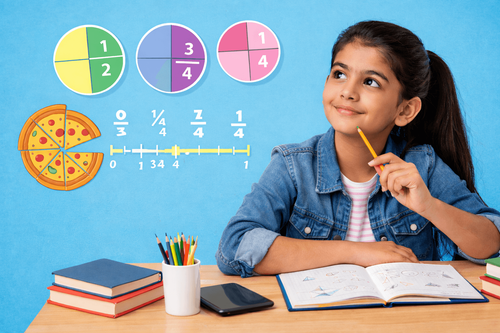

Fractions are one of the most important ideas children learn in math. At first, fractions may look confusing because they include numbers, lines, and parts. But once kids understand what fractions really mean, they become fun, logical, and even exciting. Fractions help children understand sharing, measuring, comparing, and solving real-life problems in a smarter way.
In this blog, we will explain fractions for kids step by step using simple language, real-life situations, and clear examples. We will explore what are fractions, understand the fractions meaning, look at many fraction examples, learn about types of fractions, and practice comparing fractions. By the end, fractions will no longer feel scary, they will feel familiar and friendly.
What Are Fractions?
To understand fractions clearly, let’s start with a simple question: what are fractions?
A fraction shows a part of a whole. When something is divided into equal parts and you take one or more of those parts, you are using a fraction.
Imagine a pizza cut into 4 equal slices.
If you eat 1 slice, you ate 1 out of 4 parts. This is written as:
1/4
So, a fraction tells us:
How many equal parts the whole is divided into
How many parts we are talking about
Fractions help kids understand ideas like sharing food, dividing toys, measuring ingredients, and understanding time.
Fractions Meaning Explained Simply
The fractions meaning becomes very easy once we understand its two main parts:
1. Numerator
The top number in a fraction is called the numerator.
It tells us how many parts we have.
2. Denominator
The bottom number is called the denominator.
It tells us how many equal parts the whole is divided into.
For example, in the fraction 3/5:
- 3 is the numerator (parts we have)
- 5 is the denominator (total equal parts)
So, fractions are simply a smart way of talking about parts and wholes.
Why Fractions Are Important for Kids
Learning fractions for kids is not just about passing exams. Fractions help children:
- Understand sharing fairly
- Learn measurements like half, quarter, and three-fourths
- Improve logical thinking
- Prepare for advanced math topics like decimals, percentages, and ratios
- Use math confidently in daily life
Fractions also improve problem-solving skills and help kids think clearly and practically.
Sign up now to help your child master fractions with confidence and clarity.
Understanding Basic Fractions
Before moving to complex ideas, kids must first learn basic fractions.
What Are Basic Fractions?
Basic fractions are simple fractions that show easy parts of a whole, such as:
- 1/2 (half)
- 1/3 (one third)
- 1/4 (one quarter)
- 3/4 (three quarters)
These fractions are commonly used in everyday life.
Examples of Basic Fractions in Daily Life
- Half a glass of milk (1/2)
- One slice from four slices of cake (1/4)
- Three parts of a chocolate bar divided into four pieces (3/4)
Learning basic fractions builds a strong foundation for understanding more advanced fraction concepts.
Enroll now and turn fraction learning into a fun, stress-free experience.
Fraction Examples to Make Learning Easy
Let’s look at some easy fraction examples that kids can relate to.
Example 1: Apples
You have 8 apples. You give 4 apples to your friend.
You gave 4/8 apples, which is also 1/2.
Example 2: Chocolate Bar
A chocolate bar is divided into 6 equal pieces.
You eat 2 pieces.
That means you ate 2/6 of the chocolate.
Example 3: Coloring Shapes
A square is divided into 4 equal boxes.
You color 3 boxes.
You colored 3/4 of the square.
These examples show how fractions appear naturally in fun and simple activities.
Get started today and build strong math foundations through simple fraction concepts.
Types of Fractions Explained for Kids
There are different types of fractions, and each type helps us understand numbers better.
1. Proper Fractions
A proper fraction is when the numerator is smaller than the denominator.
Examples:
- 1/2
- 3/5
- 4/7
Proper fractions always represent less than one whole.
2. Improper Fractions
An improper fraction has a numerator greater than or equal to the denominator.
Examples:
- 5/4
- 7/3
These fractions represent more than one whole.
3. Mixed Fractions
A mixed fraction includes a whole number and a fraction.
Example:
- 1 1/2
- 2 3/4
Mixed fractions make it easier to understand large quantities.
4. Equivalent Fractions
Equivalent fractions look different but have the same value.
Examples:
1/2 = 2/4 = 4/8
They represent the same part of a whole.
5. Like and Unlike Fractions
- Like fractions have the same denominator (2/7 and 5/7)
- Unlike fractions have different denominators (1/3 and 1/5)
Understanding these types helps kids compare and work with fractions more confidently.
Sign up now to make fractions easy, visual, and enjoyable for your child.
Comparing Fractions Step by Step
One of the most important skills kids learn is comparing fractions.
Comparing fractions means finding out:
- Which fraction is bigger
- Which fraction is smaller
- Or if both fractions are equal
Method 1: Same Denominator
If fractions have the same denominator, compare the numerators.
Example:
3/8 and 5/8
Since 5 is greater than 3, 5/8 is bigger.
Method 2: Same Numerator
If fractions have the same numerator, the fraction with the smaller denominator is larger.
Example:
1/4 and 1/6
Since 4 is smaller than 6, 1/4 is larger.
Method 3: Visual Comparison
Drawing shapes or using fraction strips helps kids see which fraction is bigger.
Visual learning makes comparing fractions easier and more fun.
Fractions in Real Life
Fractions are not just for math class. Kids use fractions every day without realizing it.
Examples include:
- Telling time (half hour, quarter hour)
- Cooking recipes (half cup, one-fourth spoon)
- Sports scores
- Dividing toys or snacks with friends
This shows why learning fractions meaning early is very helpful.
How Fraction Worksheets Help Kids Learn Better
Practice is key to mastering fractions. This is where fraction worksheets for kids become very useful.
Benefits of Fraction Worksheets
- Improve understanding through practice
- Build confidence step by step
- Help kids learn at their own pace
- Make revision easy
- Strengthen problem-solving skills
Worksheets often include:
- Coloring fractions
- Matching fraction values
- Comparing fractions
- Real-life word problems
Regular worksheet practice helps kids remember concepts for a long time.
Start learning today and watch your child gain confidence in fractions step by step.
Fun Ways to Teach Fractions to Kids
Fractions don’t have to be boring. Here are some fun ways to learn:
- Use pizzas, cakes, or fruits
- Draw shapes and color parts
- Play fraction games
- Use building blocks
- Solve puzzles together
When learning feels like play, kids enjoy math more.
Common Mistakes Kids Make with Fractions
Understanding mistakes helps kids improve faster.
Common mistakes include:
- Forgetting that parts must be equal
- Confusing numerator and denominator
- Comparing fractions incorrectly
- Not simplifying fractions
With clear explanation and practice, these mistakes can be easily corrected.
Sign up now for interactive fraction lessons designed especially for kids.
How PlanetSpark Helps Kids Master Fractions
PlanetSpark makes learning math engaging and easy for kids. Instead of rote memorization, PlanetSpark focuses on concept clarity, logical thinking, and real-life connections.
Through interactive lessons, visual explanations, storytelling, and practice activities, kids learn fractions in a way that feels natural and enjoyable. This approach helps children build strong math fundamentals that last a lifetime.
The key USPs of PlanetSpark’s maths course include:
- Live interactive sessions led by experienced educators who introduce mental-calculation shortcuts (including Vedic maths tricks) and connect them directly to NCERT/CBSE exam problems.
- Customised practise modules focusing on arithmetic operations, algebraic expressions, quadratic equations, and roots, so students apply the tricks within actual syllabus-aligned questions.
- Performance analytics & error-tracking tools that identify recurring calculation mistakes, helping students focus on improving speed and accuracy.
- Dedicated doubt-resolution and revision-boosters, which means that if any student is lagging on applying the tricks, the mentor provides targeted support and extra practise.
- Board-exam simulators with time-bound mock tests, where students learn to use tricks under realistic exam conditions, building confidence and speed.
Key Takeaways
Fractions are not just numbers on paper. They help kids understand the world around them. From sharing food to measuring time, fractions play a role in everyday life.
By learning fractions for kids properly starting from what are fractions, understanding the fractions meaning, practicing with fraction examples, exploring types of fractions, and mastering comparing fractions children develop strong math skills and logical thinking.
With the right guidance, practice, and support, fractions can become one of the most enjoyable topics in math.
Frequently Asked Questions
Fractions are numbers that show parts of a whole. When something is divided into equal parts, a fraction tells us how many parts we have. For example, if a pizza is cut into 4 equal pieces and you eat 1 piece, you have eaten 1/4 of the pizza. Fractions help children understand sharing and dividing fairly. They are used in daily life, such as food, time, and money.
Fractions help children understand numbers beyond counting and whole numbers. They build a strong base for advanced math topics like decimals, percentages, and ratios. Learning fractions improves problem-solving and logical thinking skills. Kids also use fractions in real-life situations like cooking, measuring, and shopping. Early understanding makes math easier and more enjoyable later.
A fraction has two main parts: the numerator and the denominator. The numerator shows how many parts are taken, while the denominator shows the total number of equal parts. For example, in 3/5, 3 is the numerator and 5 is the denominator. Together, they explain the size and value of the fraction. Understanding these parts helps kids read and compare fractions correctly.
Basic fractions are simple fractions like 1/2, 1/3, and 1/4. These fractions are easy to understand because they represent equal parts of a whole. Kids usually learn them using shapes, pictures, or objects. Basic fractions make it easier to understand sharing and dividing equally. They are the first step toward learning more complex fractions.
The main types include proper fractions, improper fractions, mixed fractions, unit fractions, and like and unlike fractions.
Kids can learn fractions easily through visual methods like pictures, diagrams, and real-life objects. Using examples such as pizza slices, fruits, or chocolate bars makes learning fun. Games, worksheets, and interactive activities also help. Practicing a little every day builds confidence and understanding. A step-by-step approach makes fractions less confusing.
Comparing fractions means finding out which fraction is bigger or smaller. Kids compare fractions by looking at the numerator and denominator or using visual models. For example, 1/2 is bigger than 1/4 because half is more than a quarter. This skill helps children understand number size and order. It also prepares them for advanced math concepts.
Yes, fractions are used in everyday life more than we realize. They are used while cooking, measuring ingredients, reading time, and sharing items. Fractions are also used in sports scores, shopping discounts, and money. Learning fractions helps kids connect math to real-world situations. This makes learning more meaningful and practical.
Fraction worksheets are practice sheets that help kids understand and apply fraction concepts. They include activities like coloring fractions, matching, and comparing fractions. Worksheets improve accuracy and build confidence through practice. They also help parents and teachers track a child’s progress. Regular practice with worksheets makes fraction learning stronger.
Kids usually start learning fractions around ages 7 to 9. At this age, they are ready to understand parts of a whole using visuals and examples. Early exposure helps reduce fear of math later. Learning fractions slowly and playfully works best. With the right guidance, kids can enjoy learning fractions from an early stage.