
NCERT Class 10 Introduction to Trigonometry Concepts and Basics


Table of Contents
- What is Trigonometry?
- Real-Life Examples of Trigonometry
- Basics of Right-Angled Triangle
- Trigonometric Ratios
- Reciprocal Ratios
- Important Relationships Between Ratios
- Important Observation About Trigonometric Ratios
- Important Trigonometric Identities
- Common Mistakes Students Make in Trigonometry
- Easy Tricks to Remember Trigonometric Ratios
- Practice Questions (Basic Level)
- Practice Questions (Intermediate Level)
- Practice Questions (NCERT Style)
- Higher Practice Questions
- Category-Wise Practice Questions for Introduction to Trigono
- Quick Recap of Introduction to Trigonometry
Ever wondered how we measure the height of a mountain, a tower, or even the distance between planets without actually touching them? The answer lies in trigonometry. Trigonometry is a fascinating branch of mathematics that studies the relationship between the angles and sides of a triangle. In Class 10, this topic forms the foundation for advanced mathematics, physics, and engineering concepts. In this guide, we will explore the introduction to trigonometry, understand trigonometric ratios, learn important identities, and practice many questions to master the topic easily.
What is Trigonometry?
The word trigonometry comes from the Greek words:
- Tri → Three
- Gon → Sides/Angles
- Metron → Measure
So, trigonometry literally means measuring triangles.
It studies the relationship between the sides and angles of triangles, especially right-angled triangles.
According to NCERT, trigonometry helps us calculate distances and heights without direct measurement.
Real-Life Examples of Trigonometry
Trigonometry is used in many real-life situations:
- Measuring the height of monuments like Qutub Minar
- Calculating the distance across a river
- Determining the altitude of airplanes or balloons
- Used in astronomy to measure distance of stars and planets
Basics of Right-Angled Triangle
To understand trigonometry, we must first understand the parts of a right-angled triangle.
A right triangle has three sides:
- Hypotenuse
- Longest side
- Opposite the right angle
- Opposite side
- Opposite to the angle considered
- Adjacent side
- Next to the angle considered
The names of sides change depending on the reference angle.
Trigonometric Ratios
Trigonometric ratios define the relationship between the sides of a right triangle and its angles.
There are six trigonometric ratios.
1. Sine (sin)
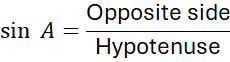
2. Cosine (cos)
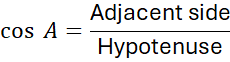
3. Tangent (tan)
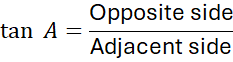
Reciprocal Ratios
Three ratios are reciprocals of the above.
4. Cosecant (cosec)

5. Secant (sec)
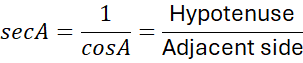
6. Cotangent (cot)
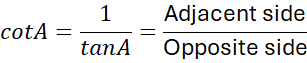

Important Relationships Between Ratios
Some relationships are always true.
Relationship 1
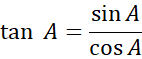
Relationship 2
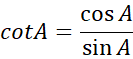
These relationships help us calculate other ratios easily.
Important Observation About Trigonometric Ratios
If the angle remains the same, the trigonometric ratios do not change, even if the triangle size changes.
This happens because similar triangles have proportional sides.
Finding Other Ratios When One Ratio is Known
Example:
If
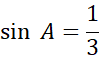
Then we assume:
Opposite = k
Hypotenuse = 3k
Using Pythagoras theorem:

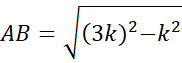
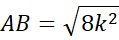
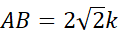
Now we can find all ratios.
Trigonometric Ratios of Standard Angles
Students must memorize the ratios of 0°, 30°, 45°, 60°, and 90°.
| Angle | sin | cos | tan |
|---|---|---|---|
| 0° | 0 | 1 | 0 |
| 30° | 1/2 | √3/2 | 1/√3 |
| 45° | 1/√2 | 1/√2 | 1 |
| 60° | √3/2 | 1/2 | √3 |
| 90° | 1 | 0 | Not Defined |
Important observations:
- sin increases from 0 → 1
- cos decreases from 1 → 0
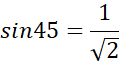
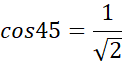
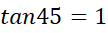
Trigonometric Ratios of 45°
For a 45°-45°-90° triangle:
Opposite = Adjacent
Using Pythagoras theorem:
Hypotenuse = √2a
Therefore:
Trigonometric Ratios of 30° and 60°
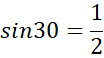
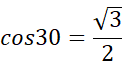
Using an equilateral triangle:
For 30°:
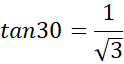
For 60°:
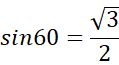
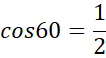
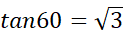
Trigonometric Ratios of 0° and 90°


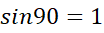
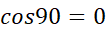
Important Trigonometric Identities
A trigonometric identity is an equation that is true for all angles.
Identity 1

Identity 2

Identity 3

These identities are derived from the Pythagoras theorem.
Common Mistakes Students Make in Trigonometry
While learning trigonometry, many students make small mistakes that can lead to incorrect answers in exams. Understanding these common errors can help students avoid confusion and solve problems more accurately.
Confusing Opposite and Adjacent Sides
Students often mix up the opposite and adjacent sides of a triangle. Remember that these sides depend on the reference angle (θ). Changing the angle changes which side is opposite or adjacent.
Forgetting Which Side Is the Hypotenuse
The hypotenuse is always the longest side of the right-angled triangle and lies opposite the right angle. Some students mistakenly use another side as the hypotenuse.
Mixing Up Trigonometric Formulas
Students sometimes forget the correct formulas for trigonometric ratios.

Mixing these formulas can lead to wrong calculations.
Not Using the Pythagoras Theorem Correctly
When a side of a triangle is missing, students sometimes forget to apply the Pythagorean theorem to find it before calculating trigonometric ratios.
Errors While Solving Identities
In trigonometric identities, students should simplify one side at a time. Trying to change both sides simultaneously often causes confusion.
Forgetting Reciprocal Relationships
Many students forget that some trigonometric ratios are reciprocals of each other, such as:
- sin θ and cosec θ
- cos θ and sec θ
- tan θ and cot θ
Calculation Mistakes
Small arithmetic mistakes can lead to incorrect final answers, especially when simplifying fractions.
Skipping Steps While Solving Problems
Students sometimes jump directly to the final answer without showing steps, which can cause mistakes and loss of marks in exams.

Easy Tricks to Remember Trigonometric Ratios
Trigonometric ratios can be difficult to remember at first, but a few simple tricks can make them easier to memorize.
1. The SOH-CAH-TOA Trick
One of the most popular ways to remember trigonometric ratios is the SOH-CAH-TOA rule.
- SOH → Sin = Opposite / Hypotenuse
- CAH → Cos = Adjacent / Hypotenuse
- TOA → Tan = Opposite / Adjacent
This simple phrase helps students recall the formulas quickly during exams.
2. Remember the Reciprocal Ratios
Each trigonometric ratio has a reciprocal.
- sin θ ↔ cosec θ
- cos θ ↔ sec θ
- tan θ ↔ cot θ
Remembering these pairs makes it easier to solve identity problems.
3. Use Triangle Diagrams
Drawing a right-angled triangle while solving problems helps students clearly identify the sides and avoid confusion.
4. Practice with Simple Triangles
Triangles like 3-4-5, 5-12-13, and 8-15-17 frequently appear in trigonometry questions. Practicing with these triangles improves speed and accuracy.
5. Learn the Basic Identity
One of the most important identities in trigonometry is:




θ = 35°|cos θ| = 0.819|sin θ| = 0.574cos² θsin² θ0.671 + 0.329 = 1
This identity is widely used to solve many trigonometric problems.
6. Practice Regularly
The best way to remember trigonometric formulas is regular practice. Solving different types of questions improves both understanding and confidence.
Practice Questions (Basic Level)
- Define trigonometry.
- What is the hypotenuse of a right triangle?
- Write the formula for sin A.
- Write the formula for cos A.
- Define tan A.
- What are reciprocal trigonometric ratios?
- Write values of sin 0° and cos 0°.
- Write values of sin 90° and cos 90°.
- Which trigonometric ratio is undefined at 90°?
- Which ratio increases as angle increases?
Practice Questions (Intermediate Level)
- If sin A = 3/5, find cos A.
- If tan A = 4/3, find sin A.
- Find cos 30° + sin 60°.
- Evaluate sin45° × cos45°.
- Find tan60° – tan30°.
- Evaluate sin²30° + cos²30°.
- Find sec45°.
- Evaluate tan45° + cos60°.
- If cosA = 12/13, find sinA.
- Find tan30° × tan60°.
Practice Questions (NCERT Style)
- In ΔABC right-angled at B, AB = 24 and BC = 7. Find sin A and cos A.
- If sin A = 3/4, find cos A and tan A.
- If cot A = 7/8, evaluate cot²A.
- If tan A = 1/3, find sin A cos C + cos A sin C.
- If sec θ = 13/12, find all other ratios.
- Prove that if sin A = sin B then A = B.
- Verify whether
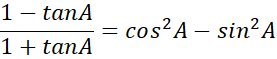
Higher Practice Questions
- Prove that

- Prove

- Prove

- Prove

- Prove

Category-Wise Practice Questions for Introduction to Trigonometry
1. Basic Concept Questions
These questions test a student's understanding of the fundamental ideas of trigonometry.
- What is trigonometry? Explain its importance in mathematics.
- Why is trigonometry mainly studied using right-angled triangles?
- What is meant by a trigonometric ratio?
- Name the six trigonometric ratios.
- What is the hypotenuse in a right-angled triangle?
- Define the opposite side and adjacent side with respect to an angle.
- Which side is always opposite to the right angle?
- Why is the hypotenuse always the longest side of a triangle?
- Can trigonometric ratios change if the size of the triangle changes? Explain.
- What happens to trigonometric ratios if two triangles are similar?
- In a right-angled triangle, how many angles are acute?
- If ∠A = 90°, which side becomes the hypotenuse?
- Explain why trigonometry is useful in real-life measurements.
- What does the symbol θ represent in trigonometry?
- Why do we use ratios instead of actual lengths in trigonometry?
You May Also Read
NCERT Solutions for class 10 Mathematics Chapter 8 Introduction to Trigonometry
2. Writing Trigonometric Ratios
Write the following ratios using sides of a right-angled triangle.

- Write the formula for sin θ.
- Write the formula for cos θ.
- Write the formula for tan θ.
- Write the formula for cosec θ.
- Write the formula for sec θ.
- Write the formula for cot θ.
- Express cosec θ in terms of sin θ.
- Express sec θ in terms of cos θ.
- Express cot θ in terms of tan θ.
- Write tan θ using sin θ and cos θ.
- Write sin θ using cosec θ.
- Write cos θ using sec θ.
- Write tan θ using cot θ.
- Express cot θ using sin θ and cos θ.
- Which trigonometric ratios are reciprocals of each other?
3. Identify Sides in a Right-Angled Triangle
Consider triangle ABC where ∠B = 90° and ∠A = θ.
- Identify the hypotenuse.
- Identify the side opposite to θ.
- Identify the side adjacent to θ.
- Write sin θ using triangle sides.
- Write cos θ using triangle sides.
- Write tan θ using triangle sides.
- Which side is opposite to angle C?
- Which side is adjacent to angle C?
- If AB = 6 cm, BC = 8 cm, AC = 10 cm, identify the hypotenuse.
- Identify the side opposite angle A.
- Identify the side adjacent to angle A.
- Which side is opposite the right angle?
- If ∠C is the reference angle, which side becomes adjacent?
- If ∠A increases, how does the opposite side appear relative to θ?
- Why does changing the reference angle change opposite and adjacent sides?
4. Numerical Questions on Trigonometric Ratios
Find the required trigonometric ratio.
- Opposite = 3 cm, Hypotenuse = 5 cm. Find sin θ.
- Adjacent = 4 cm, Hypotenuse = 5 cm. Find cos θ.
- Opposite = 5 cm, Adjacent = 12 cm. Find tan θ.
- Opposite = 8 cm, Hypotenuse = 17 cm. Find sin θ.
- Adjacent = 15 cm, Hypotenuse = 17 cm. Find cos θ.
- Opposite = 7 cm, Adjacent = 24 cm. Find tan θ.
- If sin θ = 5/13, find cosec θ.
- If cos θ = 12/13, find sec θ.
- If tan θ = 3/4, find cot θ.
- If sin θ = 7/25, find cosec θ.
- If cos θ = 9/41, find sec θ.
- If tan θ = 5/12, find cot θ.
- Opposite = 9 cm, Hypotenuse = 15 cm. Find sin θ.
- Adjacent = 16 cm, Hypotenuse = 20 cm. Find cos θ.
- Opposite = 12 cm, Adjacent = 35 cm. Find tan θ.
5. Questions Using Pythagoras Theorem
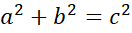




- A right triangle has sides 3 cm and 4 cm. Find the hypotenuse.
- A triangle has sides 5 cm and 12 cm. Find the hypotenuse.
- If hypotenuse = 13 cm and one side = 5 cm, find the other side.
- If hypotenuse = 10 cm and one side = 6 cm, find the other side.
- A triangle has sides 7 cm and 24 cm. Find the hypotenuse.
- A triangle has sides 9 cm and 12 cm. Find the hypotenuse.
- If hypotenuse = 25 cm and one side = 7 cm, find the other side.
- If hypotenuse = 17 cm and one side = 8 cm, find the other side.
- A triangle has sides 20 cm and 21 cm. Find the hypotenuse.
- If hypotenuse = 15 cm and adjacent side = 9 cm, find the opposite side.
6. Prove the Trigonometric Identities
- Prove





θ = 35°|cos θ| = 0.819|sin θ| = 0.574cos² θsin² θ0.671 + 0.329 = 1
- Prove

- Prove

Additional practice:
- Verify the identity if tan θ = 3/4.
- Verify the identity if sin θ = 5/13 and cos θ = 12/13.
- If cos θ = 8/17, verify sin²θ + cos²θ = 1.
- If tan θ = 5/12, verify 1 + tan²θ = sec²θ.
- If cot θ = 7/24, verify 1 + cot²θ = cosec²θ.
- If sin θ = 12/13, verify the fundamental identity.
- If cos θ = 15/17, verify the fundamental identity.
7. Higher-Level Exam Practice Questions
- If sin θ = 3/5, find cos θ and tan θ.
- If cos θ = 8/17, find sin θ.
- If tan θ = 5/12, find sin θ and cos θ.
- If sec θ = 13/12, find cos θ.
- If cosec θ = 25/7, find sin θ.
- If sin θ = 12/13, find tan θ.
- If cos θ = 15/17, find sin θ.
- If tan θ = 7/24, find sin θ and cos θ.
- If sin θ = 9/41, find cos θ.
- If cos θ = 20/29, find sin θ and tan θ.
- If tan θ = 8/15, find sin θ.
- If sin θ = 5/13, find cos θ.
- If cos θ = 24/25, find tan θ.
- If tan θ = 3/4, find sin θ and cos θ.
- If sin θ = 16/65, find cos θ.
8. Mixed Practice Questions
- If sin θ = 4/5, find cos θ and tan θ.
- If tan θ = 5/12, find sin θ.
- If cos θ = 7/25, find sec θ.
- If sin θ = 8/17, find cosec θ.
- If tan θ = 9/40, find cot θ.
- If cos θ = 24/25, find sin θ.
- If sin θ = 15/17, find cos θ.
- If tan θ = 8/15, find sec θ.
- If cos θ = 12/13, find tan θ.
- If sin θ = 5/13, find cot θ.
How PlanetSpark Helps Students Master Trigonometry and Math Concepts
- 1:1 Personalized Learning – Students receive individual attention through one-on-one sessions with expert trainers.
- Experienced Trainers – PlanetSpark educators are trained to help students improve communication, confidence, and critical thinking.
- Interactive Learning Methods – Classes include activities, storytelling, debates, and presentations that make learning engaging.
- Focus on Confidence Building – Students learn how to express their ideas clearly and confidently in front of others.
- Structured Curriculum – Lessons follow a well-designed curriculum that gradually develops speaking, writing, and analytical skills.
- Regular Feedback and Progress Tracking – Parents receive updates and feedback on the child’s improvement and learning progress.
- Skill Development Beyond Academics – PlanetSpark focuses on building critical thinking, creativity, and leadership skills.
- Supportive Learning Environment – Students feel comfortable sharing ideas, asking questions, and learning without hesitation.

Quick Recap of Introduction to Trigonometry
The introduction to trigonometry is one of the most important chapters in Class 10 mathematics. It builds the base for advanced topics like heights and distances, calculus, physics, engineering, and astronomy. By understanding trigonometric ratios, identities, and standard angle values, students can solve complex problems easily. The key to mastering trigonometry is concept clarity and consistent practice. Once you understand the logic behind the formulas, trigonometry becomes one of the most interesting and powerful tools in mathematics.
Also Read
Frequently Asked Questions
PlanetSpark helps students build strong communication and logical thinking skills. While learning topics like Introduction to Trigonometry, PlanetSpark encourages students to explain concepts clearly, ask questions confidently, and improve their analytical thinking through interactive learning sessions.
According to PlanetSpark, Introduction to Trigonometry is important because it strengthens mathematical reasoning and problem-solving abilities. PlanetSpark helps students develop the confidence and thinking skills needed to understand such mathematical concepts effectively.
PlanetSpark focuses on improving students’ speaking and presentation skills. When students learn topics like Introduction to Trigonometry, PlanetSpark helps them communicate their understanding clearly and confidently during discussions and presentations.
Yes, PlanetSpark helps students build confidence by encouraging them to express their ideas clearly. When students study topics like Introduction to Trigonometry, PlanetSpark’s interactive sessions help them overcome hesitation and explain concepts comfortably.
PlanetSpark promotes critical thinking and logical reasoning. While students practice topics such as Introduction to Trigonometry, PlanetSpark helps them develop structured thinking skills that improve their ability to analyze and solve problems.
Parents choose PlanetSpark because it focuses on overall skill development. Along with academic understanding of topics like Introduction to Trigonometry, PlanetSpark helps students improve communication, confidence, and presentation skills.