
Learn Even and Odd Numbers with Clear Rules and Examples
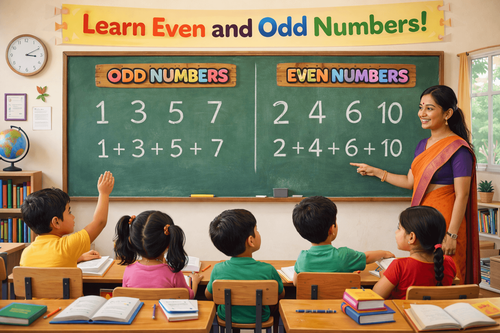

Understanding even and odd numbers is one of the most important foundational concepts in mathematics. It helps students develop number sense and prepares them for advanced topics such as multiplication, division, factors, and patterns. At an early stage, learners are introduced to numbers mainly for counting. As they progress, they learn to classify numbers based on their properties, and one of the simplest and most useful classifications is into even and odd numbers.
In daily life, we often divide objects equally, arrange items in pairs, or check whether something can be shared without leftovers. All these situations are directly connected to the idea of even and odd numbers. Therefore, learning this concept clearly helps students understand mathematics both academically and practically.
What Are Numbers? A Basic Understanding
Numbers are symbols used to count, measure, and label objects. The numbers we use in daily counting such as 1, 2, 3, 4, and so on are called natural numbers. These numbers continue endlessly and form the base of all mathematical operations.
To make learning easier, numbers are grouped into different categories based on their behavior. One such simple grouping is based on whether a number can be divided equally into two parts. This classification leads to the concepts of even and odd numbers. Before moving ahead, it is important to clearly understand the definition of odd and even numbers, as confusion at this stage can affect further learning.
Definition of Even Numbers
An even number is a number that can be divided into two equal groups without leaving any remainder. In simple words, if a number can be shared equally between two people, it is called an even number.
For example, if you have 8 books and divide them between two students, each student gets 4 books. Since there is nothing left over, 8 is an even number.
Some common even numbers are:
2, 4, 6, 8, 10, 12, 14, 16, 18, 20
Rule for Even Numbers
A number is even if:
- It is divisible by 2, and
- The remainder is zero
Another easy way to identify even numbers is by looking at the last digit. If a number ends in 0, 2, 4, 6, or 8, it is always an even number.
Definition of Odd Numbers
An odd number is a number that cannot be divided into two equal groups. When an odd number is divided by 2, one item is always left over.
For example, if you have 7 pens and try to divide them equally between two students, each student gets 3 pens, and 1 pen remains. Since equal sharing is not possible, 7 is an odd number.
Some common odd numbers are:
1, 3, 5, 7, 9, 11, 13, 15, 17, 19
Rule for Odd Numbers
A number is odd if:
- It is not divisible by 2, and
- The remainder is 1
Odd numbers usually end in 1, 3, 5, 7, or 9, which makes them easy to identify.
Book a free PlanetSpark demo class today and see how interactive learning improves your child’s communication skills.
What Number Is Even and Odd?
To clearly understand what number is even and odd, we can use simple methods such as grouping, division, and observation of patterns. Every natural number belongs to either the even group or the odd group. No number can be both even and odd at the same time.
Let us observe a simple counting pattern:
1 – odd
2 – even
3 – odd
4 – even
5 – odd
6 – even
This pattern continues for all natural numbers. Even and odd numbers always appear alternately. This means after every even number, there is an odd number, and after every odd number, there is an even number.
Understanding this pattern helps students quickly recognize whether a number is even or odd without calculation.
Identifying Even and Odd Numbers Using Objects
One of the easiest ways to understand even and odd numbers is by using real objects such as pencils, stones, or fruits.
- If objects can be paired without anything left, the total number is even.
- If one object is left unpaired, the number is odd.
For example:
- 10 pencils can form 5 pairs → even number
- 11 pencils form 5 pairs + 1 leftover → odd number
This method is very helpful for younger learners because it provides a visual and practical understanding rather than just memorizing rules.
Even and Odd Numbers Between 1 and 100
When we list numbers from 1 to 100, we notice a clear and regular pattern. Even numbers appear at every second position, while odd numbers fill the remaining places.
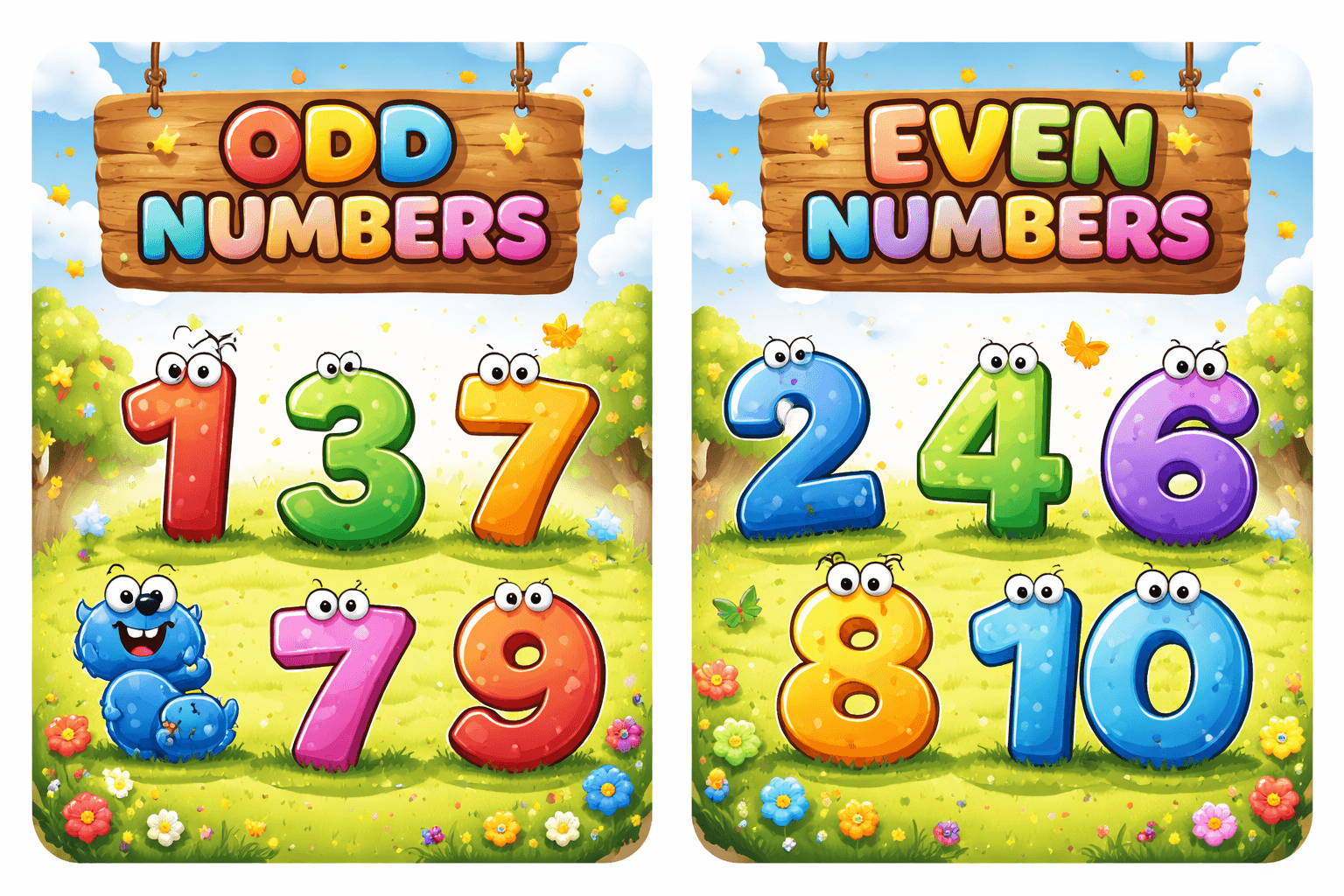
- Even numbers from 1 to 10: 2, 4, 6, 8, 10
- Odd numbers from 1 to 10: 1, 3, 5, 7, 9
This consistent pattern continues up to 100 and beyond. Recognizing this order helps students speed up calculations and improve number sense, which is crucial for higher-level math concepts.
Importance of Understanding Definitions Clearly
A clear understanding of the definition of odd and even numbers helps students avoid common mistakes in mathematics. Many errors in arithmetic occur because students are unsure about basic number properties. When students confidently know what number is even and odd, they find it easier to solve problems related to division, factors, patterns, and algebra in later classes.
At the academic level, this concept forms the foundation for many mathematical operations and logical reasoning skills. Therefore, mastering even and odd numbers at an early stage is essential for long-term success in mathematics.
Operations with Even and Odd Numbers
Once students understand the definition of odd and even numbers, the next important step is to learn how these numbers behave during mathematical operations. Knowing how even and odd numbers react when added, subtracted, or multiplied helps learners solve problems faster and with greater confidence. These rules are simple, logical, and consistent, making them easy to remember once properly understood.
Addition of Even and Odd Numbers
Let us begin with addition, one of the most basic operations in mathematics.
Even + Even = Even
When two even numbers are added together, the result is always an even number.
Example:
4 + 6 = 10
8 + 12 = 20
This happens because both numbers are divisible by 2, and their sum remains divisible by 2. Visually, when we add two equal pairings, the total can still be divided into equal pairs.
Odd + Odd = Even
Adding two odd numbers always gives an even number.
Example:
3 + 5 = 8
7 + 9 = 16
An odd number always has one extra item. When two odd numbers are added, the two extra items combine to form a complete pair, which results in an even number.
Even + Odd = Odd
When an even number is added to an odd number, the result is always odd.
Example:
6 + 5 = 11
10 + 3 = 13
Since the even number has no leftover and the odd number has one leftover, the total still has one leftover, making it odd.
Subtraction of Even and Odd Numbers
Subtraction also follows clear patterns with even and odd numbers.
- Even – Even = Even
Example: 12 – 4 = 8 - Odd – Odd = Even
Example: 9 – 3 = 6 - Even – Odd = Odd
Example: 14 – 7 = 7 - Odd – Even = Odd
Example: 11 – 6 = 5
These patterns work consistently and help students understand what number is even and odd after subtraction without needing to calculate fully every time.
Enroll for a PlanetSpark demo class to experience live, one-to-one sessions with expert educators.
Multiplication of Even and Odd Numbers
Multiplication shows another important behavior of even and odd numbers.
Even × Any Number = Even
If one of the numbers in multiplication is even, the product is always even.
Examples:
4 × 3 = 12
6 × 7 = 42
This is because an even number already contains a factor of 2.
Odd × Odd = Odd
Only when both numbers are odd does the product remain odd.
Examples:
3 × 5 = 15
7 × 9 = 63
This rule is useful when checking answers quickly in exams or calculations.
Understanding Through Patterns
Patterns are a strong way to reinforce the definition of odd and even numbers. When students write out a sequence of numbers, they quickly notice that even and odd numbers follow a repeating order.
For example:
1 (odd), 2 (even), 3 (odd), 4 (even), 5 (odd), 6 (even)
This alternating pattern never changes. Recognizing this pattern helps learners mentally classify numbers and strengthens their understanding of what number is even and odd without using division each time.
Real-Life Examples of Even and Odd Numbers
Understanding even and odd numbers becomes much easier when linked to daily life. Mathematics is not limited to textbooks, and this concept appears in many real situations.
- Sharing objects:
If 12 chocolates are shared between two children equally, there are no leftovers, so 12 is even.
If 13 chocolates are shared, one chocolate remains, so 13 is odd. - Seating arrangements:
If chairs can be arranged in pairs, the total number of chairs is even. - Counting objects:
When counting steps, pages in a book, or classroom items, students often encounter even and odd numbers.
Such examples help learners see that the definition of odd and even numbers has practical use in everyday tasks.
Common Mistakes Students Make
Even though the concept is simple, learners often make mistakes due to confusion or lack of practice.
- Checking the whole number instead of the last digit
Students sometimes struggle with large numbers. Remember, only the last digit matters when deciding what number is even and odd. - Assuming bigger numbers are always even
Size does not matter. A large number like 101 is odd, while a small number like 2 is even. - Mixing rules during operations
Forgetting that odd + odd equals even is a common mistake. Repeating and practicing rules reduces such errors.
Addressing these mistakes early improves accuracy and confidence.
Practice Questions on Even and Odd Numbers
Practicing questions helps reinforce learning. Below are simple problems suitable for academic understanding.
Identify whether the number is even or odd:
- 18
- 27
- 42
- 59
Answers:
18 – Even
27 – Odd
42 – Even
59 – Odd
Fill in the blanks:
- Even + Odd = ______
- Odd × Odd = ______
Answers:
- Odd
- Odd
Word Problem:
There are 15 students in a class. Can they be divided equally into two groups?
Explanation:
15 is an odd number. Equal division is not possible because one student will remain. This confirms the definition of odd and even numbers.
Why Learning Even and Odd Numbers Is Important Academically
Understanding even and odd numbers is not limited to basic math. It supports learning in higher topics such as factors, multiples, algebra, and number theory. Many mathematical shortcuts rely on knowing what number is even and odd, especially in exams and competitive settings.
Academically, strong basics reduce confusion in future classes. A clear understanding helps students solve problems logically rather than relying on guesswork.
Try a PlanetSpark demo class for free and discover a structured learning approach designed for young learners.
Linking Even and Odd Numbers to Advanced Concepts
As students progress, they learn topics like prime numbers, divisibility rules, and algebraic expressions. The foundation of all these concepts includes the definition of odd and even numbers.
For example:
- All even numbers greater than 2 are not prime.
- Algebraic expressions often behave differently depending on whether numbers are even or odd.
Thus, this concept is a stepping stone to deeper mathematical learning.
Conclusion
Understanding even and odd numbers builds a strong foundation in mathematics and helps students develop clear logical thinking. With a proper understanding of the definition of odd and even numbers, learners can easily identify patterns and solve basic arithmetic problems. Knowing what number is even and odd also supports learning advanced concepts in later classes. Regular practice and real-life examples make this concept simple, useful, and long-lasting in academic learning.
Frequently Asked Questions
Even numbers are numbers divisible by 2 without any remainder, while odd numbers leave a remainder of 1 when divided by 2.
An even number can be divided equally into two parts, whereas an odd number cannot be divided equally and always leaves one extra.
By checking the last digit—numbers ending in 0, 2, 4, 6, or 8 are even, and those ending in 1, 3, 5, 7, or 9 are odd.
No, every number is either even or odd, never both at the same time.