
Learn Types of Fractions with Step-by-Step Practice | PlanetSpark
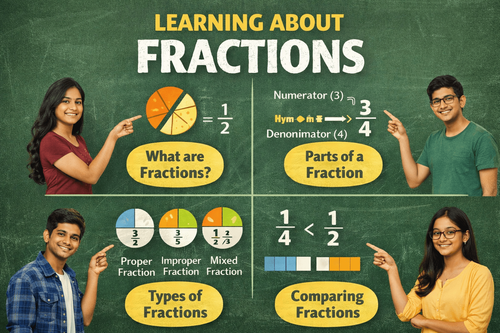

Table of Contents
- Types of Fraction with Example: Understanding the Basics
- How Many Types of Fraction Are There?
- Different Types of Fractions Explained Simply
- Types of Fractions for Kids and Beginners
- Fractions with Examples: Like and Unlike Fractions
- More Practice on Classification of Fractions
- Comparing Different Types of Fractions
- Real-Life Applications of Fraction Types
- Common Mistakes Students Make While Learning Fractions
- Step-by-Step Practice Questions
- Why Learning Types of Fractions Is Important for Students
- How PlanetSpark Helps Students Learn Fractions Step by Step
- Conclusion
Fractions are one of the most important concepts in mathematics. They form the foundation for topics such as decimals, percentages, ratios, algebra, and real-life calculations. However, many students find fractions confusing because they are introduced without clear explanations or enough practice.
Learning the types of fractions step by step helps students understand how numbers can represent parts of a whole. When concepts are explained clearly with examples, fractions become simple, logical, and even fun to learn. This guide focuses on explaining the types of fraction with example, making it ideal for kids and beginners.
Types of Fraction with Example: Understanding the Basics
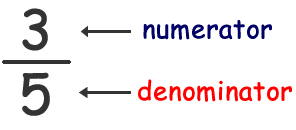
A fraction represents a part of a whole. It is written using two numbers separated by a slash (/).
- The top number is called the numerator. It shows how many parts are taken.
- The bottom number is called the denominator. It shows the total number of equal parts.
Example
If a pizza is cut into 8 equal pieces and you eat 3 pieces, the fraction is written as 3/8.
This means:
- Total pieces = 8
- Pieces taken = 3
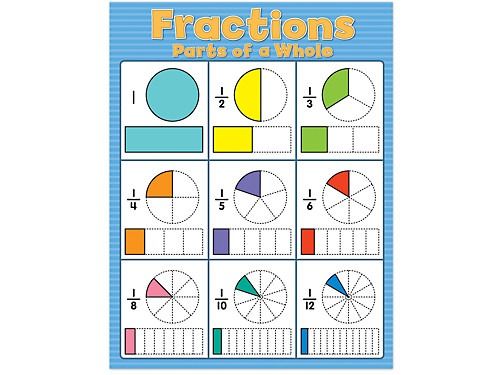
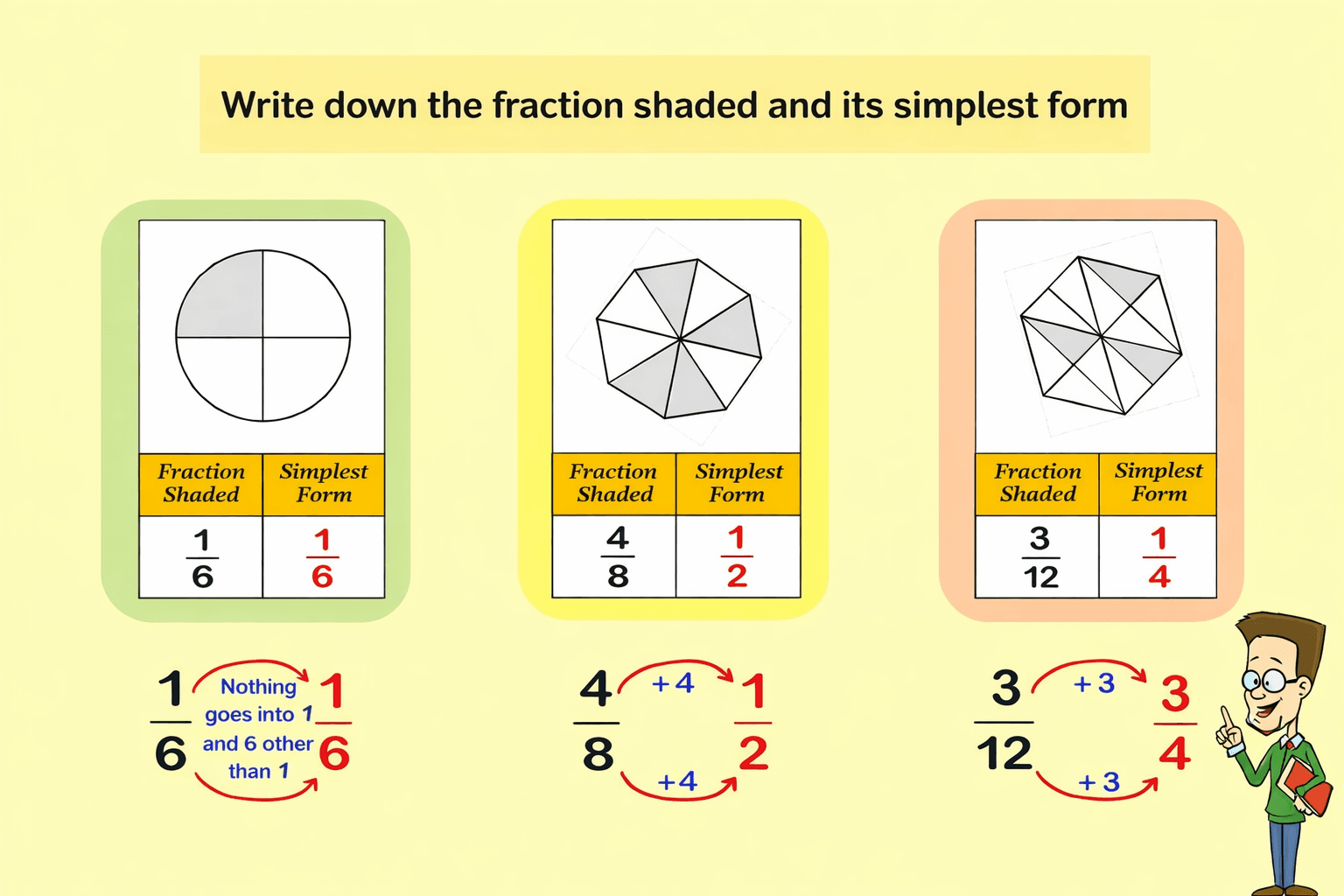
Understanding this basic idea is essential before learning the classification of fractions.
How Many Types of Fraction Are There?
Students often ask, how many types of fraction are there in mathematics.
Fractions are divided into different groups based on:
- The size of the numerator and denominator
- The form in which the fraction is written
- Whether denominators are the same or different
This classification of fractions helps students identify fractions easily and solve problems correctly.
Make fractions easy and fear-free for your child.
Book a FREE PlanetSpark Demo Class and learn fractions step by step with clear explanations.
Different Types of Fractions Explained Simply
Let us now understand the different types of fractions one by one with simple explanations and examples.
Proper Fractions
A proper fraction is a fraction in which the numerator is smaller than the denominator.
Examples
- 2/5
- 3/7
- 4/9
Explanation
In each example, the top number is smaller than the bottom number. Proper fractions always represent a value less than one whole. These are the most common fractions for beginners because they are easy to visualise.
Improper Fractions
An improper fraction is a fraction in which the numerator is equal to or greater than the denominator.
Examples
- 7/5
- 9/4
- 6/6
Explanation
Improper fractions represent a value equal to or greater than one whole.
For example:
- 6/6 means one whole
- 7/5 means one whole and two parts more
Improper fractions are often converted into mixed fractions for easier understanding.
Mixed Fractions
A mixed fraction is written using a whole number and a proper fraction together.
Examples
- 1 3/4
- 2 1/5
Step-by-Step Example
Convert 11/4 into a mixed fraction:
- Divide 11 by 4
- The quotient is 2 and the remainder is 3
- So, the mixed fraction is 2 3/4
Types of Fractions for Kids and Beginners
Teaching types of fractions for kids is most effective when concepts are simple and linked to daily experiences.
Unit Fractions
A unit fraction is a fraction in which the numerator is 1.
Examples
- 1/2
- 1/4
- 1/10
Explanation
A unit fraction represents one equal part of a whole. For example, if a chocolate bar is divided into 4 equal parts, one part is written as 1/4.
Unit fractions are usually the first fractions for beginners because they are easy to understand and use.
Fractions Explained Simply Using Everyday Objects
Understanding fractions explained simply becomes easier when students relate them to real-life objects.
Examples:
- Half of a pizza = 1/2
- One quarter of a cake = 1/4
- Three slices out of eight = 3/8
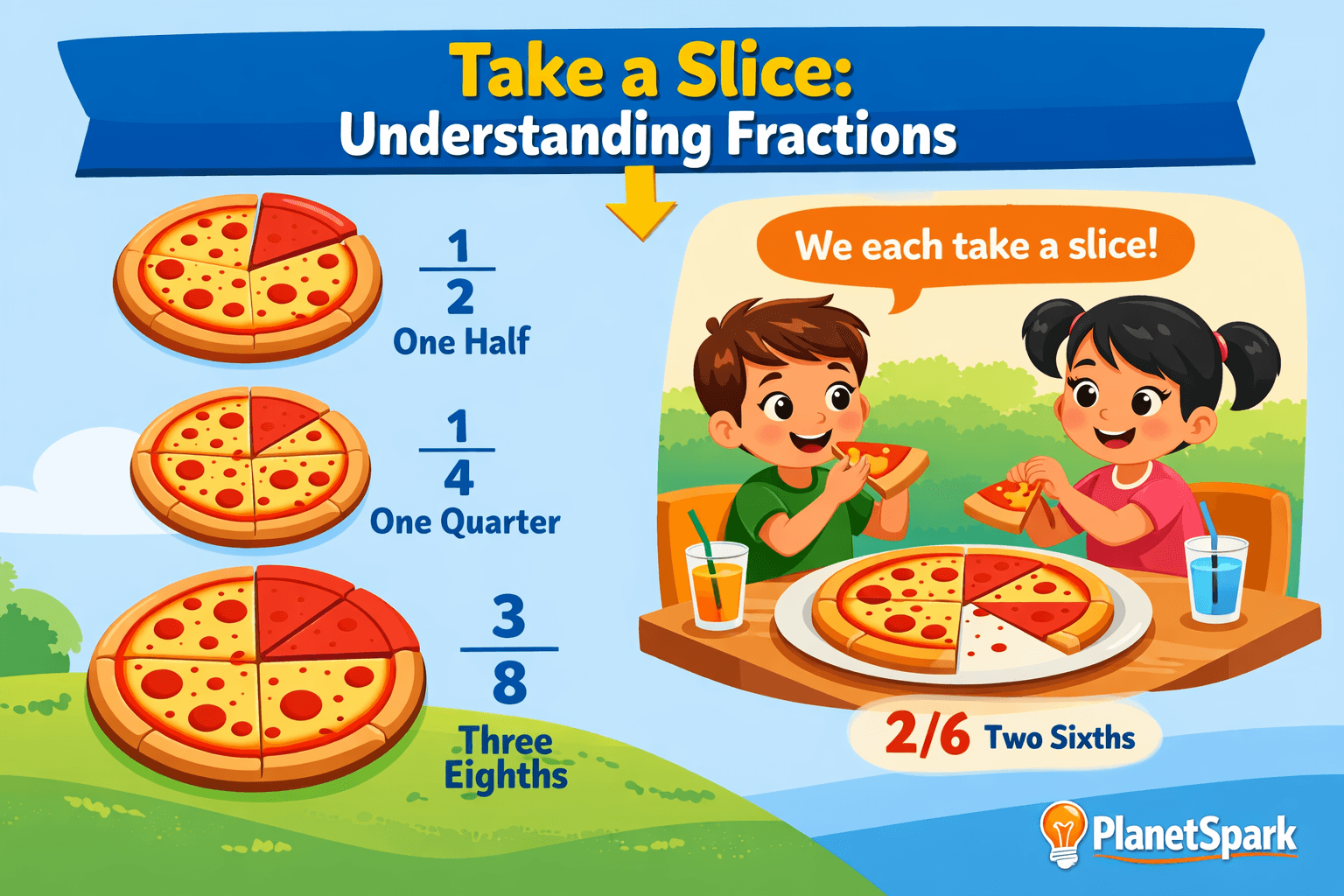
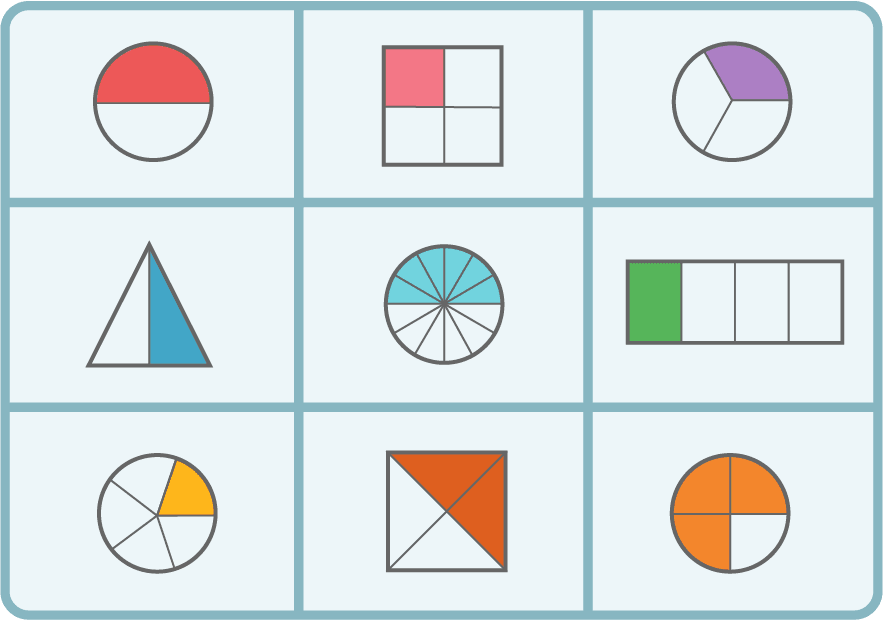
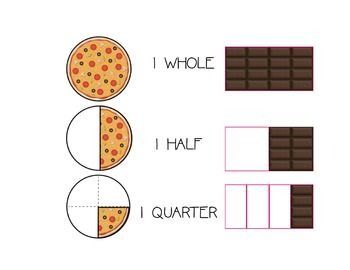
Using visuals helps children remember fraction concepts more clearly.
Struggling with fractions and basics in maths?
Try a PlanetSpark Demo Class and help your child master types of fractions with practice.
Fractions with Examples: Like and Unlike Fractions
Another important part of the classification of fractions is based on denominators.
Like Fractions
Like fractions are fractions that have the same denominator.
Examples
- 2/7
- 5/7
- 6/7
Explanation
Since the bottom number is the same, like fractions are easy to add or subtract.
Example:
- 2/7 + 3/7 = 5/7
Unlike Fractions
Unlike fractions are fractions that have different denominators.
Examples
- 1/4
- 2/5
- 3/8
Explanation
Unlike fractions cannot be added or subtracted directly. They must first be converted into like fractions by making the denominators the same.
Understanding like and unlike fractions helps students perform fraction operations correctly.
More Practice on Classification of Fractions
Once students understand the basic fraction types, it becomes important to see how the classification of fractions helps in solving questions. Recognising fraction types quickly reduces errors and improves speed in exams.
At a school level, fractions are mainly classified based on:
- Size (proper, improper, mixed)
- Structure (unit fractions)
- Denominators (like and unlike fractions)
This structured approach helps learners organise mathematical thinking instead of memorising rules.
Comparing Different Types of Fractions
Before performing calculations, students must learn how to compare fractions correctly.
Comparing Proper Fractions
When two proper fractions have the same denominator, the fraction with the larger numerator is greater.
Example
Compare 3/9 and 5/9
Since both fractions have the same denominator (9), compare the numerators:
- 5 is greater than 3
So, 5/9 is greater than 3/9
Comparing Fractions with Different Denominators
When denominators are different, fractions must first be converted into like fractions.
Example
Compare 1/2 and 3/4
Step 1: Make denominstors the same
- 1/2 becomes 2/4
Now compare:
- 2/4 and 3/4
Since 3 is greater than 2, 3/4 is the greater fraction
This is why understanding like and unlike fractions is essential before learning operations.
Real-Life Applications of Fraction Types
Learning types of fractions for kids becomes easier when students see how fractions appear in daily life.
Fractions are used in:
- Cooking (half cup, quarter spoon)
- Shopping (discounts and portions)
- Time (half an hour, quarter past)
- Sharing items equally
Example
If a chocolate bar is divided into 8 pieces and 5 pieces are eaten:
- Fraction eaten = 5/8
- Fraction remaining = 3/8
This practical use of fractions with examples improves understanding and retention.
Common Mistakes Students Make While Learning Fractions
Knowing common mistakes helps students avoid confusion.
Mistake 1: Confusing Numerator and Denominator
Students sometimes forget which number represents parts taken and which represents total parts.
Tip:
Always remember:
- Top number = parts taken
- Bottom number = total parts
Mistake 2: Adding Denominators Directly
Incorrect method:
- 1/4 + 1/4 = 2/8 ❌
Correct method:
- Add only numerators
- Keep denominator same
Correct answer:
- 1/4 + 1/4 = 2/4 = 1/2
Understanding fraction types explained clearly helps avoid such mistakes.
Step-by-Step Practice Questions
Here are a few practice questions designed especially for fractions for beginners.
Question 1
Identify the type of fraction: 6/9
- Numerator is smaller than denominator
- This is a proper fraction
Question 2
Convert the improper fraction 9/4 into a mixed fraction
Steps:
- Divide 9 by 4
- Quotient = 2, remainder = 1
- Mixed fraction = 2 1/4
Question 3
State whether the following are like or unlike fractions:
- 3/5 and 1/5 → Like fractions
- 2/3 and 4/7 → Unlike fractions
Regular practice like this strengthens understanding of the different types of fractions.
Build strong maths fundamentals early.
Join a Free Demo Class at PlanetSpark and see how fractions are taught simply and visually.
Why Learning Types of Fractions Is Important for Students
Understanding how many types of fraction there are and how they are used is a crucial step in building strong mathematical foundations. Fractions are not just a standalone topic; they are directly connected to many advanced concepts taught in middle and higher classes. When students clearly understand the types of fractions, they are able to progress smoothly in mathematics without confusion or fear.
Builds a Strong Base for Decimals and Percentages
Decimals and percentages are simply different ways of representing fractions. For example, one half, written as 1/2, can also be expressed as 0.5 or 50 percent. If students do not understand fraction types such as proper, improper, and mixed fractions, converting between these formats becomes difficult. Early mastery of fraction classification helps students learn decimals, percentages, ratios, and proportions with greater ease in later classes.
Improves Number Sense and Mathematical Confidence
Learning fraction types improves number sense, which is the ability to understand and work with numbers logically. When students recognise whether a fraction is less than one, equal to one, or greater than one, they develop a clearer sense of quantity and value. This understanding helps them estimate answers, check whether results are reasonable, and approach maths problems with confidence rather than guesswork.
Enhances Problem-Solving Ability
Fractions are often used in word problems, real-life situations, and multi-step calculations. When students can quickly identify the classification of fractions, they are able to choose the correct method for solving a problem. Understanding like and unlike fractions, for example, helps students perform addition and subtraction accurately. This structured thinking strengthens overall problem-solving skills and logical reasoning.
Boosts Exam Performance and Accuracy
Many students lose marks in exams due to basic fraction errors rather than complex calculations. Clear knowledge of fraction types explained properly reduces careless mistakes, improves speed, and increases accuracy. Students who are confident with fractions find it easier to solve questions in algebra, data handling, and applied mathematics, leading to better overall exam performance.
How PlanetSpark Helps Students Learn Fractions Step by Step
Maths becomes enjoyable when concepts are taught clearly and interactively. PlanetSpark focuses on helping students understand concepts rather than memorise rules.
PlanetSpark supports fraction learning by:
- Explaining fractions explained simply using visuals
- Teaching step-by-step methods for beginners
- Offering guided practice and expert feedback
- Building confidence in maths problem-solving
This structured approach helps children learn faster and retain concepts longer.
Conclusion
Fractions may seem challenging at first, but when students understand the classification of fractions and practise with clear examples, the topic becomes simple and logical. Learning the types of fraction with example, identifying like and unlike fractions, and applying concepts step by step builds a strong foundation in mathematics.
With the right guidance and regular practice, children can overcome fear and develop confidence in maths.
Help your child master fractions the smart way. Enrol them in PlanetSpark’s interactive learning programs and make maths simple, fun, and effective.
Frequently Asked Questions
The main types include proper fractions, improper fractions, mixed fractions, unit fractions, and like and unlike fractions.
Fractions are difficult when concepts are not explained clearly or without examples. Step-by-step learning helps beginners understand them easily.
Fractions are difficult when concepts are not explained clearly or without examples. Step-by-step learning helps beginners understand them easily.
PlanetSpark uses visual explanations, practice-based learning, and expert guidance to help children understand fraction concepts confidently.
PlanetSpark uses visual explanations, practice-based learning, and expert guidance to help children understand fraction concepts confidently.