
Polynomials Class 9 Guide-Types & Examples for Students


Table of Contents
- What Are Polynomials Class 9?
- Types of Polynomials Class 9 Based on Degree and Terms
- Zeroes of a Polynomial Class 9: Meaning, Method, and Example
- Operations on Polynomials Class 9: Addition, Subtraction, Mu
- Division of Polynomials Class 9: Long Division & Shortcut Me
- How to Represent Polynomials Graphically?
- Polynomial Examples – 3-4 Solved Examples
- Properties of Polynomials
- PlanetSpark Maths Course: Build Strong Conceptual Skills wit
- Take Small Daily Steps Toward Algebra Success
- Frequently Asked Questions
Struggling with algebraic expressions and feeling confused where to begin This guide on Polynomials Class 9 breaks the topic into simple ideas so students can understand it without confusion.
The blog explains the definition of polynomial, key terms, types of polynomials, examples, identities, factorisation, graphical representation and solved NCERT style problems. Each section focuses on building strong conceptual clarity for exams and higher classes. At the end of the blog is a helpful PlanetSpark section to support students who want structured learning and personalised maths guidance.
What Are Polynomials Class 9?
A polynomial is an algebraic expression that includes variables, coefficients, and exponents arranged in a meaningful form. A general polynomial looks like this
aₙxⁿ plus aₙ₋₁xⁿ⁻¹ plus ... plus a₁x plus a₀
Each part of this expression is known as a term. In Polynomials Class 9, the definition of polynomial focuses on exponents that are whole numbers. This means expressions like 3x² plus 5x minus 7 are polynomials while expressions with negative or fractional exponents are not. Students learn how to identify polynomials, read their structure, and understand how each term contributes to its shape and behaviour.
A polynomial has
• Variables
• Coefficients
• Exponents that are whole numbers
• Zero or more terms
Understanding these basics helps build a strong foundation for algebra
Key Terms You Must Know Before Learning Polynomials Class 9
Before exploring the types of polynomials or examples of polynomial expressions, Polynomials Class 9 requires familiarity with some essential terms. These terms appear repeatedly throughout NCERT maths chapters and form the basis of further learning.
Variable
A symbol such as x or y that can take different values.
Coefficient
The numerical part of a term. In 4x² the coefficient is 4.
Exponent
The power of the variable. In x³ the exponent is 3.
Degree of Polynomial
The highest exponent of the variable in the expression.
For example, the degree of 7x³ minus 2x plus 4 is 3.
Term
Each part of the expression separated by plus or minus signs.
Monomial
A polynomial with one term. Example 6y.
Binomial
A polynomial with two terms. Example x plus 9.
Trinomial
A polynomial with three terms. Example 2x² plus 5x minus 1.
Standard Form
A polynomial written in descending order of exponents.
These terms simplify complex expressions and make the topic easier to understand.

Types of Polynomials Class 9 Based on Degree and Terms
Types of polynomial based on degree and the number of terms form a core part of Polynomials Class 9. Classifying an expression correctly helps students recognise patterns and apply the right operations or formulas.
Based on Degree
Constant Polynomial
Degree 0
Example 5
Linear Polynomial
Degree 1
Example 3x plus 2
Quadratic Polynomial
Degree 2
Example x² minus 4x plus 6
Cubic Polynomial
Degree 3
Example 2x³ minus x plus 9
Based on Number of Terms
Monomial
One term
Example 7x³
Binomial
Two terms
Example x minus 8
Trinomial
Three terms
Example 4x² plus x minus 3
These types of polynomials help students identify patterns quickly and understand which formulas or operations fit a given algebraic expression. Classification is a key step before solving questions or analysing the degree of polynomial expressions.
Make algebra enjoyable and effective—start with a free PlanetSpark class today
Special Polynomial Identities in Class 9
In Polynomials Class 9, there are several algebraic identities that make factorisation and simplification much easier. Knowing these identities helps to factor expressions quickly even without long calculations.
Some important identities:
These identities are aligned with the NCERT syllabus and are used to simplify or factor polynomials efficiently.
Zeroes of a Polynomial Class 9: Meaning, Method, and Examples
In Polynomials Class 9, the concept of zeroes (or roots) is very important. A zero of a polynomial is a value of the variable (say ) for which the polynomial becomes zero; that is, if is a polynomial, then is a zero if .
Why Zeroes Matter
Zeroes help us solve polynomial equations.
Geometrically, for a polynomial function , these zeroes correspond to the points where the graph touches or crosses the x-axis.
In higher mathematics, understanding zeroes paves the way for factorisation, division, and theorems like the Remainder Theorem.
How to Find Zeroes (NCERT-style)
Set the polynomial equal to zero: For instance, if , write .
Factorise (if possible): Here, becomes .
Solve for : From , we get or as the zeroes.
Interpret: These zeroes match the polynomial’s degree: a quadratic (degree 2) can have up to 2 zeroes.
Important Fact
A polynomial of degree has at most real zeroes (though depending on the coefficients, some might be repeated or complex).
Transform fear of algebra into confidence
Operations on Polynomials Class 9: Addition, Subtraction, Multiplication
Working with polynomials means being able to perform four fundamental operations. In Class 9, mastering addition, subtraction, and multiplication of polynomials strengthens algebraic skills and readies students for more advanced topics.
Addition of Polynomials
Align like terms: Combine terms with the same variable and exponent.
Add coefficients: For terms that are like, just add (or subtract) their coefficients.
Example: If you add , you combine , , and , giving .
Subtraction of Polynomials
Reverse signs of the polynomial to be subtracted: Change the sign of every term in the subtrahend.
Then add: Treat it like addition of polynomials with like terms.
Example: becomes .
Multiplication of Polynomials
Distribute every term: Multiply each term of the first polynomial with every term of the second.
Add the results: Combine like terms after distribution.
Example: .
Division of Polynomials Class 9: Long Division & Shortcut Methods
Division of polynomials is a key concept in Polynomials Class 9. It helps simplify expressions, find remainders, and is also foundational for the Remainder Theorem.
Let your child gain confidence in polynomial operations
Long Division Method
Arrange the dividend and divisor in descending order of degree.
Divide the highest degree term of dividend by the highest degree term of the divisor.
Multiply the divisor by that quotient term and subtract from the dividend.
Repeat the process: bring down the next term, divide again, multiply, subtract, until the remainder has lower degree than the divisor.
Result: Dividend = Divisor × Quotient + Remainder.
Shortcut Method (Remainder / Synthetic Division)
For a linear divisor of the form , synthetic division is a faster method to get the quotient and remainder.
Alternatively, the Remainder Theorem says: if is divided by , then the remainder is simply .
Factorisation of Polynomials Class 9: Simple Methods
Factorisation means expressing a polynomial as a product of simpler polynomials. In Class 9, students often use three main strategies:
Grouping
Break the polynomial into groups of terms that share a common factor.
Factor out the common factor in each group, and then factor the entire expression.
Example theme: For a polynomial like , group as , factor out in the first group and in the second.
Using Identities
Use the special identities (from section 6) to factor expressions: for example, factor into .
Splitting the Middle Term (for Quadratics)
For a quadratic , find two numbers that multiply to and add to .
Rewrite the middle term using these two numbers, and then factor by grouping.
Example: Factorise . Here, ; find numbers −2 and −3 (sum = −5, product = 6); rewrite as ; then group and factor: .
Struggling with zeroes and factorisation? PlanetSpark can help
How to Represent Polynomials Graphically?
Graphical representation of a polynomial helps make the abstract algebra look visual.
What to Expect
A linear polynomial (degree 1) like will graph as a straight line. The coefficient ‘a’ gives the slope and ‘b’ the intercept.
A quadratic polynomial (degree 2) such as graphs as a parabola. Key features: opens upward if , downward if , and the vertex gives a turning point.
A cubic polynomial (degree 3) like may have an “S-shaped” curve, with up to two turning points and a possible inflection.
Although in Class 9 the focus is more on algebraic manipulation rather than detailed graph-analysis, being aware of these visual cues is helpful. For example: when a polynomial has a zero at , its graph touches or crosses the x-axis at .
Standard form (highest degree to lowest) assists in predicting shape and intercepts.
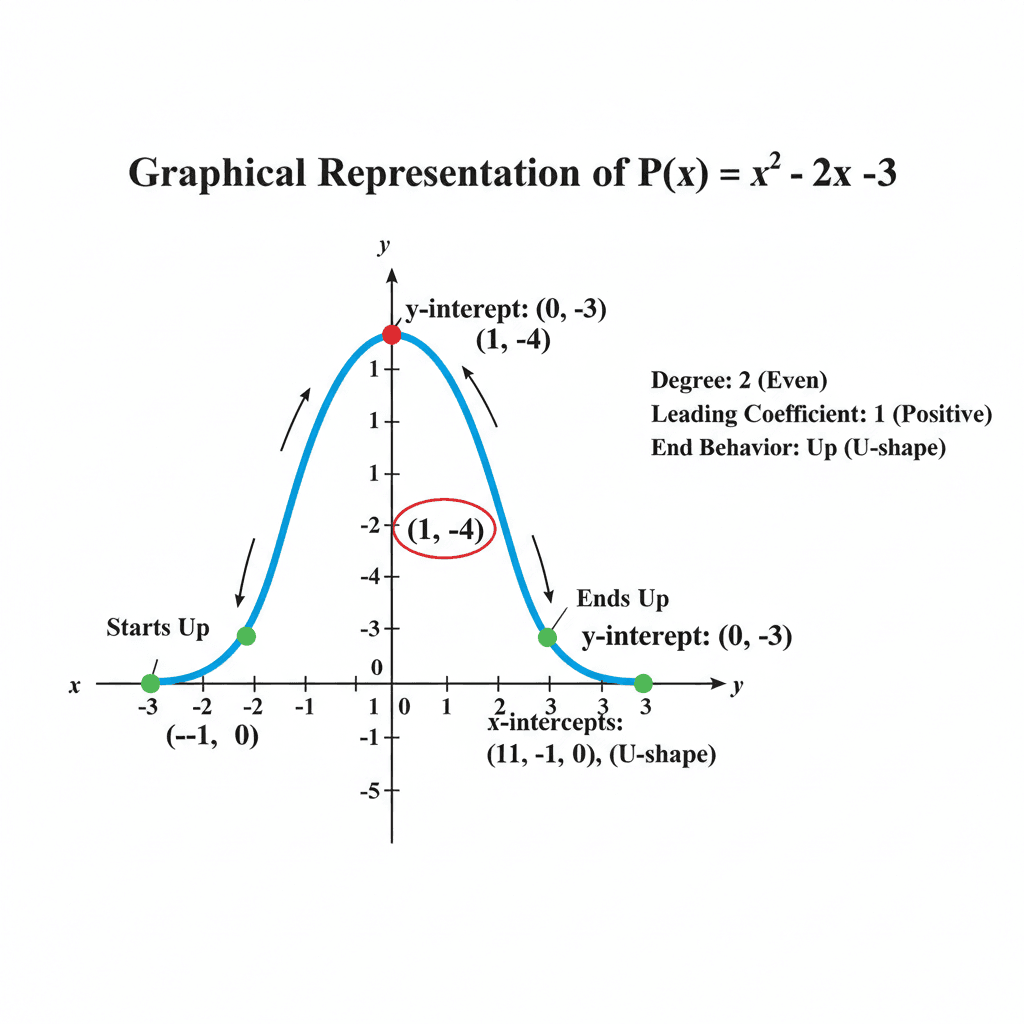
Here's how to represent a polynomial P(x) graphically. Okay, let's take the example of the quadratic polynomial:
P(x) = x^2 - 2x - 3
Here's how we represent it graphically:
Identify Degree and Leading Coefficient:
Degree: n=2 (Even)
Leading Coefficient: a_2=1 (Positive)
End Behavior: Since the degree is even and the leading coefficient is positive, both ends of the graph will go up ). This means it will look like a U-shape parabola.
Find the $y$-intercept:
Set x=0: P(0) = (0)^2 - 2(0) - 3 = -3
The y-intercept is at (0, -3)
Find the x-intercepts (Roots):
Set P(x)=0: x^2 - 2x - 3 = 0
Factor the quadratic: (x-3)(x+1) = 0.
The roots are x=3 and x=-1.
The x-intercepts are at (3, 0) and (-1, 0)
Find the Vertex (Turning Point):
For a quadratic ax^2 + bx + c, the x-coordinate of the vertex is given by x = -b/(2a)
In our case, a=1, b=-2. So, x = -(-2)/(2 \cdot 1) = 2/2 = 1
To find the y-coordinate, substitute x=1 back into P(x): P(1) = (1)^2 - 2(1) - 3 = 1 - 2 - 3 = -4
The vertex (which is a local minimum for this upward-opening parabola) is at (1, -4).
Now, let's put it all together on a graph:
Get personalised guidance for Maths Class 9 topics
Student-friendly Tip
Plot a few simple points for a polynomial, connect them smoothly, and observe where the graph crosses the axes. This helps internalise how algebraic terms translate into visual behaviour. When a polynomial has a zero at , you’ll see the graph meeting the x-axis at that point. Such visual links strengthen understanding for future topics.
Polynomial Examples – 3-4 Solved Examples
Let’s apply everything learned so far in a structured way. These solved examples cater to Polynomials Class 9 and follow NCERT-style steps.
Example 1: Find zeros of a polynomial
Consider .
Step 1: Set : .
Step 2: Factorise: .
Step 3: Solve each factor: ; .
Conclusion: The zeros are and .
Example 2: Addition & subtraction of polynomials
Add and .
Step 1: Align like terms:
Step 2: Combine coefficients:
;
;
.
Result: Sum = .
Example 3: Multiplication of polynomials
Multiply .
Step 1: Distribute each term of the first bracket across the second:
.
Step 2: Combine like terms:
;
;
Then +6 remains.
Result: .
Example 4: Factorisation by splitting the middle term
Factorise .
Step 1: Multiply .
Step 2: Find two numbers that multiply to 6 and add to 7: they are 6 and 1.
Step 3: Rewrite middle term: .
Step 4: Group: = .
Step 5: Factor common: .
Result: .
Take a small step today!
Book your free trial class at PlanetSpark and build strong algebra skills.
Properties of Polynomials
Understanding properties gives students insight into how polynomials behave when manipulated. These rules often underpin proofs and more advanced algebra.
Key Properties
If two polynomials and are added or subtracted, the degree of is at most the maximum of degree or degree . If their leading degree terms cancel, it may be lower.
If two polynomials are multiplied, .
Division algorithm: For any polynomials and non-zero , there exist unique polynomials (quotient) and (remainder) such that
where either is zero or .If is a factor of , then . This is known as the Factor Theorem.
A real polynomial of degree can have at most real zeros (counting multiplicities).
These properties are vital for recognizing what the algebraic manipulations imply and for building confidence in tackling more complex questions later.

PlanetSpark Maths Course: Build Strong Conceptual Skills with Confidence
Mastering concepts like Polynomials Class 9 becomes easier when students learn in a structured and interactive environment. The PlanetSpark Maths Course is designed to help learners build clarity, accuracy and long term confidence in mathematics through a well researched and student friendly teaching approach. The focus is on making complex topics simple through real life examples, personalised support and consistent practice.
Why the PlanetSpark Maths Course Stands Out
1. Concept Based Learning Approach
• Every chapter is taught through a step by step system that strengthens logical thinking.
• Students learn core concepts such as the definition of polynomial or types of polynomials through simple explanations and real time examples.
2. Personalised Live Classes
• Small batch sizes ensure individual attention.
• Teachers track progress and adapt the teaching plan for each learner.
3. Engaging Visual Explanations
• Graphs, visual models and interactive tools make topics like polynomial degree and identities easier to understand.
• Students retain concepts faster because learning feels intuitive.
4. Structured Practice and Doubt Solving
• Daily worksheets and revision exercises ensure consistent improvement.
• Students can ask doubts instantly during live sessions.
5. Exam Oriented Guidance
• Covers NCERT concepts in depth and prepares students for school exams and Olympiads.
• Includes chapter tests, timed practice sheets and mock assessments.
6. Real Time Progress Tracking for Parents
• Weekly performance insights.
• Clear feedback on strengths and areas of improvement.
Take Small Daily Steps Toward Algebra Success
Polynomials may once have felt like a jumble of symbols and exponents. But now, with clear definitions, familiar key terms, types, operations, factorisation methods, graphical insight and solved examples, the topic “Polynomials Class 9” has been demystified. The next step is simply this: set aside a small bit of time each day, practise one concept (perhaps zeroes, perhaps factorisation), and progressively build confidence. With consistency, the patterns will click, the problems will feel manageable and algebra will become a tool rather than a hurdle. And if structured support is needed, PlanetSpark is ready to help. Let the journey begin.
Frequently Asked Questions
Q1. What is a polynomial in Class 9?
In Class 9, a polynomial is an algebraic expression made up of variables and coefficients, where the exponents of the variables are whole (non-negative) numbers. Examples include , while expressions with negative or fractional exponents do not qualify as polynomials.
Q2. How many types of polynomials are there based on degree?
Polynomials based on degree fall into key types: constant (degree 0), linear (degree 1), quadratic (degree 2), cubic (degree 3) and so on. Recognising the degree helps decide which rules or formulas apply.
Q3. What is the difference between monomial, binomial and trinomial?
Those terms refer to how many terms the polynomial has: a monomial has one term (for example, ), a binomial has two terms (for example, ), and a trinomial three terms (for example, ). Understanding these helps when classifying expressions.
Q4. How can PlanetSpark help?
The division algorithm states for any two polynomials and , you can write where . Practising this division builds strong algebra skills and prepares for advanced topics. PlanetSpark offers guided practice sessions to master this with confidence.
Q5. How can daily practice with polynomials improve algebra?
Daily practice builds muscle memory. For “Polynomials Class 9”, tackling one new concept a day—such as factorising a quadratic, finding zeroes, or adding polynomials makes the topic less daunting and improves retention. A structured course like PlanetSpark’s ensures the right concept is covered at the right pace.
Q6. Is graphing polynomials required for Class 9 students and how does it help?
While detailed graphing may be more advanced, understanding basic shapes like a straight line for linear, parabola for quadratic (degree 2)—helps visualise what is happening when algebraic expressions change. It deepens comprehension and builds a bridge to functions later.