
Understanding Probability for Better Problem-Solving Skills
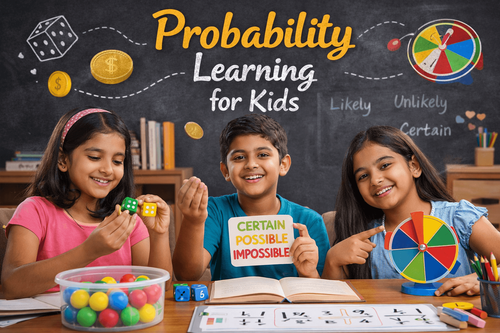

Table of Contents
Probability is one of the most important concepts in mathematics and statistics. It helps us understand uncertainty and make better decisions based on logical reasoning. Whether predicting the weather, analyzing exam performance, or calculating game outcomes, probability plays a vital role in everyday life.
For students, learning probability is not just about solving textbook problems. It strengthens analytical thinking, logical reasoning, and structured decision-making skills. In this comprehensive guide, we will define probability, explain the probability formula, explore the types of probability, understand what probability is in statistics, and examine the importance of probability in real life.
What Is Probability?
Probability is the mathematical measure of how likely an event is to occur. In simple words, probability tells us the chance of something happening.
This definition helps students solve structured problems logically.
For example, if you want to calculate the probability of picking a red ball from a bag containing 3 red balls and 2 blue balls:
- Favorable outcomes = 3 (red balls)
- Total outcomes = 5 (all balls)
Probability = 3/5
This means there is a 60% chance of picking a red ball.
For example:
- What is the chance of getting a head when tossing a coin?
- What is the probability of drawing a king from a deck of cards?
- What is the chance that it will rain tomorrow?
All these questions can be answered using probability.
The value of probability always lies between 0 and 1:
- 0 means the event is impossible.
- 1 means the event is certain.
- A value between 0 and 1 indicates how likely the event is.
For instance:
- The probability of the sun rising tomorrow is 1 (certain).
- The probability of a human flying without equipment is 0 (impossible).
- The probability of getting a 4 on a dice is 1/6 (possible but not certain).
Understanding this scale is the first step toward mastering probability.

The Probability Formula
The probability formula is straightforward but powerful:
Probability (P) = Number of Favorable Outcomes / Total Number of Possible Outcomes
Let’s break this down step by step.
Step 1: Identify the Total Possible Outcomes
These are all the possible results that can occur.
Example: Rolling a dice
Possible outcomes = {1, 2, 3, 4, 5, 6}
Total outcomes = 6
Step 2: Identify Favorable Outcomes
These are the outcomes that satisfy the condition.
Example: Probability of getting an even number
Even numbers on dice = {2, 4, 6}
Favorable outcomes = 3
Step 3: Apply the Probability Formula
𝑃 = 3/6 = 1/2
This means there is a 50% chance of rolling an even number.
Turn confusion into confidence. Enroll today and make probability easy to understand.
Types of Probability
Understanding the types of probability helps students apply the concept correctly in different situations.
1. Theoretical Probability
Theoretical probability is based on logical reasoning and known mathematical outcomes. It assumes that all outcomes are equally likely.
Example:
When flipping a fair coin:
- Total outcomes = 2 (Head, Tail)
- Probability of Head = 1/2
This calculation assumes fairness.
2. Experimental Probability
Experimental probability is based on actual experiments and observations. It may differ slightly from theoretical probability.
Example:
A coin is tossed 20 times.
Head appears 13 times.
Experimental probability = 13/20 = 0.65
Theoretically, it should be 0.5, but short-term experiments can vary.
3. Subjective Probability
Subjective probability is based on personal judgment, experience, or opinion.
Example:
A cricket expert predicts a 70% chance of a team winning based on performance history.
This type of probability is not based on exact mathematical calculation.
Understanding these types ensures students apply the correct method in different contexts.
Make math enjoyable and practical. Start mastering probability today.
What Is Probability in Statistics?
Probability is the foundation of statistics. Without probability, statistical analysis would not be possible.
In statistics, probability helps to:
- Predict outcomes
- Analyze data patterns
- Make inferences about populations
- Estimate risks
- Conduct research
For example:
- Medical researchers use probability to predict disease risk.
- Businesses use probability to forecast sales.
- Weather departments use probability to predict rainfall.
Probability provides the mathematical structure that allows statisticians to deal with uncertainty effectively.
Key Concepts in Probability
To fully understand probability, students must know a few important concepts.
Random Experiment
A random experiment is an action or process that produces unpredictable outcomes.
Example:
- Tossing a coin
- Rolling a dice
- Drawing a card
Sample Space
The sample space is the set of all possible outcomes.
Example:
Rolling a dice
Sample space = {1, 2, 3, 4, 5, 6}
Event
An event is a subset of the sample space.
Example:
Getting an even number
Event = {2, 4, 6}
Understanding these terms makes solving probability problems easier.
Join PlanetSpark and transform the way you understand mathematics and statistics.
Importance of Probability
The importance of probability extends beyond mathematics classrooms.
1. Improves Logical Thinking
Probability forces students to analyze situations carefully and logically. It builds structured thinking.
2. Enhances Decision-Making
Students learn to evaluate chances before making decisions.
Example:
If a student studies regularly, the probability of scoring high increases.
3. Helps in Risk Assessment
Probability teaches how to calculate risk before taking action.
4. Essential for Competitive Exams
Probability is a major topic in:
- School mathematics
- Board exams
- Competitive exams
- Entrance tests
5. Used in Multiple Fields
Probability is used in:
- Engineering
- Medicine
- Finance
- Artificial Intelligence
- Data Science
This makes it one of the most practical mathematical concepts.
Real-Life Applications of Probability
Students often wonder how probability applies in real life. Here are some examples:
Weather Forecasting
When the forecast says 70% chance of rain, that number is based on probability models.
Insurance Industry
Insurance companies calculate the probability of accidents to set premium prices.
Games and Sports
Sports analysts use probability to predict match outcomes.
Stock Market
Investors use probability to assess risks and potential returns.
Understanding these examples helps students connect theory with practice.
Make math enjoyable and practical. Start mastering probability today.
Common Mistakes Students Make in Probability
Even simple probability problems can become tricky if students make mistakes.
Mistake 1: Ignoring Total Outcomes
Students sometimes forget to count all possible outcomes.
Mistake 2: Assuming Outcomes Are Not Equally Likely
The probability formula only works when outcomes are equally likely.
Mistake 3: Confusing Possibility with Probability
Just because something is possible does not mean it is likely.
Avoiding these errors improves accuracy and confidence.
How Probability Strengthens Problem-Solving Skills
Probability improves problem-solving in several ways:
1. Encourages Structured Thinking
Students learn to:
- Identify known information
- Define outcomes
- Apply formulas logically
2. Builds Analytical Skills
Probability teaches students to compare different scenarios and evaluate outcomes.
3. Develops Mathematical Confidence
Mastering probability boosts overall math confidence.
4. Improves Critical Thinking
Students learn to question assumptions and evaluate fairness in experiments.
This makes probability a powerful tool for intellectual growth.
Practice Tips to Master Probability
To become strong in probability:
- Practice daily with different types of problems.
- Use real-life examples.
- Understand concepts before memorizing formulas.
- Solve word problems carefully.
- Review mistakes and correct them.
Consistent practice builds clarity and speed.
How PlanetSpark Helps Students Master Probability
Understanding probability becomes much easier when students learn through structured guidance, interactive methods, and real-life applications. This is where PlanetSpark plays an important role in strengthening conceptual clarity and problem-solving skills.
The key USPs of PlanetSpark’s maths course include:
- Live interactive sessions led by experienced educators who introduce mental-calculation shortcuts (including Vedic maths tricks) and connect them directly to NCERT/CBSE exam problems.
- Customised practise modules focusing on arithmetic operations, algebraic expressions, quadratic equations, and roots, so students apply the tricks within actual syllabus-aligned questions.
- Performance analytics & error-tracking tools that identify recurring calculation mistakes, helping students focus on improving speed and accuracy.
- Dedicated doubt-resolution and revision-boosters, which means that if any student is lagging on applying the tricks, the mentor provides targeted support and extra practise.
- Board-exam simulators with time-bound mock tests, where students learn to use tricks under realistic exam conditions, building confidence and speed.
Final Thoughts
Probability is more than just numbers and formulas. It is a logical system that helps students understand uncertainty and make informed decisions. By learning the probability formula, understanding the types of probability, and applying the concept in statistics, students build strong analytical and problem-solving skills.
The importance of probability lies not only in academic success but also in real-world decision-making. Mastering probability prepares students for higher studies, competitive exams, and careers in data-driven fields.
When students truly understand probability, they gain a powerful thinking tool that lasts a lifetime.
Frequently Asked Questions
Probability is a measure of how likely an event is to happen. It tells us the chance of something occurring, such as getting a head when flipping a coin. The value of probability always lies between 0 and 1. A probability of 0 means the event is impossible, and 1 means it is certain.
The probability formula is:
Probability = Number of Favorable Outcomes ÷ Total Number of Possible Outcomes
This formula works when all outcomes are equally likely. For example, when rolling a fair dice, the probability of getting a 3 is 1 out of 6, or 1/6.
There are three main types of probability: theoretical probability, experimental probability, and subjective probability. Theoretical probability is calculated using formulas. Experimental probability is based on actual experiments or trials. Subjective probability is based on personal judgment or experience.
In statistics, probability helps predict outcomes and analyze uncertainty. It is used to study patterns, estimate risks, and make data-driven decisions. Without probability, statistical models and research studies would not be possible. It forms the foundation of inferential statistics.
Probability improves logical reasoning and analytical thinking skills. It helps students make informed decisions and solve complex problems systematically. It is also an important topic in school exams and competitive entrance tests. Learning probability prepares students for careers in science, finance, and technology.
Theoretical probability is calculated using mathematical formulas and assumes fairness in outcomes. Experimental probability is determined by conducting experiments and observing results. For example, tossing a coin 50 times and recording results gives experimental probability, which may slightly differ from theoretical probability.
A sample space is the complete set of all possible outcomes of a random experiment. For example, when rolling a dice, the sample space is {1, 2, 3, 4, 5, 6}. Understanding the sample space helps in correctly calculating probability.
No, probability can never be greater than 1. The value always lies between 0 and 1, inclusive. If your calculation gives a value greater than 1, it means there is an error in counting favorable or total outcomes.
Probability is used in weather forecasting, medical research, insurance calculations, stock market predictions, and sports analysis. It helps estimate risks and make informed decisions. Many industries rely on probability to predict future events and reduce uncertainty.
Students can improve by practicing regularly, understanding concepts instead of memorizing formulas, and solving real-life word problems. Reviewing mistakes and learning from them also helps. Interactive learning and guided mentorship can significantly strengthen probability concepts.