
Rational Numbers for Class 8 Explained Simply With Examples


Table of Contents
- What Are Rational Numbers for Class 8?
- How to Identify a Rational Number for Class 8
- Standard Form of a Rational Number for Class 8
- Types of Rational Numbers for Class 8
- Rational Numbers on a Number Line
- Equivalent Rational Numbers Class 8 Explained
- Operations on Rational Numbers with Step by Step Examples
- Properties of Rational Numbers Class 8
- Rational Numbers vs Irrational Numbers for Class 8
- Build Powerful Maths Skills with PlanetSpark
- Small Steps Lead to Big Maths Success
- Frequently Asked Questions
Struggling to understand rational numbers or feeling unsure while solving Class 8 maths questions can make maths feel overwhelming. The good news is that rational numbers become easy once the basics are clear.
This blog breaks down every concept students need including the definition of rational numbers, how to identify them, types, comparison rules, number line placement, operations, and important properties. Everything is explained in simple student-friendly language with examples so learning becomes smooth. PlanetSpark’s structured maths programme is also highlighted at the end for learners who want guided practice and personalised support.
What Are Rational Numbers for Class 8?
Understanding rational numbers begins with a simple idea. A rational number is any number that can be written in the form p/q where p and q are integers and q is not zero. This means the numerator and denominator both belong to the set of integers but the denominator must never be zero. Rational numbers include positive fractions, negative fractions, whole numbers, integers, and decimals that terminate or repeat.
Examples of rational numbers include 4, -3, 7/9, -12/5, 0, 0.8, 3.333..., and 19/100. Class 8 students often revise this concept to strengthen their foundation for real numbers. The term rational comes from the word ratio which means a comparison or fraction. Every number that can be written as a ratio is a rational number.
Rational numbers comfortably fit into the number system because they help form a bridge between integers and real numbers. This flexibility makes them necessary for calculations and comparison across maths chapters.
How to Identify a Rational Number for Class 8
Identifying a rational number becomes simple once the core rule is understood. A number is called a rational number when it can be written in the form p/q where p and q are integers and q is not equal to zero. This single condition helps students decide whether a number belongs to the rational category or not. Class 8 maths focuses on building this clarity through examples, non examples, conversions, and comparisons.
The easiest way to recognise a rational number is to check whether the given value can be expressed as a fraction of integers. Every whole number, every integer, every terminating decimal, and every repeating decimal can be written as p/q. For example 9 can be written as 9/1, -11 as -11/1, 0.2 as 1/5, and 0.555... as 5/9. All these values qualify as rational numbers. The denominator must always remain non zero because division by zero holds no meaning in mathematics.
On the other hand certain numbers cannot be expressed in a clean fractional form. For instance values like √5, √2, π, and non repeating non terminating decimals do not convert into p/q. These fall under irrational numbers and behave very differently when used in calculations. Class 8 students often find this comparison useful while solving exercises based on the number system or rational versus irrational numbers.
To strengthen understanding further the table below summarises common values and their identification.
Improve accuracy in operations with a free PlanetSpark one to one class.
Identifying Rational Numbers for Class 8
Type of Number | Can it be written as p/q? | Rational or Irrational |
|---|---|---|
Whole numbers | 6/1 | Rational |
Negative integers | -14/1 | Rational |
Zero | 0/5 | Rational |
Terminating decimals | 75/100 | Rational |
Repeating decimals | 8/9 | Rational |
Fractions with non zero denominator | Already in p/q | Rational |
Square roots of non perfect squares | Cannot be expressed as p/q | Irrational |
Non repeating non terminating decimals | Cannot be written as p/q | Irrational |
Famous irrational constants | No | Irrational |
Standard Form of a Rational Number for Class 8
The standard form of a rational number is its simplest and most organised version. In Class 8, students learn that a rational number is in standard form only when the numerator and denominator have no common factor other than 1. This means the fraction must be fully simplified. Another important point is that the denominator of a rational number in standard form is always positive. This helps maintain uniformity while comparing or performing operations.
A rational number like 30/45 is not in standard form because both numbers have a common factor of 15. After dividing the numerator and denominator by 15, the result 2/3 becomes the standard form. Keeping the negative sign only in the numerator is also part of the rule. For example, -7/9 is the standard form, whereas 7/-9 and -7/-9 are not used in Class 8 maths.
Start your learning journey with a PlanetSpark maths trial for better understanding.
Types of Rational Numbers for Class 8
Class 8 students explore rational numbers in detail, and understanding their types makes the topic easier, faster, and more enjoyable to learn. Each type behaves differently on a number line and during operations. Breaking them into clear categories helps build strong conceptual clarity.
Positive Rational Numbers
Positive rational numbers represent values greater than zero. They are formed when the numerator and the denominator carry the same sign. This means both are positive or both are negative, but the overall value remains positive.
Examples
3/5, 12/7, 9/4, -8/-9, 15/2
A number like -8/-9 looks negative at first, but since both signs are the same, the value becomes positive. On a number line, all positive rational numbers are placed on the right side of zero.
Positive rational numbers are widely used in measurements, quantities, distances and scores. Class 8 students frequently use them while adding fractions or comparing values.
Negative Rational Numbers
Negative rational numbers represent values less than zero. They occur when the numerator and the denominator have opposite signs. The negative sign tells that the number lies on the left side of zero.
Examples
-5/6, 7/-9, -11/3, -2/5
In Class 8, the standard form keeps the negative sign only in the numerator. So instead of 7/-9, the preferred form is -7/9.
Negative rational numbers appear in temperature readings, debts, elevation levels and many real-life comparisons. Understanding their placement helps students avoid sign errors in subtraction and division.
Zero as a Rational Number
Zero is one of the simplest yet most important rational numbers. It can be written in the form 0/q where q is any non-zero integer.
Examples
0/4, 0/19, 0/-8
All these forms represent the same value: zero.
Zero neither falls in the positive category nor the negative category. It acts like a middle point on the number line and helps in understanding the placement of other rational numbers.
Equivalent Rational Numbers
Equivalent rational numbers look different but carry the same numerical value. Students create them by multiplying or dividing both numerator and denominator by the same non-zero integer.
Examples
2/3 and 6/9
4/5 and 12/15
-7/8 and -21/24
These pairs hold the same value even though they appear different. Equivalent rational numbers help Class 8 students simplify fractions, compare values and convert numbers into standard form.
Help students master Class 8 number systems with a guided PlanetSpark session.
Rational Numbers on a Number Line
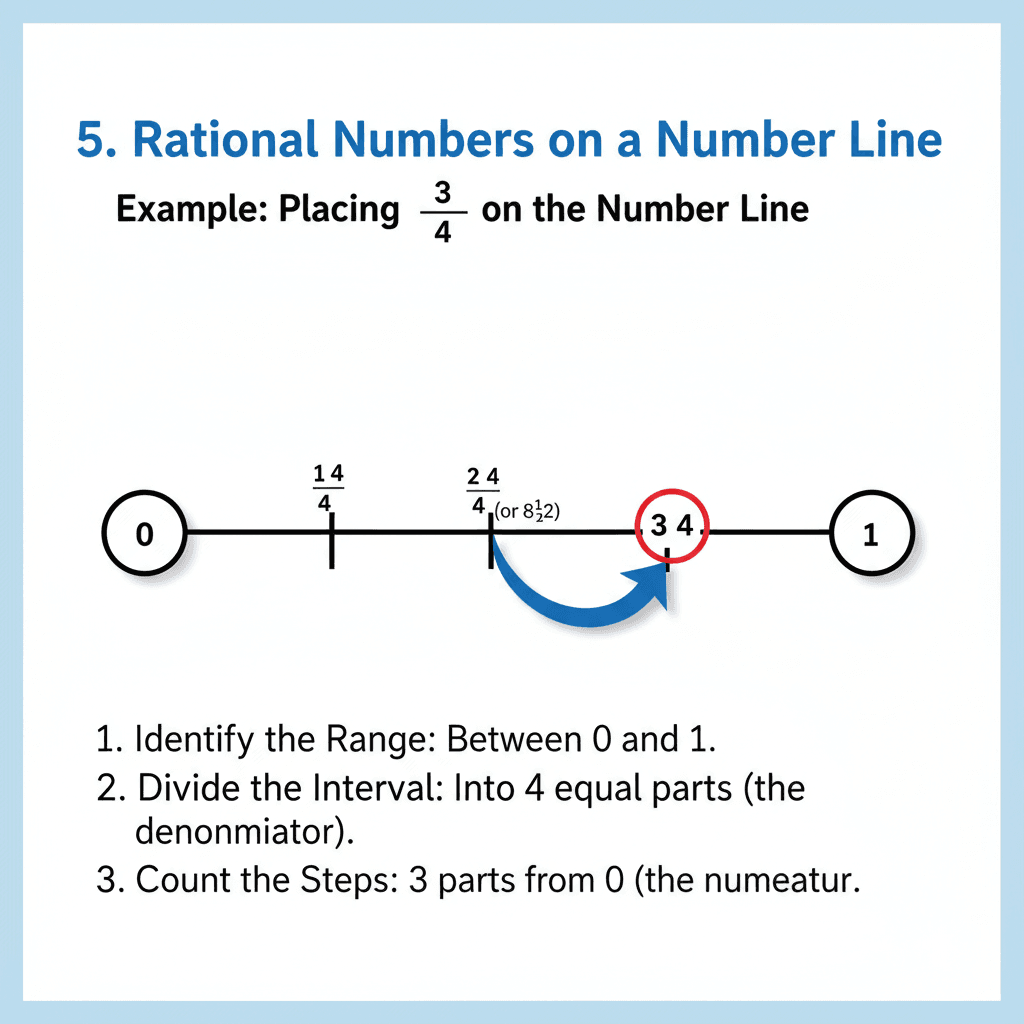
A rational number is any number that can be expressed as a fraction
Example: Placing {3}{4} on the Number Line
To place the rational number {3}{4} on a number line, we follow these steps:
Identify the Range: Since 0 < {3}{4} < 1, the number lies between {0} and{1}
Divide the Interval: The denominator, 4, tells us to divide the distance between 0 and 1 into four equal parts.
6 Count the Steps: The numerator, 3, tells us to count three of those parts from 0.
In the image, the marks would represent {1}{4}{2}{4} (or{1}{2}), and {3}{4}.
Decimal Representation of Rational Numbers
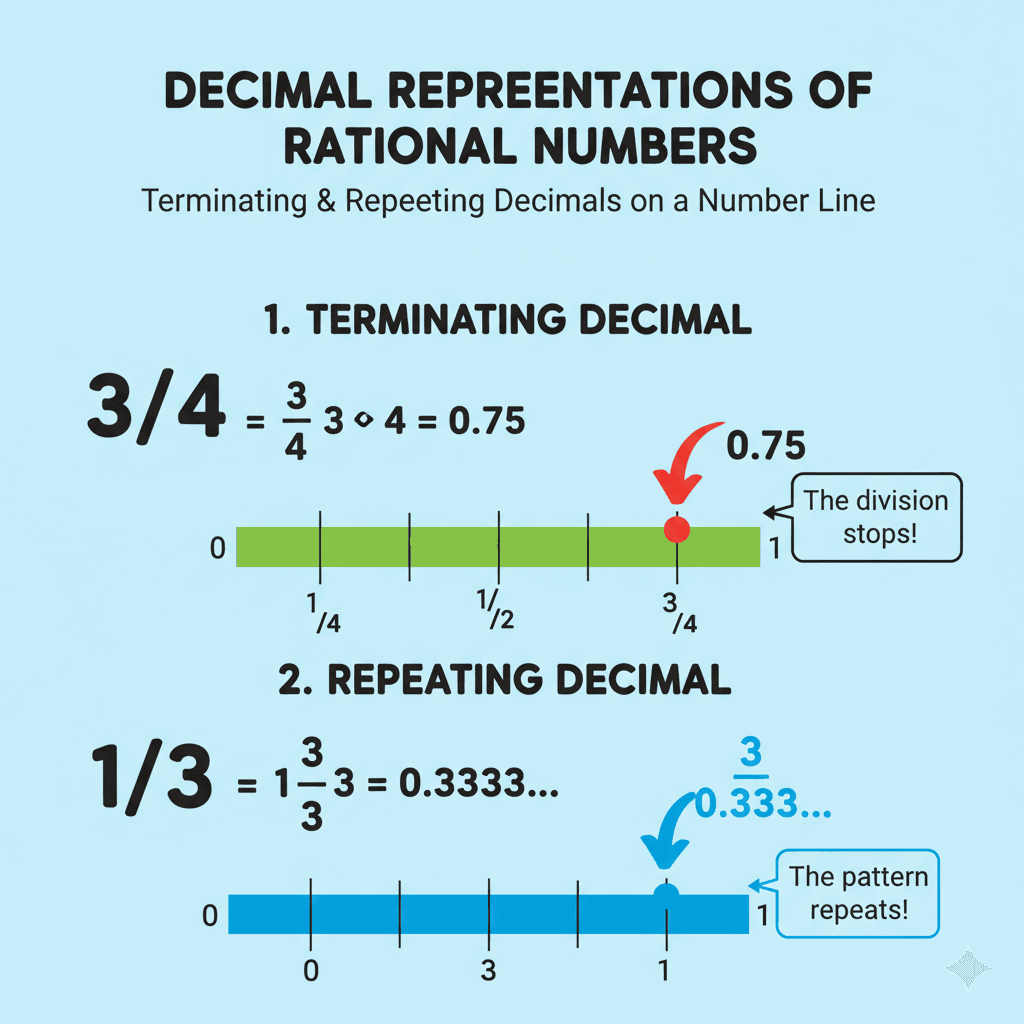
When a rational number {p}{q} is converted to a decimal by dividing the numerator by the denominator, the resulting decimal will always be either terminating or repeating (non-terminating and periodic).
Example 1: Terminating Decimal
A terminating decimal is one that has a finite number of digits after the decimal point (the division ends with a remainder of 0).
Rational Number: {3}{4}
Division:3 \div 4 = 0.75
The division stops exactly at 0.75, so it is a terminating decimal.
Example 2: Repeating Decimal
A repeating decimal (or recurring decimal) is one that has a sequence of one or more digits that repeats infinitely after the decimal point.
Rational Number: {1}{3}
Division:
10 1 div 3 = 0.3333...Decimal Form: 0.bar{3}
The digit 3 repeats infinitely, so it is a repeating decimal
Boost maths confidence by attending a PlanetSpark trial session.
Equivalent Rational Numbers Class 8 Explained
Equivalent rational numbers are rational numbers that look different but carry the same value on the number line. They work exactly like equivalent fractions. Students can create an equivalent rational number by multiplying or dividing both the numerator and the denominator by the same non zero integer.
Example through Multiplication
Consider the rational number 2/3.
Multiply both the numerator and denominator by 4.
(2 × 4) / (3 × 4) = 8/12
Therefore 2/3 and 8/12 represent the same value.
Example through Division or Simplification
Consider the rational number 10 divided by negative 15.
Divide the numerator and denominator by their common factor 5.
(10 ÷ 5) / (-15 ÷ 5) = 2/ -3
Therefore 10 divided by negative 15 and 2 divided by negative 3 are equivalent rational numbers.
Understanding equivalent rational numbers helps students compare values, simplify complex fractions, and solve Class 8 rational number problems confidently.
Operations on Rational Numbers with Step by Step Examples
This section shows how to perform addition, subtraction, multiplication and division with rational numbers. Each operation follows clear rules. Read the steps, follow the example and try the short practice question that follows.
Addition of Rational Numbers
When denominators differ first make them the same by finding the least common multiple. Then add the numerators and simplify the result.
Example
Calculate 3/5 + 1/4
Steps
Find the LCM of 5 and 4 which is 20.
Convert each fraction to an equivalent form with denominator 20.
• 3/5 = 12/20
• 1/4 = 5/20Add the numerators. 12/20 + 5/20 = 17/20
Simplify if needed. 17/20 is already in simplest form.
Quick tip
If one denominator divides the other use it directly to save time.
Practice question
Add 7/12 and 1/3
Start your learning journey with a PlanetSpark maths trial for better understanding.
Subtraction of Rational Numbers
Subtraction uses the same first step as addition. After equalising denominators subtract the numerators and simplify.
Example
Calculate 2/3 − 1/6
Steps
LCM of 3 and 6 is 6.
Convert 2/3 to 4/6. The second fraction remains 1/6.
Subtract the numerators. 4/6 − 1/6 = 3/6
Simplify 3/6 to 1/2.
Common mistake
Do not subtract denominators. Only numerators change when denominators match.
Practice question
Calculate 5/8 − 3/10
Multiplication of Rational Numbers
Multiply numerators together and denominators together. Use cancellation before multiplying to keep numbers small.
Example
Calculate (−4/7) × (21/8)
Steps
Multiply numerators and denominators. (−4 × 21) / (7 × 8)
Cancel common factors before multiplying. 4 cancels with 8 leaving 2. 7 cancels with 21 leaving 3.
Multiply the remaining values. (−1 × 3) / (1 × 2) = −3/2
Express as a mixed number if required: −1 1/2.
Useful strategy
Always look for cross cancellation to simplify calculations.
Practice question
Multiply 5/12 by 18/25
Division of Rational Numbers
To divide by a rational number multiply by its reciprocal. Keep signs correct and simplify by cancellation where possible.
Example
Calculate (5/6) ÷ (2/3)
Steps
Write the division as multiplication by the reciprocal. (5/6) × (3/2)
Cancel common factors if possible. 5 and 2 do not cancel. 6 and 3 cancel to give 2 and 1.
Multiply numerators and denominators. (5 × 1) / (2 × 2) = 5/4
Simplify or convert to a mixed number. 5/4 = 1 1/4.
Example with a negative value
Calculate (−3/5) ÷ (9/10)
Convert division to multiplication by reciprocal. (−3/5) × (10/9)
Cancel common factors. 3 cancels with 9 to give 1 and 3. 5 cancels with 10 to give 1 and 2.
Multiply. (−1 × 2) / (1 × 3) = −2/3
Practice question
Divide 7/9 by 14/27
Boost maths confidence by attending a PlanetSpark trial session.
Final checklist for all operations
• Always express answers in simplest form.
• Where denominators differ use the LCM for addition and subtraction.
• Use cross cancellation to make multiplication and division easier.
• Keep track of signs during subtraction and division.
Properties of Rational Numbers Class 8
Rational numbers follow several important properties that simplify arithmetic. These properties help students solve problems quickly and check the accuracy of their steps.
Closure Property
Rational numbers remain within the set after addition, subtraction, multiplication, or division except division by zero. This ensures operations do not produce values outside the rational number set.
Commutative Property
For addition and multiplication values remain unchanged even if the order of numbers changes. For example 5/6 + 3/4 equals 3/4 + 5/6.
Associative Property
Grouping does not affect the result in addition and multiplication. For example (2/3 + 3/4) + 1/2 equals 2/3 + (3/4 + 1/2).
Distributive Property
Multiplication distributes over addition. For example 3/5 multiplied by (2/7 + 1/7) equals 3/5 multiplied by 2/7 plus 3/5 multiplied by 1/7.
Identity Element
In addition zero is the identity element. In multiplication one is the identity element. These values do not change the number they operate with.
Inverse Property
Additive inverse refers to the number that produces zero when added. Multiplicative inverse refers to the reciprocal. Every rational number has an additive and multiplicative inverse except zero for multiplication.
These properties are widely used in solving operations and algebra based questions.

Rational Numbers vs Irrational Numbers for Class 8
Feature | Rational Numbers | Irrational Numbers |
|---|---|---|
Definition | Numbers that can be written in the form p/q, where p and q are integers and q ≠ 0. | Numbers that cannot be written in the form p/q. Their decimals are non-terminating and non-repeating. |
Decimal Form | Terminating (e.g., 2.5) or non-terminating repeating (e.g., 0.333…). | Non-terminating, non-repeating decimals (e.g., 3.141592…). |
Examples | 3/4, −5, 0.6, 11/2 | √2, π, √5, 0.1010010001… |
Build Powerful Maths Skills with PlanetSpark
PlanetSpark offers a structured maths learning experience designed for clarity and confidence. Students often struggle with rational numbers, decimals, and operations because classroom concepts feel rushed. PlanetSpark solves this through personalised sessions, step by step explanations, and interactive practice.
Key USPs of the PlanetSpark Maths Programme
Personalised one to one learning for deep understanding
Concept mastery with targeted practice for Class 8
Step based doubt solving for rational numbers and number system
Engaging visual explanations that make learning easier
Weekly progress tracking to improve accuracy and confidence
Curriculum aligned content designed for exam readiness
Students develop strong number sense and sharpen logical thinking. Parents also benefit from regular updates and clear insights into learning progress. This combination makes PlanetSpark an excellent choice for Class 8 maths preparation.

Riyansh Joshi, a proud Maths Olympiad winner, stands out for his clarity of thought, strong reasoning skills, and confident communication.
Small Steps Lead to Big Maths Success
Mastering rational numbers becomes simple when learners understand definitions, operations, and properties in a structured way. Concepts become strong when practiced consistently. A few minutes of daily revision improves accuracy and builds confidence for advanced chapters. With the right guidance and clarity every student can strengthen fundamentals and score higher. PlanetSpark’s maths programme supports this journey through personalised learning and step based teaching.
Frequently Asked Questions
1. What are rational numbers in simple terms?
Rational numbers are numbers that can be written in p/q form where p and q are integers and q is not zero. These include fractions, decimals, and integers. Class 8 students refer to this definition while learning number systems because it simplifies identification and understanding.
2. Is zero a rational number?
Zero is a rational number because it can be written as 0 divided by any non zero integer. It fits the definition of a rational number and appears frequently in operations and properties explained in Class 8 maths.
3. What is the difference between rational and irrational numbers?
Rational numbers can be expressed as fractions and include repeating or terminating decimals. Irrational numbers cannot be written as p/q and have non repeating decimals. This classification helps students understand the real number system.
4. How to compare rational numbers easily?
Use cross multiplication or convert numbers to equivalent fractions with the same denominator. This method helps Class 8 learners compare values accurately. PlanetSpark offers strong concept support for such techniques through personalised teaching.
5. How to convert a decimal into a rational number?
Convert the decimal into a fraction by removing the decimal places and simplifying. Terminating and repeating decimals can always be converted into rational numbers. This method is used widely in Class 8 exercises.
6. How does PlanetSpark help in understanding rational numbers?
PlanetSpark provides guided maths sessions with step by step explanations that simplify rational numbers operations comparison and decimal representation. Students receive personalised support which boosts clarity and accuracy.